
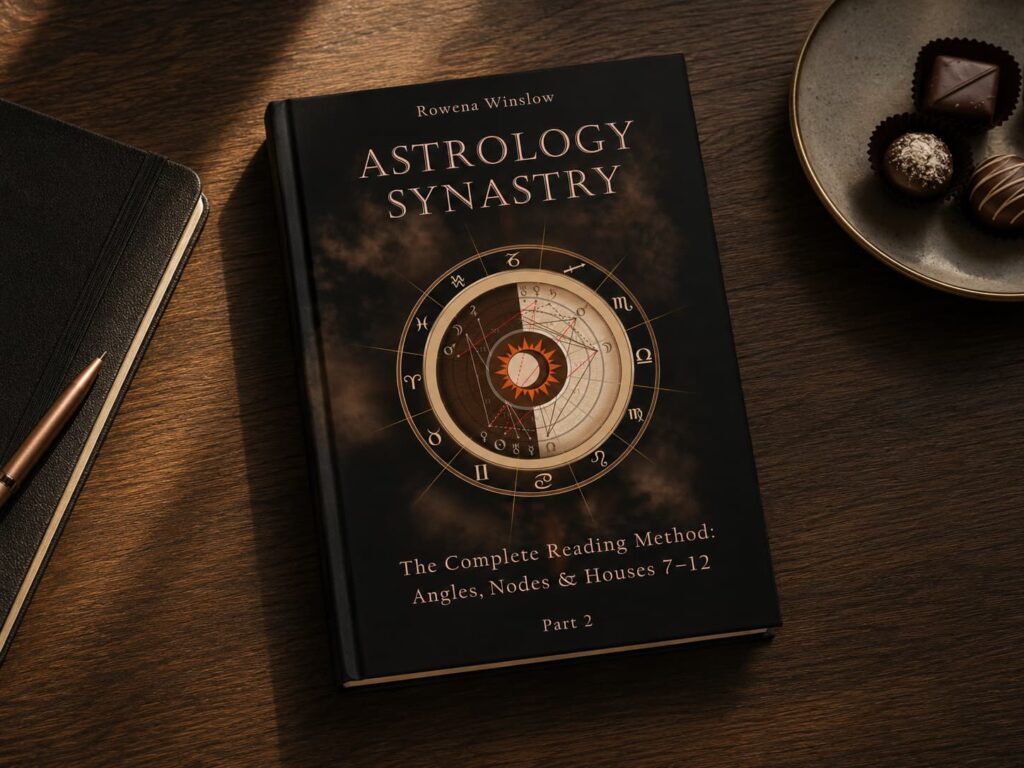
Author: Rowena Winslow Series: Astrology Synastry, Part 2 Available on: Payhip | Amazon
Part 1 gave you the methodology — how to read compatibility, count conflict, and spot the divorce formula in a single chart. Part 2 is where that methodology becomes a complete, usable system. It finishes the house-by-house reference, adds the two contact types that hit hardest in real charts — the angles and the lunar nodes — and closes with the exact step-by-step algorithm the author uses in her own consultations, plus three full worked readings.
This volume is best read after Part 1. The conflict-counting system, the Seal of Happiness and Seal of Misery, and the divorce formula introduced there are used throughout — Part 2 assumes you already have that framework in hand and shows you how to apply it completely.
See it in your own charts
Compare two birth charts free — every aspect between your planets and your partner’s, in seconds. No sign-up.
Compare Two ChartsWhat Makes This Book Different
Most synastry books stop once they’ve covered a few house placements and a handful of famous aspects. This one finishes the job — every planet through the last six houses, every angle contact, the nodes, and then a real method for assembling all of it into one coherent reading instead of fixating on the single most dramatic aspect. The three worked examples at the end are not illustrative sketches; they walk through full readings, conflict scores included, on charts with genuinely different outcomes.
What’s Inside
Part 1 — Planets in the Partner’s Houses (continued)
Chapters 1 through 6 complete the house reference that Part 1 began, covering the Seventh through Twelfth Houses. For each house, every planet — Sun, Moon, Mercury, Venus, Mars, Jupiter, Saturn, Pluto, Uranus, Neptune — is treated individually: partnership and marriage (7th), shared resources and sexuality (8th), belief and long-distance connection (9th), career and public life (10th), friendship and community (11th), and the hidden, karmic, and self-undoing patterns of the 12th.
Part 2 — The Angles in Synastry
Chapter 7 covers the Ascendant, Descendant, Midheaven, and Nadir — the four most sensitive points in any chart. A planet landing exactly on a partner’s angle is treated as a more acute, more immediate version of the equivalent house placement: the difference between a planet influencing a life domain and a planet activating its most sensitive point directly. Every planet’s contact to all four angles is covered, including the specific dynamics of Sun-Ascendant recognition, Sun-Descendant attraction, and the competitive or mirroring effects each contact tends to produce.
Chapter 8 covers the Lunar Nodes — not planets, but the points that carry karmic weight in a connection. The chapter explains how to read nodal contacts as an indicator of significance rather than outcome, why conjunctions and oppositions matter most, and what it means when a partner’s planet lands on your North or South Node.
Part 3 — Practice
This is where the book moves from reference to application.
Chapter 9 lays out the complete seven-step method for reading any synastry chart: assessing each natal chart individually before comparing them, counting conflict indicators, assessing compatibility indicators, checking planets in houses, noting nodal contacts, assembling the full picture, and stating a direct conclusion rather than hedging.
Chapter 10 puts the method to work in three complete worked readings, each following the same structure — natal charts, conflict score, compatibility indicators, and the assembled picture — but landing on very different outcomes: a high-conflict pairing, a chart where the indicators point in two directions at once, and a low-conflict chart that illustrates what long-term viability actually looks like astrologically.
Chapter 11 closes the book with pattern recognition: the recurring synastry pictures that show up again and again once you’ve read enough charts, including the specific markers of a relationship heading toward rupture and the markers of a relationship built to last.
Who This Book Is For
Readers who finished Part 1 and want the complete house reference plus the tools to actually assemble a full reading, rather than stopping at individual contacts.
Astrologers who want a repeatable method — a defined sequence of steps rather than an intuitive, case-by-case approach, with worked examples that show exactly how conclusions are reached.
Anyone trying to make sense of a connection that feels unusually intense or fated — the chapters on the angles and nodes speak directly to the kind of instant recognition or karmic pull that ordinary house placements don’t fully explain.
The Complete Synastry Series
- Synastry Part 1 — Compatibility, conflict indicators, the divorce formula, special relationships, and planets in houses 1–6
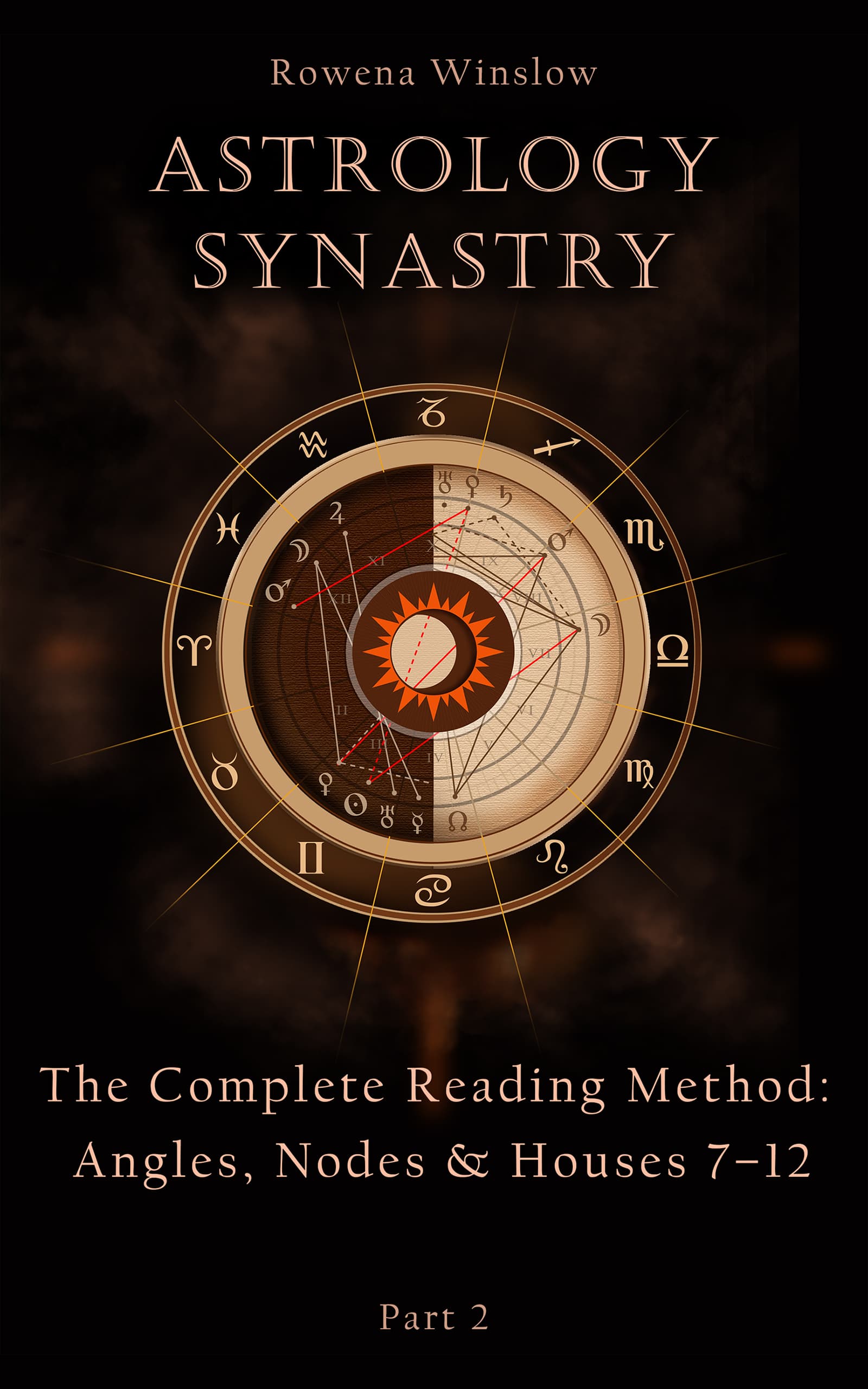
- Synastry Part 2 — The angles, the lunar nodes, the complete step-by-step reading method, and planets in houses 7–12 (this book)

Also by Rowena Winslow
You can continue your study of astrology with the following volumes:
NATAL ASTROLOGY
- Vol. 1 — Zodiac Signs and Horoscope Houses in the Birth Chart
- Vol. 2 — Planets & Aspects in the Birth Chart
PREDICTIVE ASTROLOGY
- Transits & Planetary Cycles, Part 1 — Sun, Moon, Mercury, Venus, Mars
- Transits & Planetary Cycles, Part 2 — Jupiter, Saturn, Uranus, Neptune, Pluto
SYNASTRY
SOLAR RETURN ASTROLOGY
- Part 1 — Sun, Moon, Mercury
- Part 2 — Venus, Mars, Jupiter, Saturn
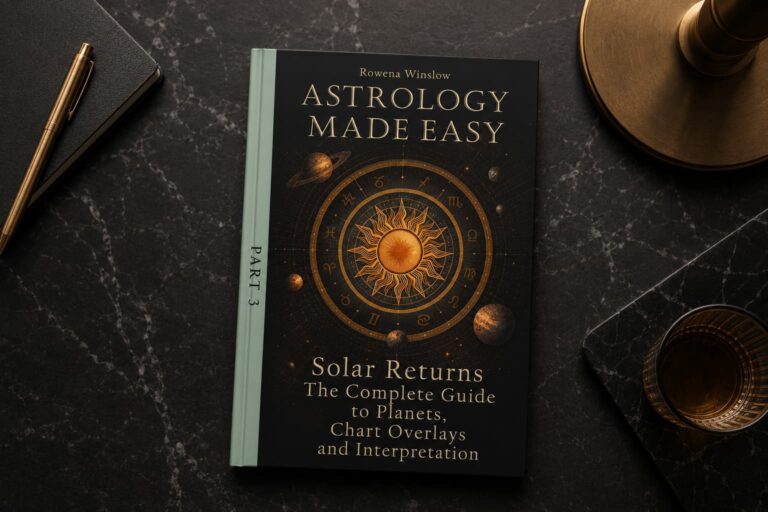
- Part 3 — Chart Overlays & Interpretation
OTHER SPECIALIZED TOPICS
Calculate your free synastry chart at AstroCore.pro — the calculator marks all major aspects between two charts, including contacts to the angles, so you can apply this book’s method directly to your own reading.

Leave a Reply