
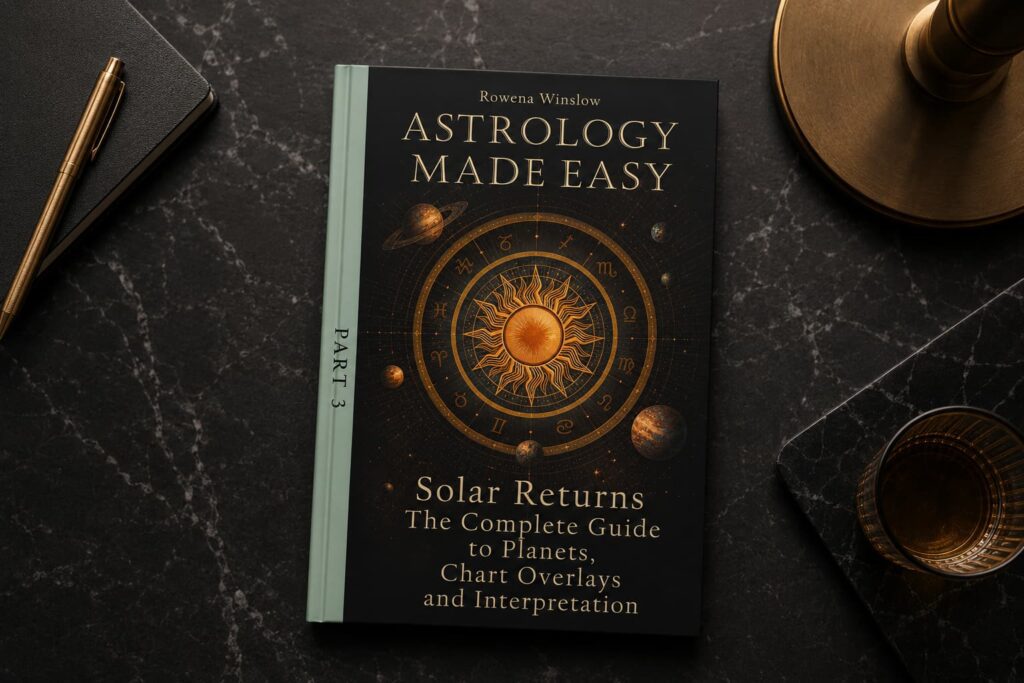
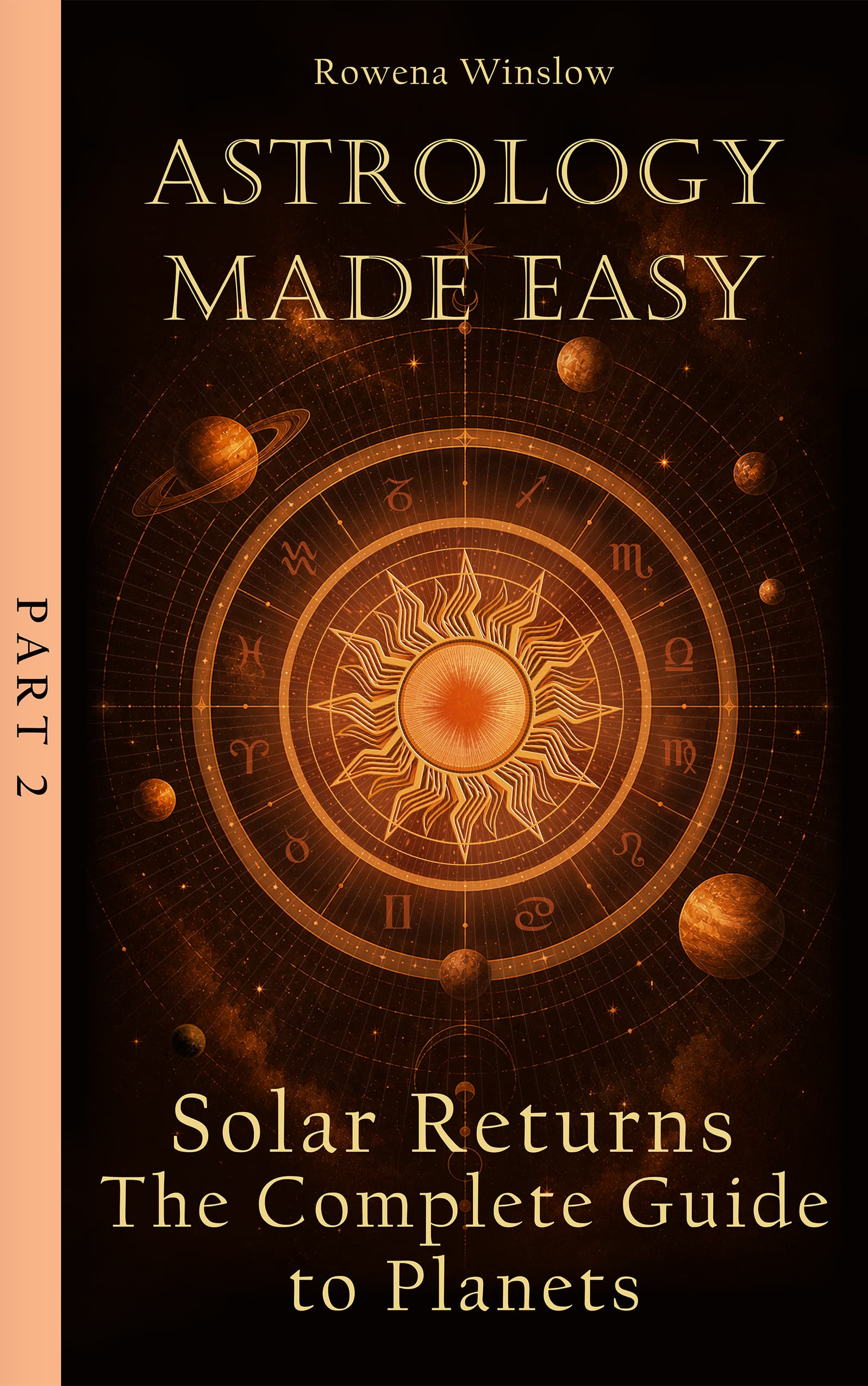
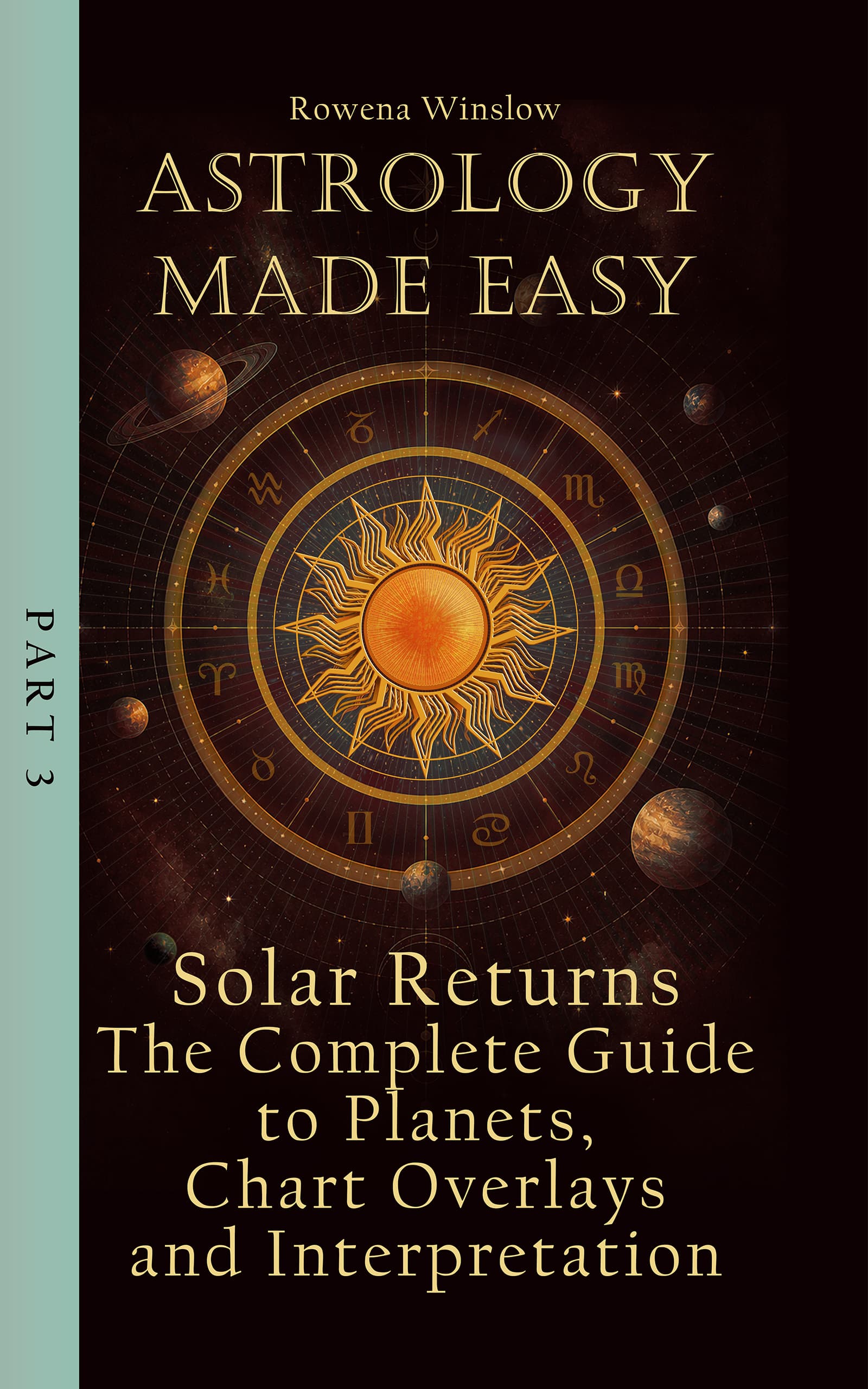
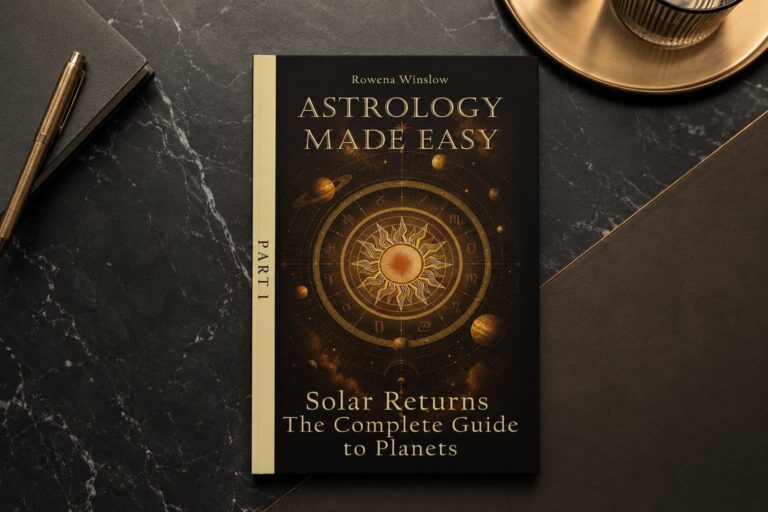
Author: Rowena Winslow
Series: Astrology Made Easy: Solar Returns, Volume 3 | 376 pages
Available on: Payhip | Amazon | Etsy
The first two volumes of this series built the complete planetary foundation of Solar Return interpretation — every personal and social planet through all twelve houses, with aspects, signs, and In Practice cases. Volume 3 completes the picture and then takes it significantly further: into the outer planets, the Solar Return Ascendant, retrograde conditions, and — the most advanced material in the series — three distinct techniques for reading the Solar Return in direct dialogue with the natal chart.
This is the volume where Solar Return interpretation becomes genuinely personal. Everything before this point described what any person with a given planetary placement might experience. What Volume 3 adds is the layer that answers the more specific question: what will you, with your particular natal chart and your particular life, encounter this year?
See it in your own chart
Calculate your Solar Return free and see what your year ahead is built around. No sign-up.
Calculate My Solar ReturnWhat’s Inside
Part I — The Outer Planets
Chapter 1: Uranus Through All Twelve Solar Return Houses
Uranus in the Solar Return chart describes the year’s most disruptive dimension — where sudden change, unexpected liberation, and genuine originality are most directly active in personal life. The chapter covers each of the twelve house placements with a clear framework: the theme and key question for the placement, detailed manifestations both when conditions are favorable and when they are challenging, and In Practice cases from real consultations.
The In Practice cases in the Uranus chapter are particularly strong. Uranus in the First House is illustrated through a corporate lawyer in her early forties who had unexpectedly started painting with urgent intensity she couldn’t explain to her professional circle — the reading identifying this not as a crisis but as an emergence, with specific advice about what not to force and what to pay attention to. Uranus in the Fourth House is shown through a school headteacher given four months to vacate a house his family had rented for eleven years, where the reading revealed a relational layer — unspoken disagreements between the couple about how much change they were each actually willing to accept — embedded in the practical emergency. Uranus in the Seventh House covers a researcher who had been conducting an internal argument about a seven-year relationship she couldn’t resolve alone, where the year’s energy was explained not as something to manage but as something to look at directly.
Across all twelve houses, the Uranus delineations maintain the distinction the whole series is built on: not what will happen, but what the chart reveals about the territory you are in and how to navigate it consciously.
Chapter 2: Neptune Through All Twelve Solar Return Houses
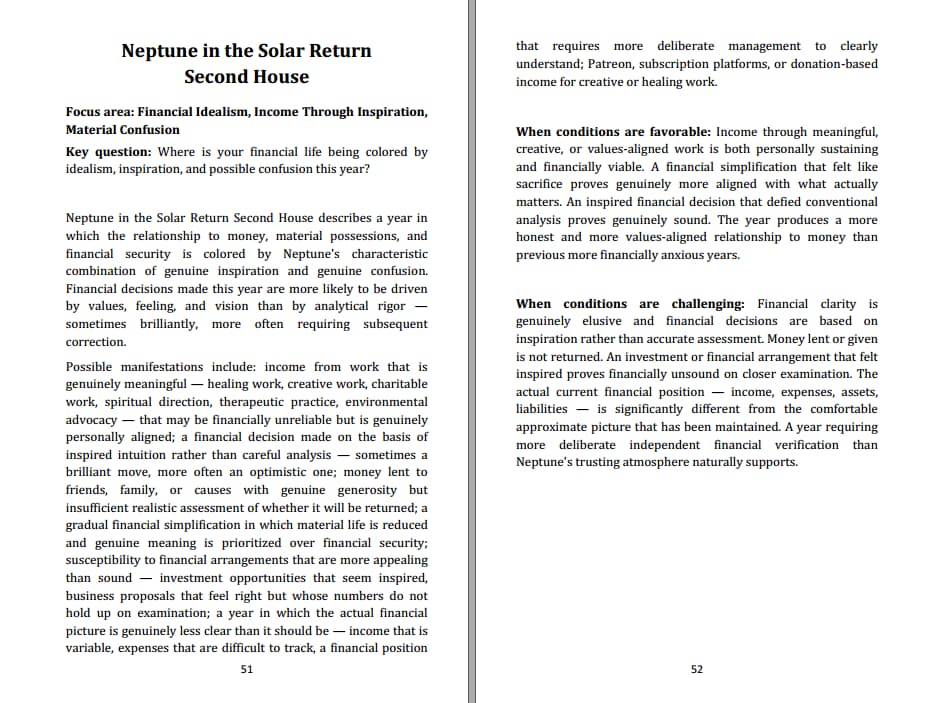
Neptune is the most nuanced planet to interpret in Solar Return work, and this chapter handles it with corresponding depth. Each of Neptune’s twelve house placements is covered through the same favorable/challenging framework, with particular attention to Neptune’s dual nature: genuine inspiration and genuine confusion arise from the same source — dissolved boundaries and heightened sensitivity — and the two are inseparable.
The In Practice cases show this dual nature in practice. Neptune in the First House is illustrated through a management consultant who had been consistently misread throughout the year — clients and colleagues attributing to him intentions he hadn’t held, positions he hadn’t taken — and the reading explaining precisely why this was happening and what practical structural solution would address it (important communications in writing, because Neptune in the First creates a gap between what is said and what is received that written communication largely bypasses). Neptune in the Fourth House covers a woman managing her mother’s estate, which revealed family financial arrangements and a relationship history she had been given a sanitized version of — the reading providing a framework for holding the disorientation of discovered family truth without being unmoored by it. Neptune in the Tenth House addresses the specific pattern of professional opportunities that appear more favorable than they are — and the practical advice for navigating a year in which the gap between the image and the reality of what is being offered must be actively managed.
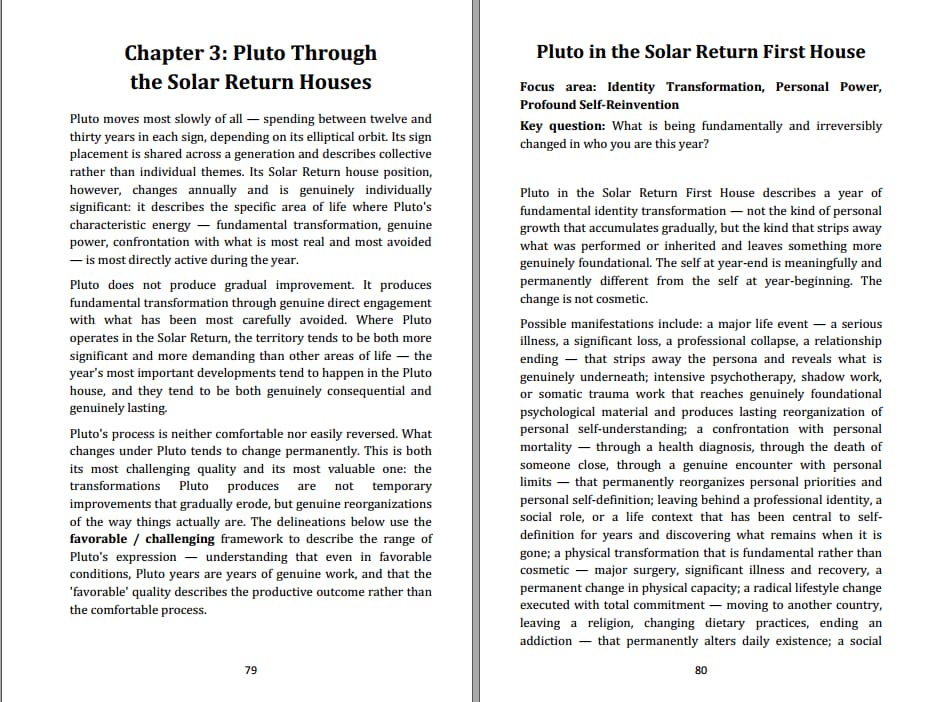
Chapter 3: Pluto Through All Twelve Solar Return Houses
Pluto describes the year’s most transformative dimension — where deep psychological change, encounters with power, and fundamental reorganization of personal structure are most active. The chapter covers each house placement with the same depth as Uranus and Neptune, including the favorable/challenging framework and In Practice cases showing how Pluto’s slow, deep transformation actually manifests in recognizable real-life situations.
Part II — Additional Interpretive Factors
Chapter 4: Retrograde Planets in the Solar Return
Three dedicated sections cover Mercury retrograde, Venus retrograde, and Mars retrograde in the Solar Return chart — not as general retrograde interpretations but specifically as they function in an annual chart. Each section covers what the retrograde condition means for that planet’s themes in the Solar Return, how it modifies the house delineations from earlier volumes, and what it implies for timing and expression during the year. The chapter closes with a note on outer planet retrogrades, explaining why their Solar Return retrograde status carries less interpretive weight than the personal planet retrogrades.
Chapter 5: The Solar Return Ascendant Through the Twelve Signs
The Solar Return Ascendant — the sign rising at the moment of the annual return — sets the year’s overall tone and characteristic approach. Unlike the natal Ascendant, which is permanent, the Solar Return Ascendant changes each year and describes a seasonal quality: the year’s personality, the mode through which all of the year’s experiences will characteristically be approached. All twelve signs are covered in full.
The chapter also includes a section on aspects to house cusps in the overlay reading — a precision tool showing how a planet aspecting a natal or Solar Return house cusp modifies the way that house’s themes are engaged and when they become most accessible.
Part III — Natal Chart Overlays and Advanced Interpretation
This is the most distinctive and most advanced section in the entire series. Three techniques are introduced for reading the Solar Return in direct dialogue with the natal chart, moving the interpretation from the generic to the genuinely personal.
Technique 1: Solar Return Planets in Natal Houses
This technique asks: where does this year’s planetary energy land in my personal chart? Each Solar Return planet is located in the natal chart, revealing which permanently personal life territory that planet’s annual energy is most directly activating. The Solar Return Sun in the Solar Return 10th house says career is the year’s primary focus. Technique 1 adds: the Solar Return Sun falls in the natal 7th house — meaning career development this year happens specifically through partnerships and professional relationships rather than through independent action. The specificity this adds is substantial.
Technique 2: Natal Planets in Solar Return Houses
The reverse question: where does my permanent planetary nature express itself through this year’s framework? Here the natal planet is the constant — it represents who you have always been — and the Solar Return house is the annual context through which that permanent nature is currently being channeled. The chapter shows concretely how two people with natal Mars in the Solar Return 7th house approach that placement in genuinely different ways depending on their natal Mars sign and condition, and why that difference matters interpretively.
Technique 3: Natal Houses in Solar Return Houses
The most precise of the three techniques. This asks: which natal life territory is being developed through which Solar Return context this year? The natal house cusp positions are located in the Solar Return chart, revealing exactly which permanent areas of life are being activated, developed, or tested through the year’s specific annual conditions. This is where the two charts are in the most direct dialogue — where the year stops being a generic annual description and becomes a specific map of how this year’s conditions relate to this person’s permanent life structure.
All three techniques are covered with step-by-step guidance, concrete examples, and full delineations. The chapter explains clearly when to use each technique and how to prioritize among them when reading an actual chart — including the specific guidance that Technique 2 is most useful as a targeted precision tool for individually prominent natal planets rather than as a full ten-planet treatment in every reading.
The Step-by-Step Reading Algorithm
The volume closes with a complete reading algorithm that integrates all layers from all three volumes into a coherent, prioritized sequence. The algorithm covers eleven steps:
Steps 1–5 establish the core story: the Solar Return Ascendant, Solar Return Sun, Solar Return Moon, angular planets, and stellia. Steps 6–9 add the conditions: aspects to the Sun and Moon, retrograde planets, and the background factors of hemispheric emphasis and modal/elemental balance. Steps 10–11 add the personal layer: the natal chart overlay through Technique 1 and Technique 3.
The algorithm is explicit about hierarchy — what always matters most, what adds depth but is not essential, and what is most useful for targeted questions about specific life areas. It includes a quick reference summary organized into four tiers: read immediately, read next, read for depth, and read for personal specificity. The section on synthesis explains the three-layer model (core story, conditions, personal specificity) and addresses the most common reading mistake: treating every planetary placement as equally important, which produces confusion rather than clarity. The timing section provides general guidance on which parts of the Solar Return year tend to be most active for different parts of the chart.
Who This Book Is For
Anyone who has worked through Volumes 1 and 2 and is ready for the full picture. The outer planet chapters complete the planetary coverage; the overlay techniques complete the interpretive methodology.
Practicing astrologers who want a complete and systematized Solar Return methodology. The three overlay techniques and the step-by-step algorithm address the most common structural gaps in Solar Return practice — particularly the jump from reading individual placements to producing a coherent, prioritized, and genuinely personal annual reading.
Students who want to understand not just what Solar Return placements mean but how to integrate them into a reading that is genuinely useful rather than exhaustively comprehensive.
The Complete Solar Returns Series
- Solar Returns Part 1 — Sun, Moon, Mercury; foundations, relocation, chart setup
- Solar Returns Part 2 — Venus, Mars, Jupiter, Saturn through all twelve houses
- Solar Returns Part 3 — Uranus, Neptune, Pluto; Solar Return Ascendant; retrograde planets; three overlay techniques; step-by-step reading algorithm (this book)
Also by Rowena Winslow
You can continue your study of astrology with the following volumes:
Natal Astrology
- Vol. 1 — Zodiac Signs and Horoscope Houses in the Birth Chart
- Vol. 2 — Planets & Aspects in the Birth Chart
Predictive Astrology
- Transits & Planetary Cycles, Part 1 — Sun, Moon, Mercury, Venus, Mars
- Transits & Planetary Cycles, Part 2 — Jupiter, Saturn, Uranus, Neptune, Pluto
Synastry
Solar Return Astrology
- Part 1 — Sun, Moon, Mercury
- Part 2 — Venus, Mars, Jupiter, Saturn
- Part 3 — Chart Overlays & Interpretation
Other Specialized Topics
Calculate your free Solar Return chart at AstroCore.pro — the dual chart format shows your Solar Return and natal chart together on a single wheel, which is exactly the format the overlay techniques in this volume require.

Leave a Reply