
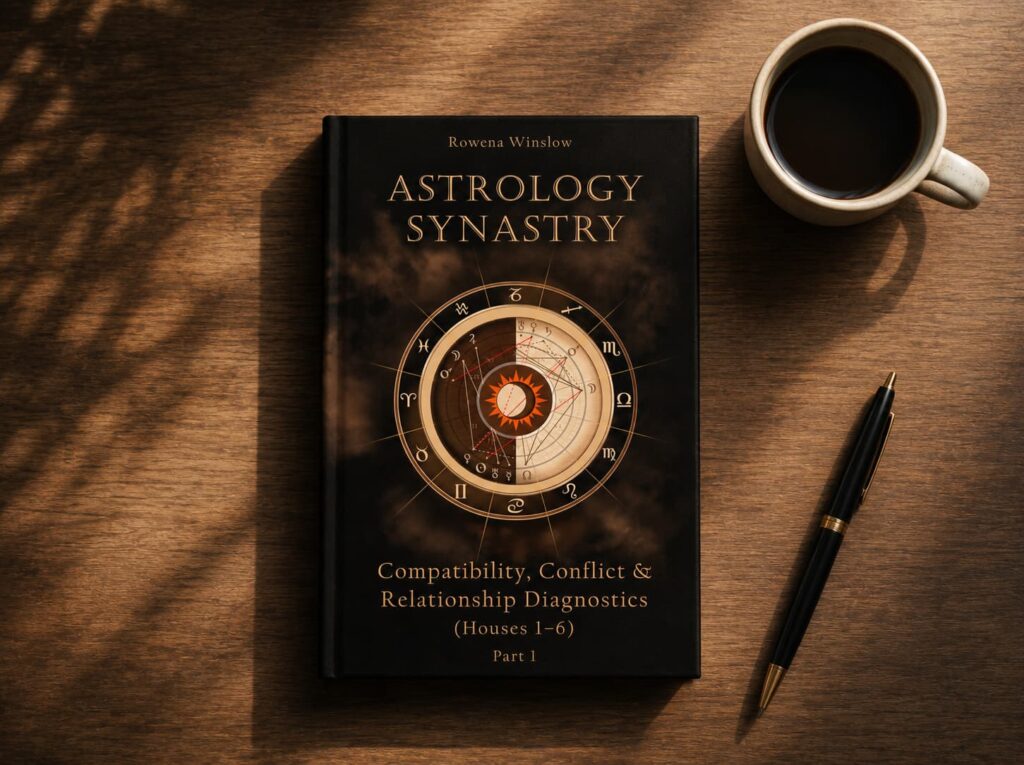
Author: Rowena Winslow Series: Astrology Synastry, Part 1 Available on: Payhip | Amazon
Most relationship astrology books will tell you whether you and a partner are compatible. This one tells you why — and whether the relationship will last. Astrology Synastry, Part 1 is built around a system rather than a checklist: it gives you the actual mechanics of compatibility and conflict, not a Sun-sign compatibility chart dressed up as depth.
This is not a book about whether Scorpio and Pisces get along. It replaces that entire approach with something far more precise — a diagnostic method that works on any two real charts, regardless of sign combination.
See it in your own charts
Compare two birth charts free — every aspect between your planets and your partner’s, in seconds. No sign-up.
Compare Two ChartsWhat Makes This Book Different
Popular synastry stops at Sun signs. This book treats compatibility as something built from distinct, separately readable layers — psychological, emotional, sexual — and treats conflict as something that can actually be counted, not just intuited. It also does something almost no accessible synastry book does: it gives you a formula for predicting structural breakdown in a relationship before you even compare two charts.
What’s Inside
Part 1 — Basics
Chapter 1 lays the groundwork: what synastry actually is, how it differs from composite chart work, what data you need before you start, the orb allowances used throughout the book, and the hierarchy of planets — which contacts carry real weight and which are secondary. This chapter closes with five rules of comparative analysis that govern every reading that follows.
Part 2 — Compatibility
Chapter 2 breaks compatibility into its component layers: psychological compatibility through the Sun, emotional compatibility through the Moon, sexual compatibility through Venus and Mars, and the Jupiter-Saturn axis — introduced here as the Seal of Happiness and the Seal of Misery, the single strongest indicator of whether a relationship expands both people or quietly suppresses them.
Part 3 — Conflict
Chapter 3 introduces the conflict planet system: which four planets generate genuine relationship friction, how to identify when they’re activated between two charts, and how to count conflict indicators without over- or under-reading a chart comparison. This section includes the Rule of Three Indications and a direct discussion of when separation is structurally inevitable rather than merely difficult.
Chapter 4 covers the divorce formula in the natal chart — a pattern read in a single person’s chart, independent of any partner, that shows a structural tendency toward partnership breakdown. The chapter covers what the formula means in practice, the role Uranus plays in it, what it means when both partners carry it, and a note on how relocation affects the picture.
Part 4 — Special Relationships
Three relationship types most synastry books skip entirely:
- Chapter 5 — Parent and Child Synastry: what to look for first, how the conflict planets operate differently in a parent-child pair, the Fourth and Fifth House roles, and how to use conflict indicators ethically in this context.
- Chapter 6 — Business Synastry: the key planets for a working partnership, the houses that matter most, Mercury as the business compatibility indicator, Saturn as the endurance indicator, and a practical warning about what conflict indicators mean before signing a business contract.
- Chapter 7 — Friendship vs. Romance: what romance requires that friendship doesn’t, the Fifth vs. Eleventh House axis, and how to read a connection that feels genuinely ambiguous.
Part 5 — Planets in the Partner’s Houses
The reference core of the book. Chapters 8 through 13 cover, house by house, what it means when a partner’s Sun, Moon, Mercury, Venus, Mars, Jupiter, Saturn, Uranus, Neptune, or Pluto falls in your First through Sixth House — identity, resources, communication, home and family, self-expression, and daily work and health. Each planet-in-house placement is treated individually and in real depth, not compressed into a paragraph.
Who This Book Is For
Anyone trying to understand a specific relationship — not through Sun-sign generalities, but through what two actual charts are doing together.
Astrologers who want a working diagnostic method, including a way to count conflict rather than just sense it, and a formula that flags structural risk in a single chart before synastry even enters the picture.
Readers considering business partnerships or evaluating a parent-child dynamic, where most synastry material offers nothing at all.
The Complete Synastry Series
- Synastry Part 1 — Compatibility, conflict indicators, the divorce formula, special relationships, and planets in houses 1–6 (this book)
- Synastry Part 2 — The angles, the lunar nodes, the complete step-by-step reading method, and planets in houses 7–12
Also by Rowena Winslow
You can continue your study of astrology with the following volumes:
NATAL ASTROLOGY
- Vol. 1 — Zodiac Signs and Horoscope Houses in the Birth Chart
- Vol. 2 — Planets & Aspects in the Birth Chart
PREDICTIVE ASTROLOGY
- Transits & Planetary Cycles, Part 1 — Sun, Moon, Mercury, Venus, Mars
- Transits & Planetary Cycles, Part 2 — Jupiter, Saturn, Uranus, Neptune, Pluto
SYNASTRY
SOLAR RETURN ASTROLOGY
- Part 1 — Sun, Moon, Mercury
- Part 2 — Venus, Mars, Jupiter, Saturn
- Part 3 — Chart Overlays & Interpretation
OTHER SPECIALIZED TOPICS
Calculate your free synastry chart at AstroCore.pro — the calculator generates both charts side by side with all major aspects marked, in the exact format this book’s methodology is built around.


Leave a Reply