
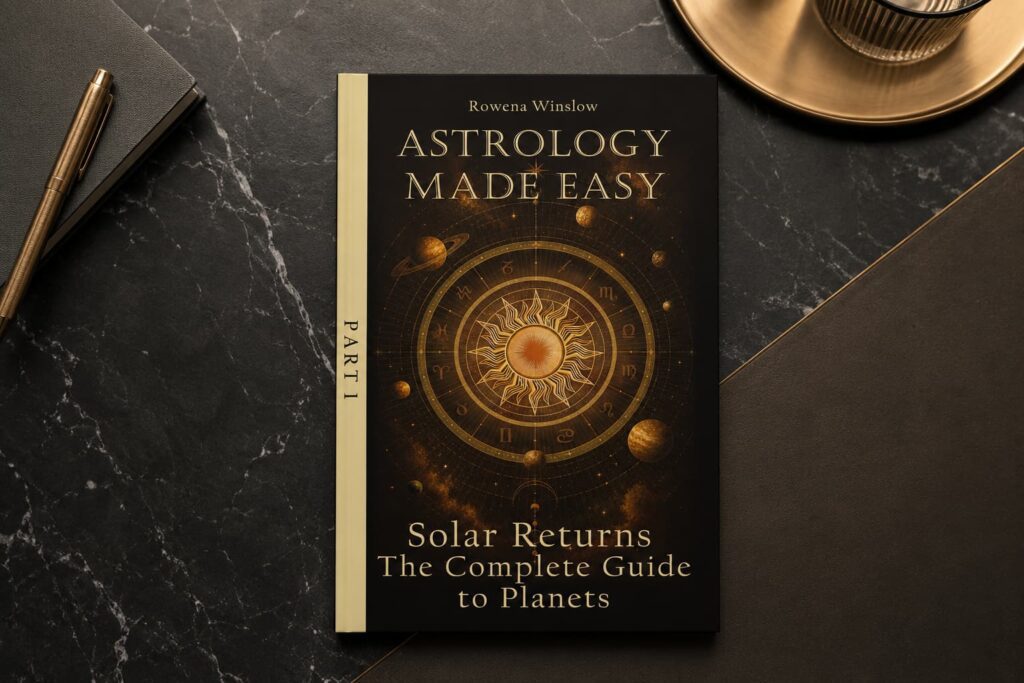
Author: Rowena Winslow
Series: Astrology Made Easy: Solar Returns, Volume 1 | 385 pages
Available on: Payhip | Amazon | Etsy
The natal chart tells you who you are. The Solar Return tells you what this particular year is about. Volume 1 of the Solar Returns series is the first part of what Winslow describes as the most comprehensive treatment of Solar Return astrology currently available — and based on what this first volume contains, that is not an overstatement.
This book is aimed at readers who already know the basics: signs, houses, planets, aspects. If you are coming to it directly, it will make more sense after working through the natal chart volumes. But for anyone with that foundation, this is the book that shows you how to apply it to an annual chart — in real depth, with genuine practical precision.
See it in your own chart
Calculate your Solar Return free and see what your year ahead is built around. No sign-up.
Calculate My Solar ReturnWhat Solar Returns Are — and What This Book Actually Teaches
A Solar Return is the chart calculated for the exact moment the Sun returns to its natal degree each year. It is cast for wherever you happen to be at that moment, which means the house structure shifts depending on your location — a fact that has practical consequences covered in detail.
The book is built around a principle that distinguishes it from most Solar Return guides: the house placement of a planet carries far more interpretive weight than its sign. The sign describes how the energy expresses; the house describes where it lands in your actual life. This distinction is stated clearly at the outset and carried consistently through every chapter.
What’s Inside
Part I — Foundations of Solar Return Interpretation
Before any planet is covered, the book lays out the conceptual and technical groundwork across four chapters. This section is worth reading carefully even for experienced astrologers, because the material goes well beyond what most resources cover.
Chapter 1 covers what a Solar Return is and what it describes: the astronomical basis, the location factor, the year’s dominant themes, psychological climate, areas of activation, and — importantly — what the Solar Return does not describe. The limits of the tool are defined as carefully as its uses. The chart works in dialogue with the natal chart; it does not replace it, and it does not produce conditions from nothing.
Additional interpretive factors are covered in depth before the planet chapters begin — material that most Solar Return books either skip entirely or handle in a paragraph:
- Hemispheric and quadrant emphasis — what it means when nine or more planets are concentrated above or below the horizon, or in the eastern or western hemisphere; what each of the four quadrant emphases describes for the year’s primary orientation
- Modal balance — what five or more cardinal, fixed, or mutable planets describe for the year’s characteristic pace and flexibility, including the risk profiles of each extreme
- Elemental balance — what five or more fire, earth, air, or water planets describe for the year’s characteristic mode of engagement
- Planets near house cusps — practical guidance on how to read a planet that falls within a few degrees of a cusp, including the angular cusps as the most powerful points in the chart
- Stelliums — what a concentration of four or more planets in a single house produces for the year, including both the focused productive potential and the risk of imbalanced over-concentration
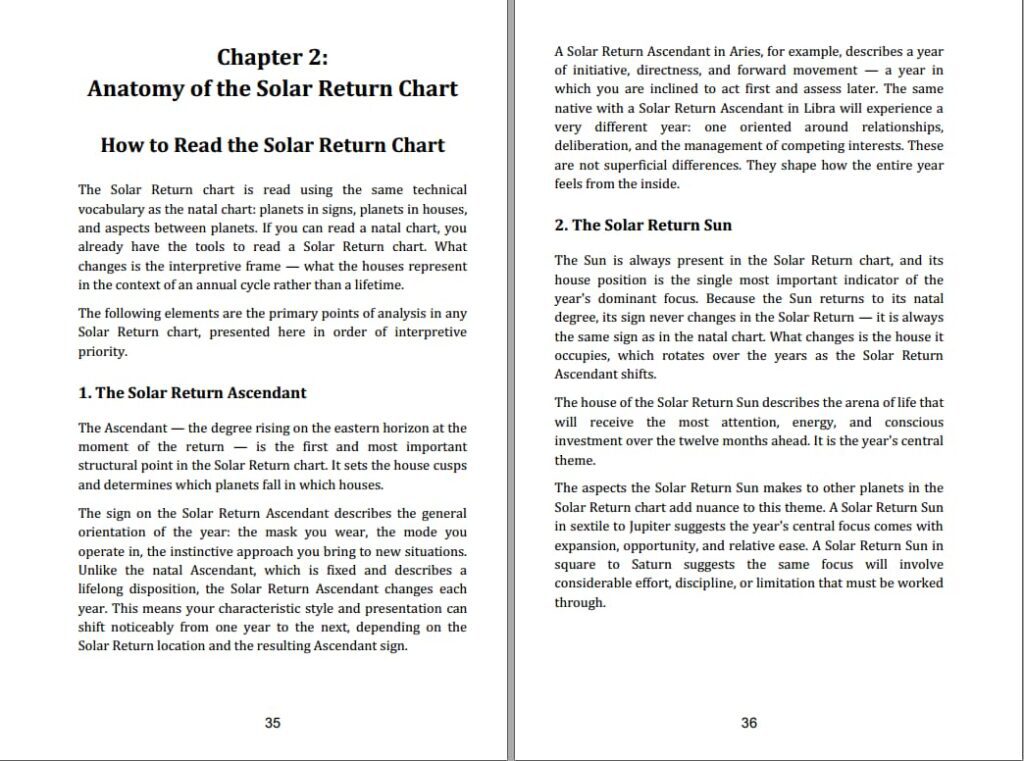
Chapter 2 covers the anatomy of the Solar Return chart — how to read it, in what order, and what each primary element represents. The Solar Return Ascendant, the Solar Return Sun, the Solar Return Moon (including its function as a timing device), angular planets, stellia, and the aspect structure are all covered with clear priority guidance. The chapter closes with an introduction to the natal house overlay technique — how to identify which Solar Return house each natal house cusp falls in, and what that tells you about how the year’s themes will express in specific life areas.
Chapter 3 covers practical chart calculation — what data you need, how to use the free calculator at AstroCore, and a seven-step setup sequence for beginning a Solar Return reading.
Chapter 4 covers Solar Return relocation in more depth than almost any other accessible resource: what changes when you relocate (Ascendant and house cusps), what does not change (planetary positions and mutual aspects), when relocation is genuinely worth considering, how far you need to travel to produce a meaningful shift, how to evaluate a relocation option systematically, and the ethical limits of the technique. The chapter includes a concrete case example showing a client whose home chart presented a difficult angular Saturn and how the relocated chart distributed that Saturn into a less immediately pressuring position.
Part II — The Sun Through All Twelve Solar Return Houses
The Solar Return Sun chapter is the longest in the book and the most detailed. For each of the twelve house placements, the chapter provides:
- The focus area and key question — the year’s central theme stated directly
- Detailed delineations of how the house placement manifests in practical life, with multiple specific and recognizable examples for each house
- Favorable aspects — how conjunctions, trines, and sextiles from each of the nine other planets modify the year’s central theme, with specific manifestation examples for each combination
- Challenging aspects — how conjunctions with difficult planets, squares, and oppositions from each of the nine other planets create friction, developmental pressure, or specific risks in the year’s primary domain
- An In Practice section — a real client case showing how the placement and its aspects manifested in an actual chart reading, including the advice given and what happened
The In Practice cases are particularly valuable. They are not illustrative anecdotes but genuine demonstrations of interpretive method — showing not just what the placement means but how an experienced astrologer reads it in the context of a real person’s life and circumstances.
A few examples of what individual house chapters cover: the Sun in the First House is presented as a year of identity and physical vitality — personal needs become unusually prominent, the body becomes a primary site of personal development, and the year’s most significant work is showing up as yourself more fully than previous accommodations have allowed. The Sun in the Second House addresses financial circumstances and the psychological relationship to self-worth simultaneously — not just income but what a person believes they deserve to have. The Sun in the Tenth House is covered as a year of career prominence, public visibility, and the kind of professional reckoning that either produces lasting advancement or reveals that current professional direction requires genuine reassessment.
Each house receives this level of depth. The aspect sections alone — nine favorable combinations and nine challenging combinations per house, each with specific manifestation examples — constitute a reference resource that could stand independently.
The Solar Return Moon Through All Twelve Houses
The Moon chapter follows the same structure as the Sun but with one significant addition: the Moon’s sign placements are treated in more detail than those of any other planet, because the Moon moves through all twelve signs each month and therefore genuinely describes individual emotional qualities that vary year to year.
The Moon chapter covers the emotional tone of the year for each house placement, the Moon’s role as a timing device through the Progressed Solar Return Moon technique (which house the Moon moves through each month, activating the year’s themes sequentially), and the full aspect structure for both favorable and challenging combinations with every other planet.
Mercury Through All Twelve Solar Return Houses
Mercury is the third planet covered in this volume, following the same structure: house placements with detailed manifestation examples, aspects both favorable and challenging, and In Practice cases. The Mercury chapter covers communication, learning, and local environment themes — including a particularly detailed section on the retrograde Mercury in the Solar Return chart, which will be covered fully in Volume 3.
What Makes This Book Different
Most Solar Return books give you a paragraph or two per house placement. This one gives you pages — with specific, recognizable examples of how each placement actually manifests in real life, aspect combinations that modify and nuance the placement, and case studies that show the reasoning behind real interpretive decisions.
The foundational chapters on hemispheric emphasis, modal and elemental balance, and relocation go well beyond what most accessible Solar Return resources cover. The In Practice sections show not just what placements mean but how to think through them in context — which is what turns reference material into actual interpretive skill.
Who This Book Is For
Astrologers who already use Solar Returns and want more depth, precision, and systematic coverage than most resources provide. The aspect sections and foundational chapters fill gaps that most practitioners have been working around.
Students who have completed the natal chart volumes and are ready to move into predictive work. The Solar Returns series builds directly on the natal chart foundation — the interpretive vocabulary is the same, applied to an annual rather than lifelong frame.
Anyone who wants to understand what the current year is actually about — not in the vague sense of general themes, but with the specificity that comes from knowing where the Sun, Moon, and Mercury fall in their Solar Return houses and what aspects are modifying those placements.
The Complete Solar Returns Series
- Solar Returns Part 1 — Sun, Moon, Mercury through all twelve houses; foundations, relocation, chart setup (this book)
- Solar Returns Part 2 — Venus, Mars, Jupiter, Saturn through all twelve houses
- Solar Returns Part 3 — Uranus, Neptune, Pluto; Solar Return Ascendant through the signs; retrograde planets; three natal chart overlay techniques; step-by-step reading algorithm
Also by Rowena Winslow
You can continue your study of astrology with the following volumes:
Natal Astrology
- Vol. 1 — Zodiac Signs and Horoscope Houses in the Birth Chart
- Vol. 2 — Planets & Aspects in the Birth Chart
Predictive Astrology
- Transits & Planetary Cycles, Part 1 — Sun, Moon, Mercury, Venus, Mars
- Transits & Planetary Cycles, Part 2 — Jupiter, Saturn, Uranus, Neptune, Pluto
Synastry
Solar Return Astrology
- Part 1 — Sun, Moon, Mercury
- Part 2 — Venus, Mars, Jupiter, Saturn
- Part 3 — Chart Overlays & Interpretation
Other Specialized Topics
Calculate your free Solar Return chart at AstroCore.pro — the calculator generates a dual chart showing your Solar Return and natal chart together on a single wheel, which is exactly the format this book’s overlay techniques require.




Leave a Reply