

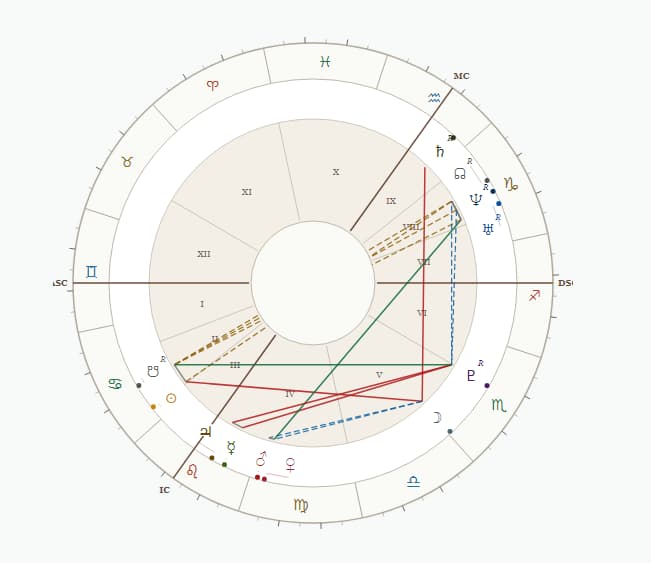
One of the most common questions I receive from people who have just looked at their birth chart for the first time: “I have empty houses — does that mean something is missing from my life?”
The short answer is no. The longer answer is more interesting than that.
See it in your own chart
Calculate your natal chart free — with a real interpretation of your Sun, Moon, and Ascendant. No sign-up.
Calculate My ChartFirst: what an empty house actually is
A natal chart has twelve houses. Most people have ten planets (or points) to distribute among them. Which means, by simple arithmetic, most charts will have at least two or three empty houses — and some will have significantly more.
An empty house is simply a house with no planets in it. That is the entire definition. It does not mean the life areas governed by that house are absent, damaged, or unimportant. It means those areas operate differently than they would with a planet present.
The tradition is specific about this: when a house has no planets, that house is called empty, and its influence is determined by the position and characteristics of its ruler — the planet that governs the sign on the house cusp.
The house ruler: where the real information lives
Every house has a cusp — the degree of the zodiac that marks its beginning. The sign on that cusp determines the house’s ruler, which is the planet governing that sign. When no planets occupy the house, this ruler becomes the primary significator for everything the house represents.
So if your 7th House of partnership is empty but Virgo sits on its cusp, Mercury becomes the ruler of your 7th House. Mercury’s sign, house placement, and aspects tell you everything the planets-in-the-7th-house person’s chart tells them directly. The information is the same; the route to it is different.
This is why empty houses are not absences — they are redirections. The question is not “what does this empty house mean?” but rather “where is the ruler of this house, and what is it doing?”
What each empty house actually means
Empty 1st House: The Ascendant’s ruler carries the full weight of your personal presentation and physical vitality. You are not lacking in identity — your identity is expressed through the domain where your Ascendant ruler sits. An empty 1st House often describes someone whose energy is more naturally directed outward, toward others and the world, than toward self-focus.
Empty 2nd House: Financial matters are not absent from your life — they are governed by the 2nd House ruler’s placement. Money and material security become a theme through that planet’s domain. Some people with an empty 2nd House report that financial concerns take up less of their mental attention than the same concerns do for others; others find that the ruler’s challenges produce consistent financial complexity.
Empty 3rd House: Communication, siblings, and short-distance movement are governed by the ruler. An empty 3rd House does not mean you cannot communicate — it means communication operates less as a primary life arena and more as a function that the 3rd House ruler handles. If that ruler is strong and well-placed, the communication life is easy; if afflicted, there may be specific difficulties in the areas the 3rd governs.
Empty 4th House: Home, family, and psychological roots are not absent — they are simply not a dominating theme driven by planets in residence. The 4th House ruler’s condition tells you about the family life and home environment. An empty 4th can sometimes describe someone for whom “home” is more of a concept than a fixed place, or whose psychological foundation was established more through the ruler’s domain than through conventional domestic circumstances.
Empty 5th House: Children, creativity, romance, and play are governed by the 5th House ruler. An empty 5th does not mean you cannot have children or creative expression — it means these things operate through the ruler’s placement. The ruler in the 11th House might describe creative expression that happens most naturally in group or community contexts; the ruler in the 8th might describe a creative life that goes into deep, intense territory.
Empty 6th House: Health, daily work, and routine are governed by the 6th House ruler. Health is not absent as a concern — but it may not be a dominating preoccupation. The ruler’s condition tells you about the physical constitution and the relationship to daily work and service.
Empty 7th House: Partnership is not absent. The 7th House ruler, wherever it sits, describes the nature of significant relationships and what you attract in committed partnership. This is one of the most commonly misread empty houses — people worry that an empty 7th means they will not find a partner. It does not. It means partnership is not governed by a planet sitting directly in that house; it is governed by the ruler operating from wherever it actually lives in the chart.
Empty 8th House: Shared resources, transformation, and encounters with depth are governed by the 8th House ruler. An empty 8th does not protect you from crisis or loss — it means these themes operate through the ruler’s placement rather than through direct planetary occupation of the house.
Empty 9th House: Philosophy, higher education, travel, and meaning-making are governed by the 9th House ruler. Some people with an empty 9th find that the search for meaning is not a primary preoccupation; others find it is intensely significant but approaches them through the ruler’s domain — through relationships, through work, through crisis — rather than through formal religious or educational structures.
Empty 10th House: Career and public reputation are not absent. The 10th House ruler, its sign, house, and aspects, tells the full career story. Many people with an empty 10th have rich and significant professional lives — the information is simply in the ruler rather than in planets occupying the house itself.
Empty 11th House: Community, friendship, and long-term goals are governed by the 11th House ruler. An empty 11th does not mean you cannot have friends or community — it means these operate through the ruler’s placement and are not a dominant theme driven by planetary occupation.
Empty 12th House: The hidden, the unconscious, and the solitary are governed by the 12th House ruler. An empty 12th is actually one of the more favorable empty house configurations — it means no planets are operating from the domain of self-undoing and concealment, which simplifies the psychological picture considerably.
The houses that matter most
The tradition is consistent on one point: not all houses carry equal weight. The most important houses in any chart are the angular houses — the 1st, 4th, 7th, and 10th — particularly when they contain planets. A stellium in an angular house is described as having exceptionally important significance.
Empty angular houses are worth more attention than empty cadent houses (the 3rd, 6th, 9th, and 12th). When the 1st, 4th, 7th, or 10th are empty, the ruler of that house becomes a genuinely important planet in the chart — often more important than it would appear if you were simply looking at the planet’s sign and house without considering its role as angular house ruler.
What empty houses tell you about emphasis
One practical use of empty houses is understanding where your life emphasis is not. A chart with most planets concentrated in three or four houses and many empty houses elsewhere is describing a highly focused life — someone whose energy is concentrated in specific domains rather than distributed evenly across all areas of experience.
The concentration itself is not good or bad. It is information. The person with a stellium in the 10th and most other houses empty may find that their professional life absorbs an enormous amount of their energy, with other domains feeling less compelling or less developed. The person with a stellium in the 12th and most other houses empty may find that their inner life, solitary work, and the encounter with what is hidden dominates the experience of being alive.
Reading the empty houses alongside the occupied ones gives you the full picture of where the chart is directing its energy — and where it is not.
One more thing: transits activate empty houses
Empty houses are not permanently empty in terms of experience. Planets transit through every house over the course of a year (for fast-moving planets) or decades (for slow-moving ones). When a transiting planet crosses through an empty house, it activates the themes of that house in the life — temporarily, but genuinely.
The empty 5th House that has little activity for years suddenly activates when Jupiter transits through it. The empty 7th House that has seemed quiet comes to life when Saturn crosses the Descendant. Emptiness in the natal chart describes the baseline state; transits describe what happens over time.
Understanding both the natal empty houses and the transits that periodically activate them gives you a considerably more complete picture than the natal chart alone.
See it in your own chart
Calculate your natal chart free — with a real interpretation of your Sun, Moon, and Ascendant. No sign-up.
Calculate My ChartIf you want to understand what your empty houses mean specifically — including where their rulers are and what they are doing in your chart — a full natal chart reading addresses this directly.
Rowena Winslow is a professional astrologer and the author of the Astrology Made Easy series. Her practice covers natal chart interpretation, Solar Returns, and predictive astrology. astrocore.pro

Leave a Reply