
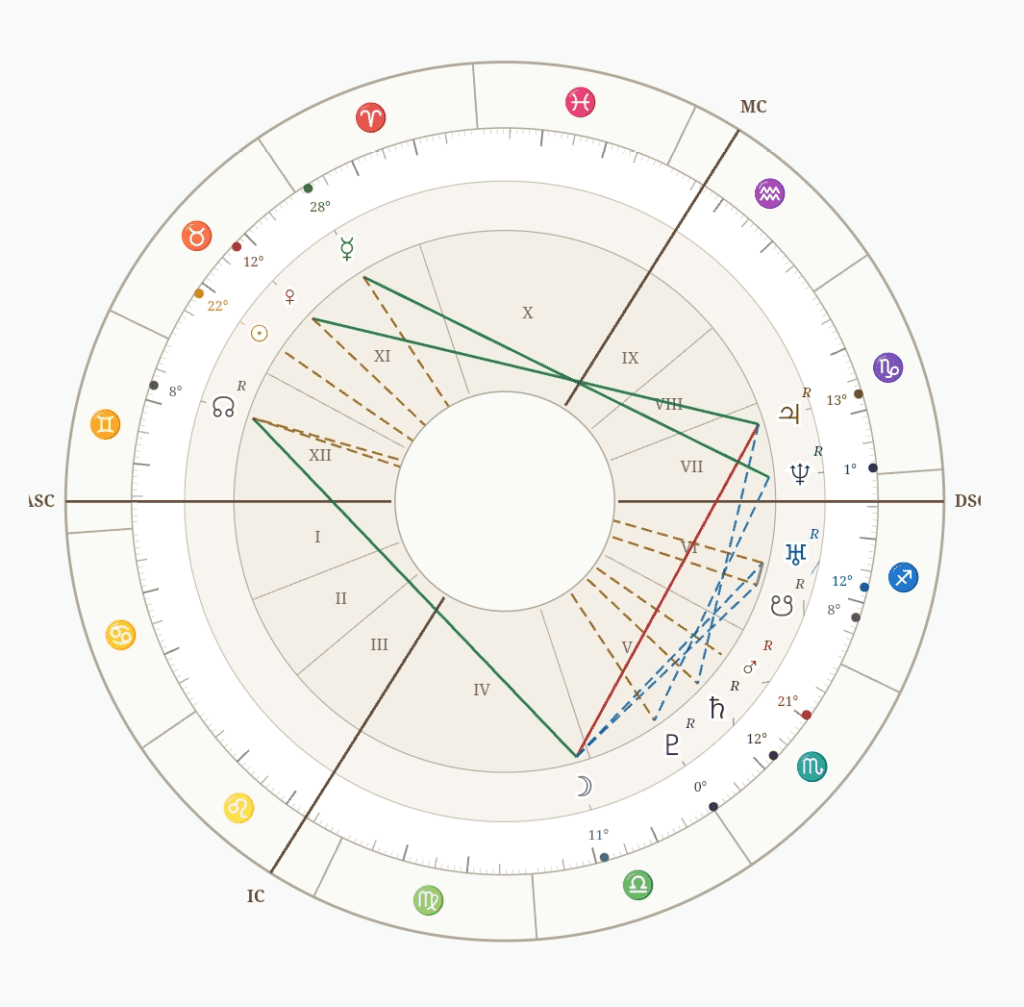
If you’ve ever typed your birth details into an app and received a wheel covered in symbols, lines, and numbers — and had absolutely no idea what you were looking at — you’re not alone.
Most people encounter their natal chart and immediately feel like they’ve opened the wrong door. It looks complicated. It is complicated. But the complication is the point.
A natal chart is not a personality quiz. It is not a list of traits generated by your Sun sign. It is a precise astronomical map of the sky at the exact moment you were born — calculated to your birth date, birth time, and birth location. Every planet in our solar system was somewhere specific in that sky. Your natal chart shows exactly where.
What astrology does with that map is interpret it. And that interpretation — done properly — is one of the most detailed, specific, and genuinely useful frameworks for understanding human psychology and life patterns that I’ve encountered in over twenty years of practice.
Here’s how it actually works.
The Three Foundations: Planets, Signs, and Houses
Every natal chart is built from three layers that work together. Understanding each layer separately — before you try to read them together — is the only way to make sense of what the chart is telling you.
Planets: What Is Operating
The planets are the actors in the chart. Each one represents a distinct psychological function — a drive, a need, a mode of operating in the world.
The Sun represents identity and conscious purpose — who you are trying to become. The Moon represents emotional nature, instinctive responses, and what you need to feel safe. Mercury rules how you think and communicate. Venus governs what you value and how you relate to others. Mars is drive, desire, and the way you pursue what you want.
The outer planets — Jupiter, Saturn, Uranus, Neptune, Pluto — operate more slowly and represent larger forces. Saturn shows where you face limitation and are required to build real structure. Jupiter shows where things expand, sometimes usefully and sometimes not. Uranus disrupts. Neptune dissolves. Pluto transforms, usually by destroying first.
Most people know their Sun sign. Some know their Moon and Rising. Very few know where all ten planets sit — and that’s where most of the real information lives.
Signs: How It Operates
The sign a planet occupies describes the quality and style of how that planet functions. It’s the adjective to the planet’s noun.
Mars in Aries acts differently than Mars in Libra. Both are Mars — both represent drive and desire — but Aries Mars pursues directly, impulsively, without much concern for consequences. Libra Mars weighs, negotiates, and sometimes doesn’t act at all because the decision feels too costly.
The sign doesn’t change what a planet is. It changes how that planet behaves.
This is why Sun sign astrology — the kind in magazines — is so limited. Knowing someone has a Scorpio Sun tells you something about their core identity. It tells you nothing about how their mind works (Mercury), what they need emotionally (Moon), how they pursue things (Mars), or what they’ve come here to build (Saturn). Those planets could be anywhere.
Houses: Where It Operates
The twelve houses divide the chart into twelve areas of life. The 1st house covers the self and physical appearance. The 2nd covers money and values. The 3rd covers communication and immediate environment. The 4th covers home and family. The 5th covers creativity and romance. The 6th covers work and health. The 7th covers partnerships. The 8th covers shared resources, transformation, and death. The 9th covers beliefs, travel, and higher learning. The 10th covers career and public reputation. The 11th covers community and future goals. The 12th covers the hidden, the unconscious, and what we keep from ourselves.
When a planet occupies a house, it brings its energy into that life area. Saturn in the 7th house brings Saturn’s themes — limitation, structure, serious reckoning — into partnerships. Venus in the 2nd brings Venus’s values directly into the area of money and possessions. Mars in the 12th operates largely out of conscious awareness, which tends to create patterns the person can’t quite explain.
The house a planet occupies is often more revealing than the sign it’s in. Most people focus on signs. Experienced astrologers focus on houses.
The Ascendant: The Most Misunderstood Point in the Chart
The Ascendant — also called the Rising sign — is the zodiac sign that was rising on the eastern horizon at the moment of your birth. It changes approximately every two hours, which is why birth time matters so much for chart accuracy.
The Ascendant is not your personality. It is the lens through which your personality is expressed — the style, the presentation, the first impression you make on the world. It also sets the entire house structure of the chart, which is why an inaccurate birth time produces a chart that doesn’t work properly.
People often identify strongly with their Ascendant because it describes how they appear — to others and often to themselves. A Capricorn Rising person tends to project seriousness, competence, and self-containment regardless of what their Sun or Moon are doing. A Gemini Rising person tends to appear curious, quick, and adaptable even if their inner world is far more fixed.
The Ascendant and its ruling planet — the planet that rules the Ascendant’s sign — form what’s called the chart ruler. The chart ruler is the planet that, in many ways, sets the tone for the entire chart. It deserves more attention than most people give it.
Aspects: The Conversations Between Planets
Once you understand planets, signs, and houses, the next layer is aspects — the angular relationships between planets in the chart.
When two planets are a certain number of degrees apart, they form an aspect. The major aspects are the conjunction (0°), sextile (60°), square (90°), trine (120°), and opposition (180°). Each describes a different quality of relationship between the two planets involved.
Trines and sextiles are generally considered harmonious — the planets work together fluidly. Squares and oppositions create tension — the planets are in conflict, which creates difficulty but also drives growth. Conjunctions intensify — the two planets merge their energies, for better or worse depending on which planets are involved.
A chart with many trines sounds pleasant but often produces people who don’t develop their potential because nothing forces them to. A chart full of squares produces difficulty and friction — but also the drive to work, build, and overcome. The most interesting charts are rarely the easy ones.
Aspects are where the chart comes alive as a system rather than a list of separate parts. A planet doesn’t operate in isolation. It is in relationship with every other planet it aspects, and those relationships shape how it functions.
What a Natal Chart Cannot Tell You
This is important, and most astrology articles skip it entirely.
A natal chart shows potential — the raw material of a life. It does not show destiny. It does not tell you what will happen. It does not show whether you will be happy, successful, or fulfilled. Those outcomes depend on what you do with the material you were given.
Two people can have nearly identical charts and live completely different lives. The chart shows the terrain. What you do with the terrain is up to you.
A natal chart also cannot be read accurately without a correct birth time. The Ascendant, house positions, and many timing techniques are entirely dependent on the birth time. A chart with an estimated or incorrect time is a partial chart — useful for some things, unreliable for others. If you don’t know your birth time, your priority should be getting it.
And a natal chart cannot substitute for actual self-knowledge. The best use of a chart reading is as a map — something to orient yourself with, not something to follow blindly. The chart describes tendencies, patterns, and potentials. What you do with that information is the actual work.
How to Start Reading Your Own Chart
Reading a natal chart is a skill that takes years to develop properly. But there are entry points that give you something real to work with immediately.
Start with the chart ruler. Find your Ascendant sign, then find the planet that rules that sign. That planet’s sign, house, and aspects tell you something fundamental about how your chart operates as a whole.
Look at your Moon. Most people over-focus on their Sun and under-attend to their Moon. The Moon shows what you need emotionally — what makes you feel safe, what you default to under stress, where you are most instinctive and least rational. Understanding your Moon often explains patterns that the Sun sign doesn’t.
Find where Saturn sits. Saturn’s house and sign show the area of life that requires your most serious effort — where you will face the most difficulty, and where you have the potential to build something that actually lasts.
Look for stelliums. A stellium is three or more planets in the same sign or house. Where planets cluster, energy concentrates. A stellium in the 7th house means relationships are a central theme. A stellium in Capricorn means Saturn’s themes run through everything those planets represent.
Don’t read placements in isolation. A Moon in Scorpio reads differently in the 1st house than in the 12th. Mars in Aries reads differently conjunct Saturn than trine Jupiter. The chart is a system. Individual placements only make full sense in context.
Why a Professional Reading Matters
There is a difference between knowing what your placements are and understanding what they mean together.
An app can tell you that you have Mercury in Pisces square Saturn in Sagittarius. What it cannot tell you is how that tension plays out in a chart with a Virgo Ascendant, a 3rd house stellium, and the chart ruler in the 12th. Context changes everything. The same placement in two different charts can operate completely differently.
A professional reading doesn’t just list your placements. It reads the chart as a whole — the patterns, the tensions, the dominant themes, the areas of genuine strength and the areas that require real work. It also brings the experience of having read hundreds of charts, which means recognizing patterns that would take years of self-study to identify.
If you want to understand your natal chart properly — what it actually says, not just what the individual placements mean in isolation — a Natal Chart Reading with Rowena will give you a complete interpretation, written specifically for your chart.
You can also generate your natal chart for free using the Natal Chart Calculator on AstroCore — it will show you your placements, which is the starting point for everything else.
Rowena Winslow is a professional astrologer and the author of five volumes on natal chart interpretation, planetary transits, and career astrology. She has been reading charts for over two decades.



Leave a Reply