
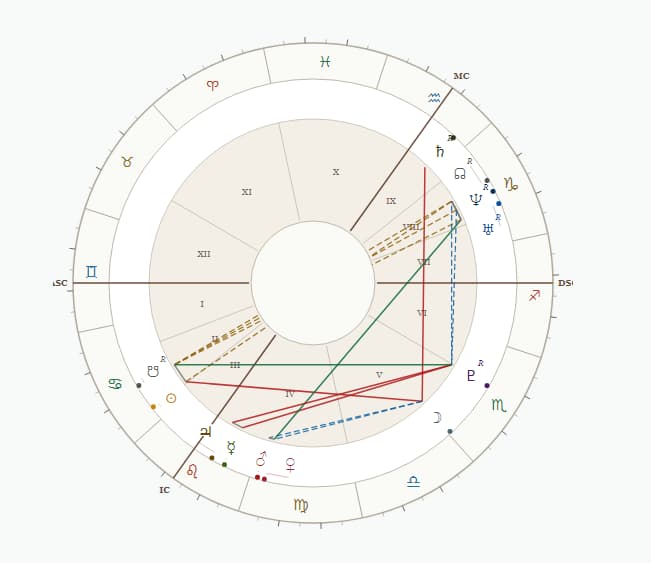
If the zodiac signs describe who you are, and the planets describe what drives you, then the houses describe where in life all of that plays out.
The twelve houses are the most concrete and immediately practical part of the birth chart. They divide the chart into twelve distinct life domains — career, relationships, money, health, family, creativity, and more — and show which areas of life are most activated by your particular planetary placements.
Understanding the houses transforms a birth chart from a collection of abstract symbols into a map of an actual life.
What Are the Houses?
The twelve houses are divisions of the birth chart based on the Earth’s rotation. Where the zodiac signs follow the Sun’s annual journey around the sky, the houses follow the Earth’s daily rotation — completing one full cycle every twenty-four hours.
The chart is divided into twelve sections, each corresponding to a two-hour window of the day. The house that was rising on the eastern horizon at the moment of your birth becomes your 1st House, setting the entire framework. From there, the remaining eleven houses follow in sequence around the chart.
This is why birth time matters so much in astrology. The houses shift approximately one degree every four minutes of clock time. An inaccurate birth time produces inaccurate house positions — and without accurate houses, the chart loses much of its practical precision.
The Angular, Succedent, and Cadent Houses
Before looking at each house individually, it helps to understand how they are grouped.
The twelve houses fall into three categories of four:
Angular houses (1st, 4th, 7th, 10th) are the most powerful positions in the chart. Planets here are prominent, active, and visible in the life. These houses correspond to the four cardinal points of the chart — the Ascendant, IC, Descendant, and Midheaven — and they describe the most immediately consequential areas of life: identity, home, partnership, and career.
Succedent houses (2nd, 5th, 8th, 11th) follow the angular houses and describe where the energy of those primary domains is consolidated and sustained. Resources, creativity, shared finances, community.
Cadent houses (3rd, 6th, 9th, 12th) precede the angular houses and describe the domains of preparation, service, understanding, and completion. Communication, daily work, philosophy, the hidden life.
The 12 Houses: What Each One Governs
The 1st House — The House of Self
The 1st House describes who you are at the most immediate and instinctive level — before you have had time to think, calculate, or adjust. It governs the physical body, the temperament, the characteristic energy, and the first impression you make on the world. The sign on the 1st House cusp is your Ascendant — the most personally specific point in the chart.
The 2nd House — The House of Value
The 2nd House governs material resources: money, earned income, possessions, and the capacity to generate and sustain them. But its deeper territory is value itself — what you consider worth having, worth building, worth protecting. The relationship between financial behavior and self-worth is one of the 2nd House’s most consistently revealing dimensions.
The 3rd House — The House of Mind and Environment
The 3rd House describes how you think and communicate — the quality of the intellect in daily action, not in philosophical contemplation. It also governs the immediate environment: siblings, neighbors, local travel, and the daily exchange of information between you and the world in close proximity.
The 4th House — The House of Roots
The 4th House governs home, family, origins, and the private foundations of the self. It describes where you come from — literally and psychologically — and where you return to for genuine restoration. The 4th House is also the chart’s final house in one important sense: classical tradition associates it with the end of life and the circumstances that surround it.
The 5th House — The House of Creation
The 5th House governs creative expression, romance, children, and pleasure. It is the house of the self expressing itself outward — through what it makes, who it loves, and how it plays. This house describes what you create for the joy of creating, and the quality of romantic connection before it becomes the sustained commitment of the 7th House.
The 6th House — The House of Work and Health
The 6th House governs daily work, practical service, and physical health. It describes the quality of daily functioning — the routines, the habits, the relationship to the body, and the work you do not for public recognition but because it needs to be done. Health vulnerabilities and the body’s characteristic patterns of illness are read here.
The 7th House — The House of Partnership
The 7th House governs significant one-on-one relationships — romantic partnerships, business partnerships, and formal agreements. It is also the house of the open adversary: legal disputes and formal opposition. What you seek in a partner, what you project onto others, and the recurring patterns in your closest relationships are all described here.
The 8th House — The House of Transformation
The 8th House governs shared resources, inherited wealth, sexuality, death, and the profound transitions that permanently alter a life. This is not a comfortable house — it is a necessary one. The 8th House describes the territory where genuine transformation becomes possible: crisis, loss, the surrender of one version of the self in order to become the next.
The 9th House — The House of Understanding
The 9th House governs philosophy, higher education, long-distance travel, and the search for meaning. Where the 3rd House describes the immediate, curious mind in daily action, the 9th House describes the mind reaching toward larger frameworks — the beliefs, the worldview, the principles that give the life its direction and its sense of purpose.
The 10th House — The House of Vocation
The 10th House governs career, public standing, professional ambition, and the contribution you make in the world. It is the most publicly visible house in the chart — the house of reputation, achievement, and what you will be remembered for. The Midheaven, which sits at the top of the chart, is the 10th House cusp.
The 11th House — The House of Community
The 11th House governs friendships, groups, collective endeavors, and long-term goals. It describes the social world beyond the immediate partnership of the 7th House — the community you belong to, the causes you support, the aspirations that extend beyond personal life into something larger.
The 12th House — The House of Dissolution
The 12th House governs solitude, the unconscious, hidden matters, and the completion of cycles. It is the house of what operates below the surface — the psychological patterns not yet brought to consciousness, the private life, and the spiritual dimensions of experience. Often described as difficult, the 12th House is more accurately understood as the house of preparation: the inner work that makes the next cycle possible.
The House Ruler: The Hidden Connection
Each house has a ruler — the planet that governs the sign on that house’s cusp. The house ruler’s placement elsewhere in the chart creates a connection between the two houses it bridges, describing how one area of life feeds into or expresses itself through another.
This is where house interpretation becomes genuinely specific and genuinely sophisticated. The ruler of the 7th House in the 2nd House, for instance, describes a life in which partnership and financial matters are consistently intertwined. The ruler of the 10th House in the 5th describes a career expressed through creative work or a professional life shaped by children.
Every house has a ruler. Every ruler has a house. Reading those connections — the chain of relationships between houses — is one of the most powerful interpretive tools in the natal chart, and it is covered in full detail in Astrology Made Easy: A Comprehensive Guide to Zodiac Signs and Horoscope Houses in the Birth Chart.
Why the Houses Matter More Than Most People Realize
Most people who explore astrology start with sun signs — and sun signs are genuinely useful. But the houses are where astrology becomes specific to your life rather than to everyone born in the same month.
Two people with the same sun sign and the same rising sign can have entirely different house emphases — different concentrations of planetary energy in different life domains — and therefore genuinely different life experiences and genuinely different developmental challenges.
The person with most of their planets in the upper hemisphere of the chart — houses 7 through 12 — lives a more publicly oriented life than the person whose planets are concentrated below the horizon. The person with a stellium in the 4th House will find that home, family, and private life consistently demand more of their attention than their career, regardless of professional ambition. The person with multiple planets in the 8th House will encounter transformation, crisis, and depth as recurring life themes in a way that someone with an empty 8th House will not.
The houses tell you where the life is actually happening — which areas are most activated, most demanding, most productive — and that information is irreplaceable.
Finding Your Houses
To work with the houses, you need your birth chart calculated accurately — with birth date, birth time, and birth location. The time is essential: the houses shift approximately one degree every four minutes, and an inaccurate time produces an inaccurate chart.
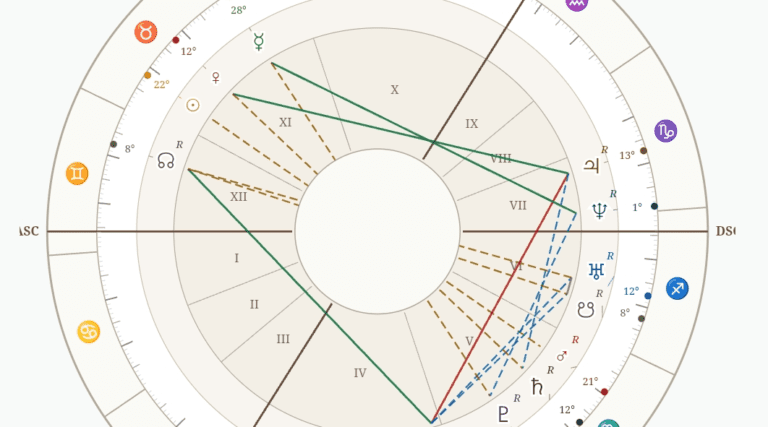
The free natal chart calculator at AstroCore generates a complete chart with all house positions, a full aspect table, and aspects to house cusps that most standard calculators omit.
For a complete guide to interpreting all twelve houses — including the sign on each cusp, the house ruler’s placement, and the planets occupying each house — Astrology Made Easy: A Comprehensive Guide to Zodiac Signs and Horoscope Houses in the Birth Chart covers the full system. Available on Amazon and Etsy.
For a professionally worked natal chart reading — with the houses, their rulers, and their planetary occupants read as an integrated whole — readings are available at AstroCore.
Rowena Winslow is the author of the Astrology Made Easy series, available on Amazon and Etsy. Free natal chart and Solar Return calculators are available at AstroCore.

Leave a Reply