
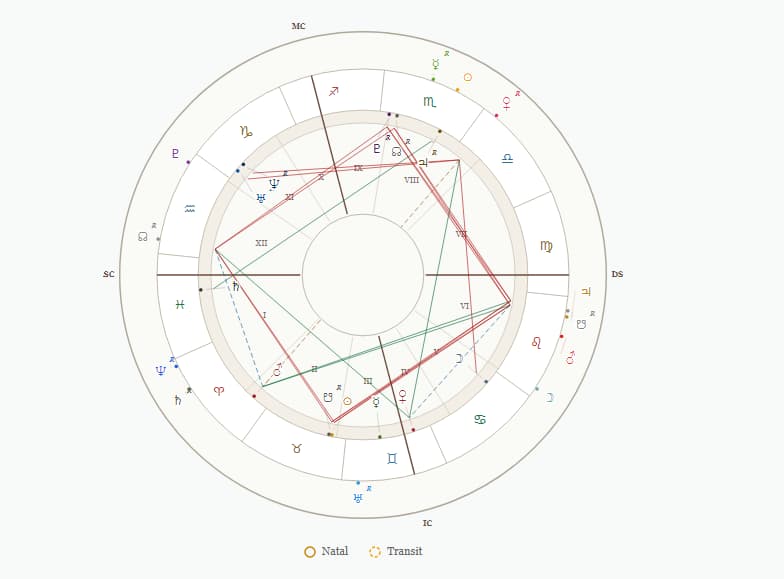
A transit chart looks like any other chart: a wheel, planets, lines between them. What makes it hard to read is that there is no obvious place to start. Most people look at every planet at once, see a dozen aspects, and come away with nothing.
Predictive astrology answers one question: when? The order below is the one that gives you a usable answer. Start with the planets that matter most, find what they govern in your chart, wait for the aspect that switches the transit on, and only then read the timing. Six steps.
See it in your own chart
Calculate your current transits free — every planet activating your chart right now. No sign-up.
Check My TransitsStep 1: Your natal chart and today’s sky on one wheel
A transit chart is your birth chart with the current positions of the planets laid over it. The natal chart never changes: it is a snapshot of the sky at your exact time, date and place of birth. The transits are dynamic, and you can calculate them for any moment, past, present or future.
You do not need to draw this yourself. The AstroCore calculator generates the double chart for you: your natal chart and the transiting planets together on one wheel, for any date you choose. Exact birth time matters, because the houses depend on it, and the calculator uses Koch houses, the same system as the Astrology Made Easy books.
Everything you read is the relationship between the two. A transit means nothing on its own. Saturn in a given sign is the same for everyone; what it does depends on what it touches in your chart.
Step 2: Decide which planets deserve your attention
Not all transits carry the same weight, and knowing which ones matter saves you from reading noise.
- Jupiter and Saturn are the most significant for personal forecasting. Their transits tend to line up with the real turning points: a change of career, a move, a marriage or a divorce, a shift in family responsibilities. Saturn brings structure and testing, Saturn’s return being the best-known example; Jupiter brings growth and opportunity, though not automatically.
- The Sun, Moon, Mercury, Venus and Mars shape everyday experience: moods, a week of intense communication, a burst of activity. They matter most for timing. The Moon’s transits last hours.
- Uranus, Neptune and Pluto are generational planets. They work in the background and often feel like nothing is happening, until it already has. Their effect is strongest when a faster planet such as Jupiter, Saturn or Mars echoes them.
Step 3: Find what the transiting planet governs in your chart
A transiting planet keeps its own nature, but it also acts as the representative of the houses it rules in your natal chart. This is the step most people skip, and it is what makes a reading specific to you.
To find it, look at the sign on the cusp of each house and the planet that rules that sign. If Gemini is on your 10th-house cusp, Mercury rules your career, and a transiting Mercury will speak for that field. If Aries is on your 4th-house cusp, Mars rules home and family. In this system the rulers are: Aries, Mars; Taurus and Libra, Venus; Gemini and Virgo, Mercury; Cancer, the Moon; Leo, the Sun; Scorpio, Pluto; Sagittarius, Jupiter; Capricorn, Saturn; Aquarius, Uranus; Pisces, Neptune.
Also note the house the planet is moving through, the houses it aspects, and above all the houses it rules. When a transiting planet activates the house it rules, its effect is more direct.
Step 4: Wait for the aspect
A planet can sit in a house for months and nothing much happens. The house shows the field of life; the aspect is what switches the transit on. Until the transiting planet forms an exact angle to a natal planet, its influence stays potential rather than active.
Use tight orbs. For the slow planets, Saturn through Pluto, keep the orb within 1°. For the Sun, Mercury, Venus and Mars, 2° is acceptable. The Moon is the exception: it covers up to 14° in a day, so its transits are brief.
Then read the aspect:
- Conjunction: often the beginning of a new phase.
- Trine and sextile: ease and unfolding opportunities.
- Square: challenge and pressure.
- Opposition: tension that arrives through external events.
The planets involved matter more than the label. Look up the exact pair in your chart before you decide what a square or a trine means.
Step 5: Read the timing
An aspect that is approaching its exact degree (applying) tends to start events more reliably than one that is already moving away (separating). Each planet also has its own tempo:
- Mars and the Sun can trigger action just before the aspect becomes exact.
- Saturn and Neptune build up gradually and bring results later.
- Uranus tends to act at the moment of exact contact.
- Pluto is subtle and delayed: its events can look invisible at first and reveal their meaning weeks or months later.
Step 6: Look for triggers and repeated passes
Sometimes a powerful aspect from a slow planet is in place and nothing visible happens. Then a faster planet, especially the Moon, forms the same aspect to the same point and acts as the trigger, the final spark. This is also why Mercury retrograde is better read as a trigger for what is already active in your chart than as a general warning.
Retrograde motion adds a second layer, especially with the outer planets. On the first pass, as the planet moves forward, the influence may show up only as a hint, an inner shift or a sense of anticipation. When it turns retrograde and repeats the aspect, the event often reaches full expression. On the final direct pass the theme concludes: the situation resolves, fades or turns into something new.
Putting it together: an example
Imagine a chart with Aries rising: Taurus is on the 2nd-house cusp, Libra on the 7th and Capricorn on the 10th. Venus sits in the 7th house, so it rules both the 2nd and the 7th. Now transiting Saturn, which rules the 10th, is applying a square to natal Venus within 1°. Reading in order:
- Which planet: Saturn, one of the two most significant planets for personal forecasting. Expect months, not days.
- What it governs: Saturn speaks for career and public standing (10th), and Venus for partnership (7th) and money (2nd).
- Aspect: a square, so challenge and pressure, not catastrophe.
- Timing: Saturn builds gradually; the Moon or Mars forming the same square will mark the days when it surfaces.
- Passes: if Saturn turns retrograde near that degree, expect the theme to return and to reach full expression on the second contact.
The reading: a period in which professional obligations press on the relationship and on shared finances. It is a time to test what is solid, not to end things in a hurry. The transit shows the pressure. What you do with it is yours.
What a transit chart can’t tell you
A transit chart shows what is active and when. It does not tell you what you will do, and not every transit brings dramatic events: some pass quietly and show up as a mood rather than an event. How a transit feels also depends on the condition of the planets involved. A transiting Venus in Pisces, where it is exalted, acts more fluidly than Venus in Virgo, where it is in fall.
Transits make sense only against something fixed: your birth chart. If you have not worked through the natal chart yet, start with Planets and Aspects in the Birth Chart. That is also the difference between a calculator, which gives you positions, and an interpretation, which takes either the method or someone who has it.
Where to go next
Learn to read transits yourself. The Astrology Made Easy transit series covers every planet in the same order: its nature, its retrograde, its transits through the signs and the houses, and its aspects to each natal planet. Part 1 covers the fast, personal planets: the Sun, Moon, Mercury, Venus and Mars. Part 2 covers the slow cycles of Jupiter, Saturn, Uranus, Neptune and Pluto, which mark the major turning points of a life. PDF and EPUB, instant download.
Have it read for you. The Transit Reading, Current shows what is happening in your chart right now: $37, delivered within two business days. The Transit Reading, Year Ahead maps the next twelve months month by month, with the exact date windows that matter: $57, delivered within two business days.
Related reading
- Transit Astrology Timing: When to Act and When to Wait
- Saturn Return: What Age Does It Happen, and What to Expect
- Mercury Retrograde Is Not Your Problem. Your Chart Is.
- When Does Saturn Enter Aries? Dates, Meaning, and What to Expect
Rowena Winslow is a professional astrologer and the author of the Astrology Made Easy series. Her practice covers natal charts, Solar Returns, and predictive astrology. astrocore.pro


Leave a Reply