

Some people move through relationships the way others move through jobs — with genuine effort each time, genuine hope each time, and a pattern of endings that they cannot fully explain. They are not cruel. They are not indifferent. They want what everyone wants. But something in the architecture of their chart makes sustained partnership structurally difficult.
This is one of the more uncomfortable things astrology can show. It is also one of the most useful.
The 7th House: Where Partnership Lives
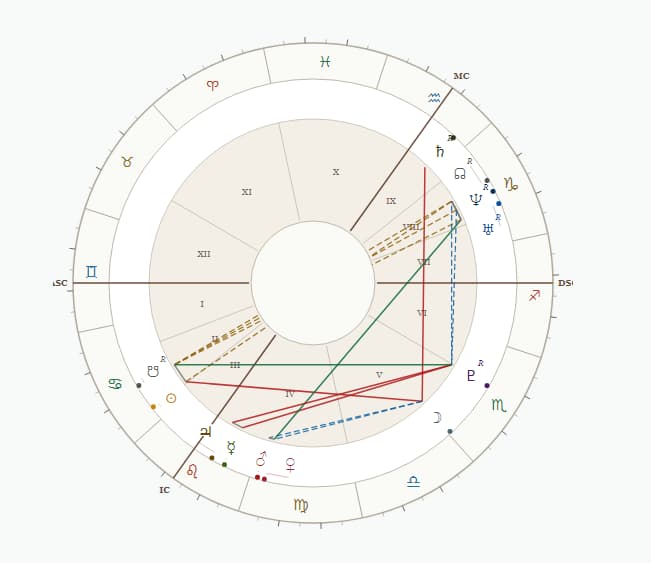
The 7th House is the house of committed partnership — marriage, long-term relationships, and significant one-on-one alliances. The sign on the Descendant (the 7th House cusp) describes the quality of partnership the person is oriented toward. The ruler of the 7th House — its condition, sign, and house placement — describes how that partnership tends to develop and what gets in its way.
A well-configured 7th House tells one story. An afflicted 7th tells another.
The ruler of the 7th House afflicted by malefic planets is the single clearest indicator of consistent difficulty in partnership — separation through divorce, or through the partner’s death, or through the specific pattern of choosing partners who cannot or will not stay. The ruler of the 7th in the 12th House specifically indicates separation: the partnership domain is ruled from the house of hidden things, of endings, of confinement. What is meant to be a public alliance retreats into concealment or dissolves entirely.
Malefic planets conjunct the Descendant — Saturn, Mars, Uranus, or Pluto sitting directly on the 7th House cusp — describe partnership as a place of difficulty, conflict, or sudden rupture. These are not small obstacles. They are structural features of how the person relates to committed partnership.
The Planets That Disrupt Relationships
Uranus: The Rupture Planet
Uranus is the planet of sudden change, of freedom, and of the refusal to be contained. In the 7th House or in hard aspect to Venus, it produces a person who genuinely wants closeness and just as genuinely cannot tolerate the constraints that closeness requires.
The pattern is consistent and, once you see it, unmistakable. The person falls in love with real intensity. The relationship begins with genuine excitement. Then, at some point — sometimes gradually, sometimes overnight — the sense of constraint becomes intolerable. The freedom that was temporarily suspended reasserts itself. The relationship ends, often suddenly, often without adequate explanation, because the Uranian impulse toward liberation does not produce adequate explanation. It simply leaves.
Uranus in the 7th House specifically indicates a parallel connection — a relationship outside the official structure — that may prove more durable than the legal union. The person is not built for conventional partnership. They are built for something less defined, more intermittent, more autonomous.
Venus–Uranus in hard aspect produces the specific quality of falling in love with people who are unavailable, unconventional, or transient — and a chronic difficulty sustaining interest once a relationship becomes stable and predictable. The excitement is real. The commitment, once the excitement fades, is not.
Saturn: The Fear That Prevents
Saturn in relationship to Venus or the 7th House produces a different problem than Uranus. Where Uranus breaks free, Saturn freezes. The person with Saturn heavily aspecting their relationship significators is not someone who leaves easily. They are someone who never fully arrives.
Saturn afflicting Venus describes a deep ambivalence about love — a longing for partnership combined with a structural fear of it. The person may delay committed relationships significantly, entering them later in life than their peers. When they do enter them, they bring a quality of heaviness that can be exhausting for partners: the need for control, the difficulty with vulnerability, the sense that love must be earned rather than simply received.
When Saturn is very strong in hard aspect to Venus, the person may choose partners who are emotionally unavailable, significantly older, or otherwise unable to provide the warmth that is being sought. The unconscious logic is that what cannot be fully given cannot be fully lost.
Saturn conjunct the Descendant describes partnership as a place of duty and obligation — a serious, often joyless institution that the person enters from a sense of necessity rather than genuine desire. The marriages tend to be functional, stable in structure, and emotionally cold.
Mars: The Conflict That Destroys
Mars in the 7th House or in hard aspect to the 7th House ruler produces partnerships that are genuinely passionate and genuinely combative — sometimes indistinguishably so. The person attracts partners who are strong, assertive, and confrontational. The relationship has force. It also has friction.
Mars in the 7th House afflicted describes the pattern of ending relationships through conflict — through the accumulation of clashes that eventually exceed what either party can absorb. The person does not intend to destroy their relationships. But Mars here brings a combativeness into partnership that, without conscious management, turns every close relationship into a battleground.
Mars from the 7th House in square to the Moon is worth noting specifically: this configuration describes the pattern of deceiving or being deceived in partnerships, of close alliances that carry a quality of betrayal.
Pluto: The Control That Suffocates
Pluto in hard aspect to Venus or the 7th House ruler describes an approach to love that is intense, consuming, and fundamentally about power. The person experiences love as transformation — which it is, at its best — but also as control, possession, and the terror of loss.
The pattern this produces in relationships is one of intensity followed by crisis. The initial connection is overwhelming. The investment is total. And because the investment is total, the fear of loss is equally total, which produces the controlling behavior that eventually drives the partner away. What Pluto fears most — abandonment, loss of power — it often creates through the very behaviors designed to prevent it.
Multiple Marriages: The Structural Indicators
Some charts are simply not built for one partnership across a lifetime. This is not a moral judgment. It is a structural description.
The classical indicators for multiple marriages include: a stellium in the 7th House; the Ascendant in a Mutable sign (Gemini, Virgo, Sagittarius, or Pisces); the majority of planets in the western hemisphere above the horizon, particularly in cadent houses; and malefic planets conjunct the Descendant.
Mutable Ascendants are particularly relevant here. The Mutable signs are built for adaptability, for movement, for the ability to change course when circumstances shift. This is genuinely valuable. In relationship terms, it can also describe someone for whom no single partnership fully contains the range of what they are. They outgrow relationships, or grow in directions their partners cannot follow, or simply find that the person they were when the relationship began is not the person they are five years later.
The Gemini Ascendant specifically can describe two significant partners, or two simultaneous connections, or the persistent sense that the person they are with is not quite the right one — that the right one is still out there.
What None of This Means
The configurations described above do not predict that a person will always be alone, or that their relationships will always fail, or that they are constitutionally incapable of love. They describe the specific obstacles — the architecture of difficulty — that this person is working with in the domain of partnership.
Uranus in the 7th does not mean you cannot commit. It means you need a kind of partnership that provides more freedom than conventional arrangements allow — and that until you find that, the conventional arrangements will keep ending in the same way.
Saturn on Venus does not mean you are incapable of warmth. It means the warmth is hard to access, buried under layers of self-protection that formed for good reasons, and that it becomes available when the protection is no longer necessary.
What I have found consistently in chart work is that the people who struggle most with relationships are not the people who care least. They are often the people who care most — whose investment is highest, whose vulnerability is greatest, and whose defenses against that vulnerability are correspondingly formidable.
The chart shows the obstacle. Understanding the obstacle is the first step toward doing something different with it.
You can calculate your natal chart — including your 7th House and its ruler — at AstroCore. If you want to understand what your chart specifically shows about partnership and why certain patterns keep repeating, a full natal chart reading addresses this directly.
Rowena Winslow is a professional astrologer and the author of the Astrology Made Easy series. Her practice covers natal chart interpretation, Solar Returns, and predictive astrology. astrocore.pro

Leave a Reply