

Yes. You can.
That’s the short answer — and I want to give it to you directly before anything else, because too many people assume that reading a birth chart is something that requires years of study before you can touch it. It doesn’t. You can begin today, with the chart in front of you, and understand more about yourself in an afternoon than most people learn in a lifetime of vague sun sign columns.
But here’s the honest part: yes, you can read your chart — and the depth available to you grows with the tools you bring to it. A birth chart is not a page you read once. It’s a language. You can learn enough of that language in a week to have genuine insight. You can spend years deepening it and still find new things.
What I want to do in this article is show you exactly where to start, what the chart actually contains, and how to build the kind of understanding that makes the chart genuinely useful — not just interesting.
What Your Birth Chart Actually Is
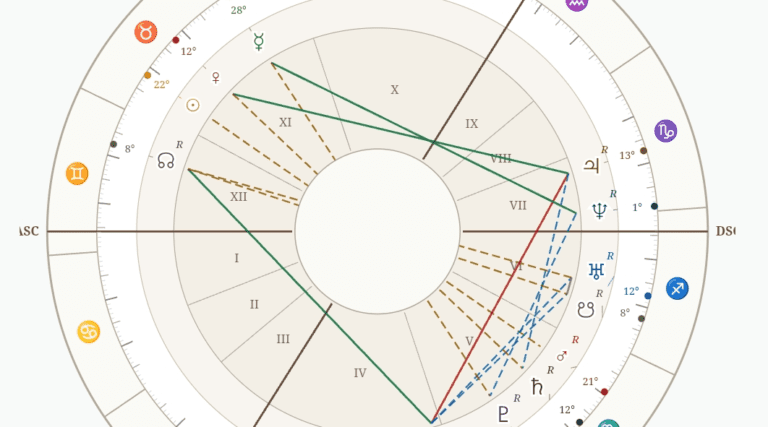
Your birth chart is a snapshot of the sky at the exact moment you were born — the precise positions of the Sun, Moon, and planets relative to the horizon at your birth location.
What makes it personal is the combination of three things: when you were born, where you were born, and the exact time. Change any one of those, and you get a different chart. The chart is yours alone — a map of the psychological patterns, natural talents, recurring challenges, and life themes that are uniquely yours.
The chart is divided into three layers that work together:
Signs — the twelve zodiac signs describe how energy expresses itself. Aries acts directly and boldly; Virgo acts carefully and analytically. The sign a planet occupies tells you the quality and style of that planet’s expression in your life.
Houses — the twelve houses describe where in life that energy plays out. The 7th House governs significant partnerships. The 10th House governs career and public standing. The 2nd House governs money, resources, and what you value. The house a planet occupies tells you which area of life is most directly shaped by that planet’s influence.
Planets — each of the ten planets represents a fundamental psychological function. The Sun is your conscious identity and central life direction. The Moon is your emotional life and instinctive responses. Venus governs love, beauty, and what you value. Mars governs drive, desire, and how you take action. Saturn governs discipline, limitation, and where you are asked to develop genuine mastery through effort.
Put these three layers together — sign, house, planet — and you have a precise picture. Mars in Aries in the 10th House is not the same as Mars in Libra in the 4th House. Same planet, entirely different story.
The Three Questions Every Placement Answers
When I read any placement in a birth chart, I’m always asking three questions simultaneously:
What planet is it? — What psychological function are we looking at? Is this about how you communicate (Mercury), how you love (Venus), how you assert yourself (Mars), where you feel called to grow (Jupiter), where life asks the most of you (Saturn)?
What sign is it in? — How does that function express itself? Is your Venus in Aries — direct, passionate, impatient in love? Or in Taurus — sensual, loyal, slower to commit but deeply devoted once committed? Or in Gemini — drawn to intellectual connection, needing variety, falling in love with minds?
What house is it in? — Where in your life does this energy play out? Venus in the 2nd House shapes your relationship with money and material comfort. Venus in the 7th House shapes your significant partnerships. Venus in the 12th House operates more privately — love that tends toward the hidden, the spiritual, or the self-sacrificing.
These three questions, applied to each placement in your chart, give you a genuinely specific picture of how you operate — in relationships, in work, in creative life, in the way you handle difficulty and the way you experience joy.
Where to Start: The Five Placements That Matter Most
A full birth chart contains dozens of placements. If you’re beginning, don’t try to read everything at once. Start here, in this order:
1. Your Sun sign and house
Your Sun is your central identity — the core of who you are consciously becoming throughout your life. Most people know their Sun sign; fewer know which house it falls in. The house is where that identity finds its primary expression. Sun in the 10th House: your identity is deeply connected to your career and public role. Sun in the 4th House: your sense of self is rooted in home, family, and private life. Sun in the 5th House: creative expression, play, and romantic life are central to who you are.
2. Your Moon sign and house
Your Moon describes your emotional life — how you feel, what you need to feel secure, how you instinctively respond before you have time to think. The Moon sign tells you the emotional style; the house tells you where emotional life is most active. Moon in the 7th House: emotional security comes through close relationships. Moon in the 2nd House: emotional security comes through material stability. Moon in the 12th House: emotional life is rich but often private, processed internally rather than expressed outwardly.
3. Your Ascendant (Rising sign)
The Ascendant is the degree of the zodiac rising on the eastern horizon at your birth time — and it requires an accurate birth time to calculate correctly. The Ascendant describes how you approach the world and how others experience you before they know you well. It’s the filter through which everything in the chart expresses itself outwardly. A Scorpio Ascendant with a Sagittarius Sun will present as more intense and private than the Sun sign alone suggests. A Gemini Ascendant with a Capricorn Sun will seem lighter and more communicative in first meetings than the underlying drive for structure and achievement.
4. Venus sign and house
Venus governs your love life, aesthetic sensibility, and what genuinely gives you pleasure. The sign describes your relational style; the house describes the arena where love and beauty are most active in your life. For understanding your pattern in relationships — why you’re drawn to certain people, what you need from a partner, where relational ease or difficulty comes from — Venus is the primary planet to understand.
5. Saturn sign and house
Saturn shows where life asks the most of you — the area of genuine difficulty, sustained effort, and, eventually, genuine mastery. People often resist their Saturn placement early in life. By midlife, those who have worked with it — rather than against it — often find it becomes their greatest strength. Saturn in the 3rd House: communication, writing, and learning required sustained development. Saturn in the 7th House: committed partnership required serious honest reckoning before it could flourish. Saturn in the 10th House: career success came through genuine long-term discipline rather than early ease.
These five placements — Sun, Moon, Ascendant, Venus, Saturn — give you a working picture of who you are, how you feel, how you present yourself, what you love, and where your deepest life work lies.
What You Need to Read Your Chart
Two things: your birth chart, and a reliable guide to what the placements mean.
Your birth chart requires your birth date, birth time, and birth location. The time is important — it determines your Ascendant and house cusps, which change significantly throughout the day. If you don’t know your exact birth time, check your birth certificate; many countries record it. If it’s genuinely unavailable, a chart can still be read for signs and general planetary positions, but the houses will be uncertain.
A free birth chart calculator is available at AstroCore — it generates a full natal chart with a complete aspect table, including aspects to house cusps that most standard calculators omit. Generate your chart there before going further.
A reliable guide is where most people get lost. The internet offers endless fragments — a paragraph here, a keyword list there — none of it structured in a way that builds genuine understanding. Reading sign descriptions and house descriptions in isolation, without understanding how they interact, produces a collection of disconnected observations rather than a coherent picture.
The approach I recommend — and the one I designed my own series around — is to learn the layers systematically rather than randomly.
How to Actually Build Chart-Reading Skill
The most common mistake beginners make is trying to memorize keywords for every placement before understanding the underlying logic. Keywords can be a starting point, but they produce a mechanical reading that misses everything the chart actually contains.
What produces genuine chart-reading skill is understanding the logic of each layer — why Aries expresses energy the way it does, what the 8th House is actually about, what Saturn’s function in the psyche actually is — and then applying that logic to each placement rather than looking up a pre-packaged answer.
This is the approach behind my two-volume series on natal chart interpretation.
Volume 1 — Zodiac Signs and Horoscope Houses begins exactly where a beginner needs to begin: with the stage before the actors. It covers what each zodiac sign reveals about personality and life expression, how each house connects to specific life areas — love, career, health, spirituality, money, creative expression — and includes practical sections on career orientation and health tendencies based on astrological indicators. This is the foundation without which the planets are difficult to interpret accurately.
Volume 2 — Planets and Aspects in the Birth Chart is where the chart comes alive as a story rather than a diagram. It covers every planet through all twelve houses — what it means when your Sun is in each house, when your Moon is in each house, when Venus, Mars, Jupiter, Saturn, and the outer planets each fall in specific areas of the chart. It also covers aspects — the angular relationships between planets that describe how different parts of your psyche interact, cooperate, or create friction.
Together, the two volumes give you a complete working system for reading any natal chart — your own, and anyone else’s.
What a Professional Reading Adds
Reading your own chart is genuinely valuable. I encourage it. The self-knowledge that comes from working carefully with your natal placements over time is the kind that doesn’t wash off.
And there is something a professional reading adds that self-study cannot fully replicate: the trained eye that has seen thousands of charts, that recognizes the specific way a particular combination of placements manifests in lived experience, and that can read the chart as a whole rather than as a collection of individual pieces.
When I read a chart professionally, I’m not reading each placement in isolation. I’m reading the relationships between placements — how your Saturn’s position modifies what your Moon is asking for, how your Venus-Neptune aspect shapes the specific way your 7th House manifests in actual relationships, how the timing of your current transits is activating natal patterns that have been waiting for precisely this window.
That integration is the difference between a list of accurate observations and a reading that feels like someone finally gave you the key to something you’ve been trying to understand about yourself for years.
If that’s what you’re looking for, professional natal chart readings are available at AstroCore.
The Answer, Again
Can you read your own birth chart?
Yes. Start with your chart generated at AstroCore. Learn the three layers — signs, houses, planets — in that order. Begin with your Sun, Moon, Ascendant, Venus, and Saturn. Use a guide that builds genuine understanding rather than keyword lists.
The chart is not a mystery that requires an expert to decode. It is a language — and like any language, it rewards genuine engagement. The more fluently you read it, the more it gives back.
Start today. The chart has been waiting.
Rowena Winslow is a professional astrologer and the author of the Astrology Made Easy series. Her practice covers natal chart interpretation, Solar Returns, and predictive astrology. astrocore.pro


Leave a Reply