

Author: Rowena Winslow Series: Astrology Made Easy: Solar Returns, Volume 2 Available on: Payhip | Amazon | Etsy
Volume 1 of the Solar Returns series covered the Sun, Moon, and Mercury — the planets most immediately tied to the year’s central focus, emotional landscape, and communicative activity. Volume 2 picks up exactly where it left off, covering the four remaining personal and social planets: Venus, Mars, Jupiter, and Saturn. Together, these two volumes give you a complete picture of every major personal planet in the Solar Return chart.
The structure is identical to Volume 1: each planet delineated through all twelve Solar Return houses, with favorable and challenging aspects for each placement, sign interpretations, and In Practice cases drawn from real client consultations. If you have been using Volume 1 at the chart table, this volume sits alongside it in exactly the same way.
See it in your own chart
Calculate your Solar Return free and see what your year ahead is built around. No sign-up.
Calculate My Solar ReturnWhat’s Inside
Venus Through All Twelve Solar Return Houses
Venus governs what makes life genuinely pleasurable — romantic and close relationships, aesthetic experience, financial comfort, social ease, and the capacity to appreciate what is genuinely good in daily life. In the Solar Return chart, its house position describes where the year’s genuine warmth, beauty, and enjoyment are most available and most personally significant.
Each of the twelve Venus house placements is given a full chapter covering the focus area and key question for the year, detailed manifestations of how the placement expresses in practical life, favorable and challenging aspect combinations, and an In Practice case from a real consultation.
A few examples of how individual house placements are treated: Venus in the First House describes a year of heightened personal attractiveness and social ease — but the In Practice case shows a client whose Venus in the First was squared by Saturn from the Fourth, producing a specific and recognizable pattern where the magnetism was real but an internal self-protective mechanism consistently undermined it. The case and the advice given — what to pay attention to, and why no remedial action was possible until the pattern became visible — demonstrate the kind of interpretive precision that distinguishes the book from standard reference material.
Venus in the Seventh House is treated as one of the most relationally favorable annual placements, and the In Practice case shows a client with Venus conjunct Jupiter in the Seventh who had been feeling strong romantic optimism — the reading confirming the chart’s genuine direction while providing measured advice about how to engage with it rather than either dismissing or overcommitting to what it appeared to promise.
Venus in the Tenth House receives particular attention for its professional implications — how personal warmth, aesthetic quality, and genuine likeability shape career outcomes in a way that pure competence alone does not. The In Practice case covers a client whose Venus in the Tenth was squared by Neptune from the First, producing a year in which professional opportunities appeared more favorable than they actually were — and the practical advice given for seeing through the idealized picture before committing to anything on its terms.
Venus in the Twelfth House — often misread as a diminished placement — is treated as a year in which genuine pleasures, significant relationships, and meaningful aesthetic experiences are private rather than public. The In Practice case for this placement (Venus in the Twelfth without major aspects) addresses specifically how unaspected Venus here operates without external interference, and why some of the most significant creative work a person does in their lifetime happens precisely in a year when no one is watching.
Mars Through All Twelve Solar Return Houses
Where Venus describes where the year’s genuine pleasures are available, Mars describes where the year’s genuine energy, initiative, and drive are concentrated. The Mars chapter covers physical vitality, assertiveness, competitive drive, and the specific challenges that arise when Mars energy is either over-expressed or insufficiently directed.
Each house placement is covered with the same depth as the Venus chapter: focus area, key question, detailed manifestations, favorable and challenging aspects, and In Practice cases. Mars aspects receive particular attention because Mars in challenging aspect — especially to Saturn or Pluto — describes specific friction patterns that, if understood, can be worked with consciously rather than simply experienced as unavoidable difficulty.
The In Practice case for Mars in the First House covers a client whose Mars trine Jupiter from the Fifth produced unusual physical and professional momentum — and the specific advice given about directing that energy toward initiatives requiring genuine personal visibility rather than simply increased effort. The case demonstrates how the same Mars energy produces very different results depending on whether it is pointed at something that requires you to be seen.
Jupiter Through All Twelve Solar Return Houses
Jupiter describes where the year’s genuine expansion is available — where opportunities arise more naturally, where confidence has real grounds, and where the investment of energy is most likely to compound. The Jupiter chapter is, in Winslow’s own description, often the most immediately encouraging placement in any Solar Return chart — but the delineations are careful to distinguish between genuine expansion and the overconfidence and overextension that Jupiter can produce when its aspects are challenging.
Each house placement covers what Jupiter genuinely opens up in that domain, what the favorable aspect combinations add, and — importantly — what the challenging combinations produce. Jupiter square or opposite Saturn, for example, describes a specific tension between genuine opportunity and genuine structural constraint that requires a different interpretive approach than Jupiter trine Sun. The sign placements for Jupiter are also covered, adding the layer of how Jupiter’s expansive energy is stylistically expressed in any given year.
Saturn Through All Twelve Solar Return Houses
Saturn is the most carefully and most extensively treated planet in this volume. In Winslow’s framing, Saturn’s house position requires the most honest reading of any planet in the Solar Return chart — because Saturn describes where the year’s genuine demands fall, and reading those demands as worse or better than they actually are produces poor preparation in either direction.
The Saturn chapter covers each of the twelve house placements with particular attention to the distinction between what Saturn genuinely requires — discipline, structural engagement, sustained effort — and what it does not require: catastrophising, avoidance, or treating difficulty as punishment rather than as development. The In Practice cases for Saturn are among the most psychologically detailed in the volume, showing how Winslow reads Saturn’s house position in the context of a real person’s circumstances and gives advice that is both practically specific and psychologically honest.
Favorable aspects to Saturn are covered with equal depth as challenging ones, because Saturn in favorable aspect — trine or sextile from Jupiter or the Sun, for example — describes a very different quality of year than Saturn in square or opposition. The difference between a Saturn year that is demanding and productive and one that is demanding and depleting lies largely in the aspect structure, and the chapter treats those differences with the precision they deserve.
The In Practice Cases
The In Practice sections throughout this volume are worth specific mention. They are drawn from real client consultations, and they function as demonstrations of interpretive method rather than illustrative anecdotes. Each case shows not just what the placement means in the abstract but how an experienced practitioner reads it in the context of a specific person’s life, what advice was given and why, and what actually happened.
The cases range across the full variety of life circumstances — romantic questions, professional decisions, health concerns, family transitions — and they consistently model the kind of reasoning that produces useful readings: neither over-deterministic (“this placement means X will happen”) nor so hedged as to be meaningless, but genuinely specific about what the chart suggests is most likely and what the person can do with that information.
Who This Book Is For
Anyone using Volume 1 who wants to complete the planetary picture. Volume 2 is designed as a direct companion — same format, same depth, same organization. The two volumes together cover every major personal and social planet in the Solar Return chart.
Practitioners who want a comprehensive reference for Venus, Mars, Jupiter, and Saturn in annual chart work. The aspect sections and In Practice cases are organized for professional consultation use, not just personal study.
Students who have a solid natal chart foundation and are developing Solar Return skills. The house-by-house structure and the consistent format make it straightforward to build interpretive fluency systematically.
The Complete Solar Returns Series
- Solar Returns Part 1 — Sun, Moon, Mercury; foundations, relocation, chart setup
- Solar Returns Part 2 — Venus, Mars, Jupiter, Saturn through all twelve houses (this book)
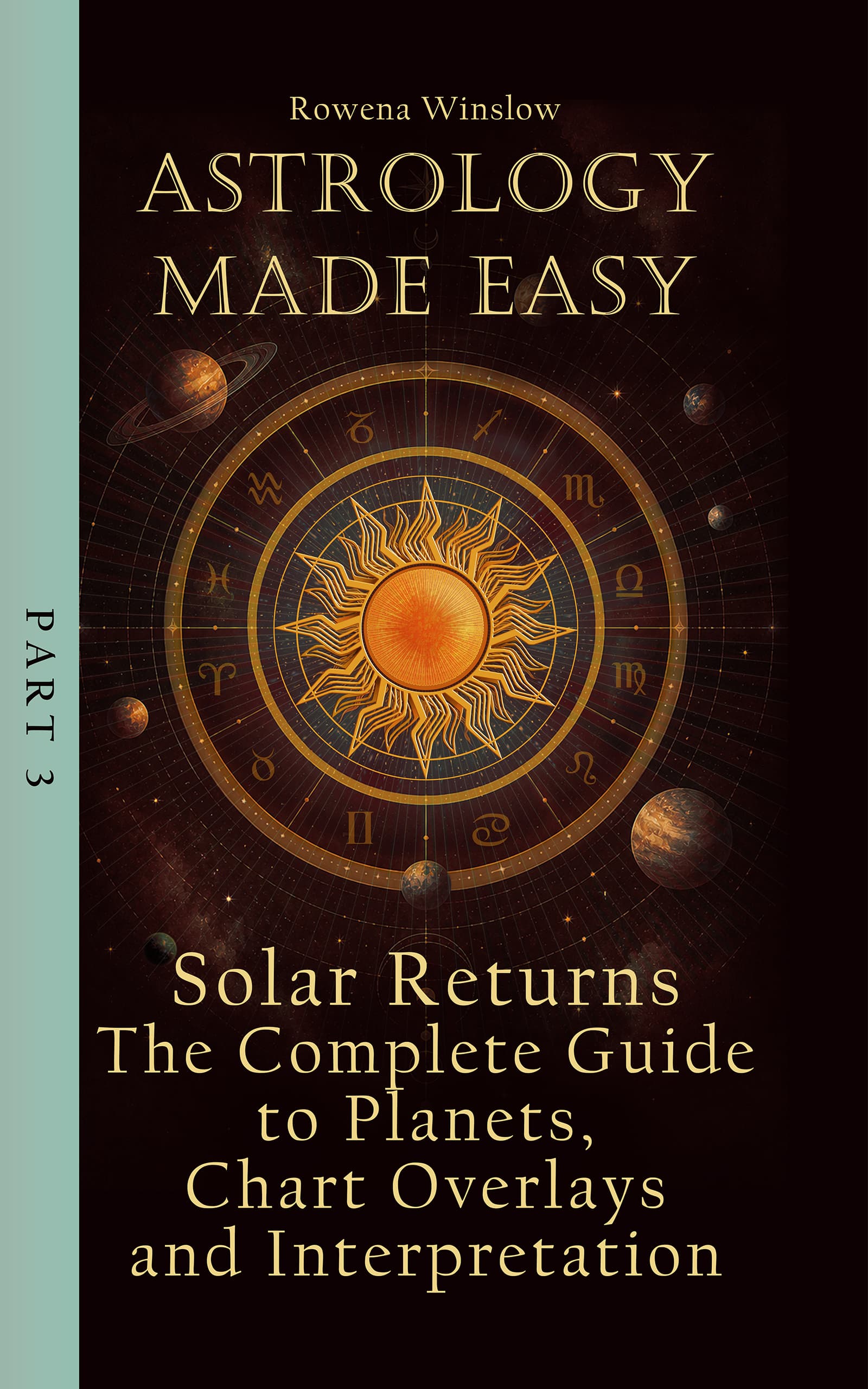
- Solar Returns Part 3 — Uranus, Neptune, Pluto; Solar Return Ascendant; retrograde planets; three natal chart overlay techniques; step-by-step reading algorithm


Also by Rowena Winslow
You can continue your study of astrology with the following volumes:
Natal Astrology
- Vol. 1 — Zodiac Signs and Horoscope Houses in the Birth Chart
- Vol. 2 — Planets & Aspects in the Birth Chart
Predictive Astrology
- Transits & Planetary Cycles, Part 1 — Sun, Moon, Mercury, Venus, Mars
- Transits & Planetary Cycles, Part 2 — Jupiter, Saturn, Uranus, Neptune, Pluto
Synastry
Solar Return Astrology
- Part 1 — Sun, Moon, Mercury
- Part 2 — Venus, Mars, Jupiter, Saturn
- Part 3 — Chart Overlays & Interpretation
Other Specialized Topics
Calculate your free Solar Return chart at AstroCore.pro — the dual chart format shows your Solar Return and natal chart together on a single wheel, which is how this book’s integration techniques are designed to be used.


Leave a Reply