
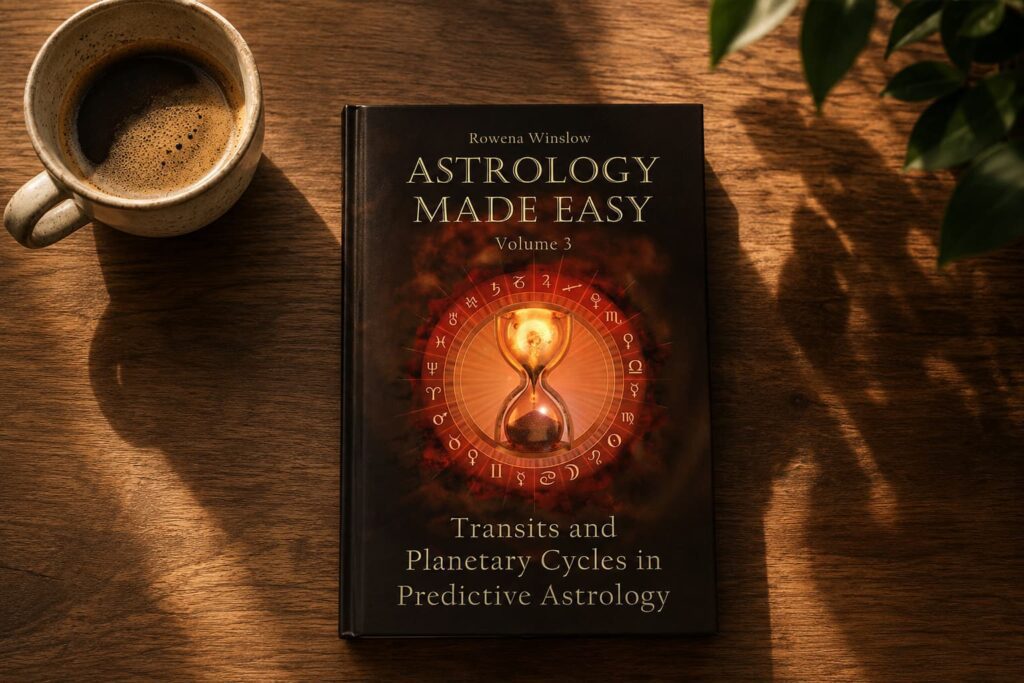
Author: Rowena Winslow Series: Astrology Made Easy, Volume 3 Available on: Payhip | Amazon | Etsy
Volumes 1 and 2 gave you the structure of the natal chart and the planets that fill it. Volume 3 answers the question that naturally follows: when? When will things shift? When is the right moment to act, to wait, to rebuild? When does the chart come alive in the real world?
Astrology Made Easy: Transits and Planetary Cycles in Predictive Astrology is the most practically oriented volume in the series — and for many readers, the one that makes everything finally click into place. It covers the full scope of planetary transits: what they are, how to read them, and how to use them to understand the timing of events, patterns, and turning points in your own life.
See it in your own chart
Calculate your current transits free — every planet activating your chart right now. No sign-up.
Check My TransitsWhat This Book Is Actually About
Predictive astrology is not fortune-telling. Winslow is clear about this from the opening pages. Transits don’t dictate what will happen — they describe when the conditions are ripe for certain kinds of change. Knowing that Saturn is squaring your natal Sun doesn’t tell you what to expect down to the detail, but it does tell you that a period of pressure, restructuring, and hard-earned growth is likely underway. That kind of awareness changes how you move through your life.
The book frames predictive astrology as timing — the ability to recognize where you are in your personal cycles, and to act accordingly. That framing runs through everything that follows.
What’s Inside
The Foundations of Transit Interpretation
Before any planet is covered individually, the book builds a solid conceptual base that most transit guides skip over or handle superficially.
What transits are and how they work — transiting planets interact with the fixed positions of natal planets to activate specific life themes. The book explains clearly why not every transit produces dramatic events, why some pass quietly, and what determines whether a transit’s influence is felt at all.
How to cast and read a transit chart — practical guidance on overlaying current planetary positions onto the natal chart, with an explanation of how to identify which life areas each transiting planet governs based on house rulership. This section is particularly useful: it explains that a transiting Mercury doesn’t just bring general communication themes — it activates the specific life areas Mercury rules in your natal chart. If Mercury rules your 2nd house, its transits connect to money and values; if it rules your 7th, relationships and legal matters come into focus.
Aspects and timing — a thorough section on how aspects work in predictive astrology: orb allowances by planet speed (1° for outer planets, 2° for faster ones), the difference between applying and separating aspects, trigger transits, and the triple-pass mechanism that occurs when a retrograde planet crosses the same natal point three times. This retrograde multi-pass section alone is one of the most useful explanations of why certain periods feel drawn-out or repeatedly activated.
Which planets matter most — a practical hierarchy: Jupiter and Saturn as the primary markers of long-term turning points; Sun, Moon, Mercury, Venus, and Mars as short-term activators of mood and daily experience; Uranus, Neptune, and Pluto as slow background forces that shape the environment in which personal decisions unfold. This hierarchy helps you know where to focus attention when reading a transit chart.
Ten Planets — Each Covered in Full Depth
The heart of the book is ten planet chapters, each structured consistently across four layers:
1. The nature and role of the transiting planet — its symbolism in predictive work, how its energy expresses depending on speed and aspect type, what favorable vs. challenging transits from this planet tend to produce, and practical guidance on how to work with its influence consciously.
2. The planet transiting through the signs — how the planet’s themes shift as it moves through each of the twelve zodiac signs. This section is particularly valuable for slower planets like Saturn, Jupiter, Uranus, Neptune, and Pluto, whose sign transits last months or years and shape collective as well as personal themes.
3. The planet transiting through the houses — how the planet’s energy manifests in each of the twelve houses of the natal chart, covering which life areas become activated and what to expect as the planet moves through each domain.
4. The planet in aspect to every natal planet — the full set of aspect interpretations: what happens when the transiting planet forms a conjunction, sextile, square, trine, or opposition with each natal planet in turn. This is the most detailed section of each chapter and the one most useful for real-time transit reading.
That means for every transiting planet, you have: interpretations for the transit through each sign (12), transit through each house (12), and transit aspects to each natal planet across all major aspect types. The coverage is genuinely comprehensive — this is a reference book as much as it is a study guide.
Retrograde Sections for Every Planet
One feature that sets this book apart from most transit guides is the dedicated retrograde section within each planet chapter. For every planet from Mercury through Pluto, the book covers:
- What the retrograde period means for that planet’s themes
- How retrograde changes the expression of the planet’s energy — more internalized, revisionary, and often delayed
- Practical guidance: what to do and what to avoid during each retrograde period
The Mercury retrograde section is notably thorough — not just the familiar practical warnings, but the deeper psychological patterns that emerge and how the triple-pass activation of a natal point during Mercury’s retrograde cycle affects timing.
The Saturn retrograde section covers the theme of structural reassessment in detail — including how to distinguish between a retrograde that calls for patience and one that signals a genuine need to change direction entirely.
Highlights by Planet
The Sun chapter is the most immediate — solar transits are the fastest, lasting days rather than weeks or months, and the section on the Sun moving through all twelve signs gives a clear picture of the shifting monthly atmosphere that applies directly to planning and timing.
The Moon chapter covers the fastest-moving transit of all. The Moon completes the zodiac in 28 days, so its transits are brief but emotionally immediate and surprisingly consistent. The section on the Moon transiting through each house is particularly useful for understanding why certain days reliably feel more draining or energizing — and how to plan accordingly.
The Jupiter chapter covers one of the most anticipated transit cycles. Jupiter’s roughly 12-year journey through the zodiac means it spends about a year in each house, and the house transit section is clear and specific about what each Jupiter passage tends to open up, expand, or bring into focus. The Jupiter return — transiting Jupiter conjunct natal Jupiter — is covered as a major reset point in the growth cycle.
The Saturn chapter is the most comprehensive in the book and arguably the most valuable. Saturn’s transits coincide more consistently than any other planet with major life restructuring — career changes, relationship transitions, health realities, shifts in responsibility and direction. The house passage section covers all twelve houses in depth. The aspect section is particularly detailed on the combinations most people actually experience: Saturn conjunct natal Venus, Saturn square natal Moon, Saturn opposite natal Sun. The Saturn return — occurring around ages 29 and 58 — is covered as the defining maturation transit of adult life.
The Uranus chapter addresses the planet most associated with sudden and unexpected change. Uranus transits tend to be visible and abrupt in a way that Neptune and Pluto are not — they produce events rather than just atmospheric shifts. The section on the Uranus opposition (transiting Uranus opposite natal Uranus, occurring around age 42) is covered as one of the major life-cycle transits that tends to trigger significant reassessment of direction and identity.
The Neptune chapter handles one of the most difficult planets to interpret in transit work. Neptune’s effects are subtle, cumulative, and often understood only in retrospect. The book covers its dissolving, idealizing, and sometimes disillusioning influence with nuance, and includes practical guidance on how to work consciously with Neptune transits — particularly important given that Neptune can make it genuinely difficult to see circumstances clearly while the transit is active.
The Pluto chapter covers the deepest and longest-lasting transit influence. Pluto’s aspects to natal planets can remain active for years, and its effects operate at the level of psychological transformation rather than surface events. The house passage section is particularly strong — each placement is covered in terms of the specific kind of power, depth, and often unavoidable confrontation that gets activated in that area of life.
Who This Book Is For
Readers who have worked through Volumes 1 and 2 and are ready to apply their knowledge to real-time chart reading. The book assumes familiarity with signs, houses, planets, and aspects — it builds on that foundation rather than re-explaining it.
Anyone who wants to understand why certain periods of their life felt the way they did. The transit framework makes past patterns legible in a way that is often genuinely revelatory — looking back at a difficult year through the lens of a Saturn transit or a Pluto aspect frequently produces clarity that years of reflection alone couldn’t provide.
Practicing astrologers who want a thorough and well-organized reference. The planet-in-house and planet-in-aspect sections are structured for direct consultation during a reading, not just for study.
Anyone interested in timing decisions more consciously — when to launch, consolidate, wait, or change course. The book doesn’t make those decisions for you, but it gives you the framework to ask the right questions at the right time.
Part of the Astrology Made Easy Series
- Volume 1 — Zodiac signs and horoscope houses
- Volume 2 — Planets and aspects in the birth chart
- Volume 3 — Transits and planetary cycles (this book)
- Solar Returns Parts 1, 2 & 3 — The complete guide to solar return planets and chart overlays (coming soon)
- Standalone — Astrology and career & money in the natal chart
To work with transits in real time, use the free transit calculator at AstroCore.pro — it generates a dual chart showing your natal positions and current planetary placements together, so you can apply what this book teaches directly to your own chart.



Leave a Reply