
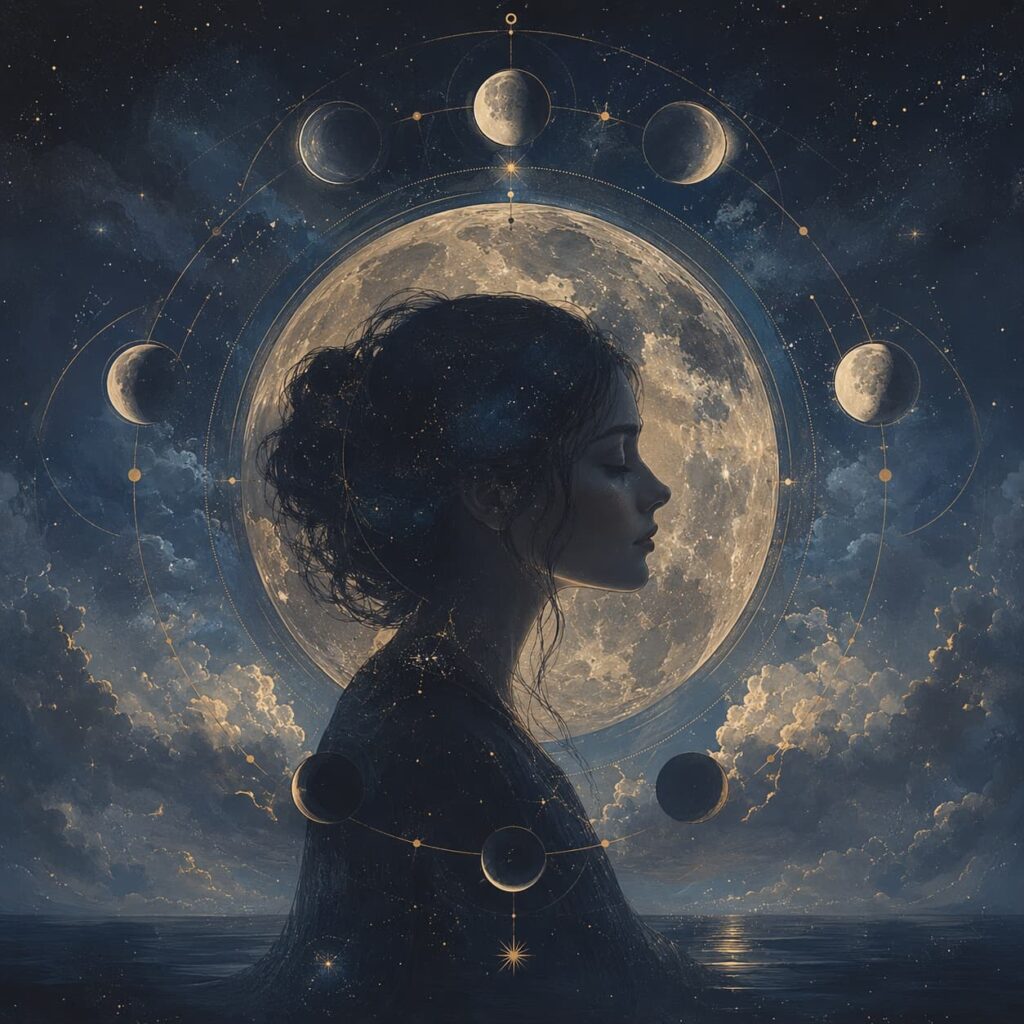
Most people know their Sun sign. Fewer know their Moon sign — and almost everyone who discovers it has the same reaction: this describes me more accurately than my Sun sign ever did.
That reaction makes sense. The Sun sign describes who you are becoming, the conscious identity you are developing across a lifetime. The Moon sign describes who you already are — at the most instinctive, unguarded level. It is the self that shows up when you are tired, when your defenses are down, when no one is watching.
Understanding your Moon sign is not a supplement to understanding your Sun sign. It is a different layer of the same person — and often the more revealing one.
What the Moon Represents in the Natal Chart
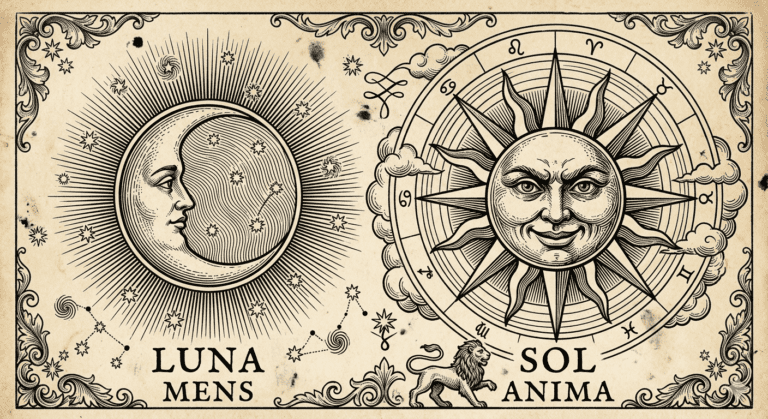
If the Sun is the steady flame of identity, the Moon is the ever-shifting tide of emotion.
In the natal chart, the Moon symbolizes the instinctive, reactive, emotional side of the personality — the part that feels, remembers, nurtures, and responds before rational thought has had time to intervene. It governs moods, emotional memory, intuition, the rhythms of daily life, and the deep, often unconscious patterns that shape how you respond to the world around you.
The Moon describes what you need to feel safe. Not what you want — what you need, at a level below conscious preference. It describes the emotional habits you slip into when you are not actively managing yourself. It describes your relationship to the past, to family, to the concept of home — wherever home lives for you.
It also describes your relationship to your mother, or to the maternal figure who shaped your earliest emotional experience. The Moon’s condition in the chart — its sign, its house, the aspects it makes to other planets — tells a great deal about that formative relationship and how it continues to echo through the emotional life in adulthood.
Unlike planets with clear reputations for being helpful or difficult, the Moon is neutral by nature. Its influence depends entirely on its placement: its sign, its house, and the aspects it makes. Sometimes it flows like water, smoothing everything it touches. Other times it stirs turbulence that must be carefully navigated.
Moon Sign vs. Sun Sign: Why Both Matter
The Sun sign and the Moon sign describe two genuinely different dimensions of the same person.
Your Sun sign describes your conscious identity — the qualities you are here to develop and express, the person you are actively becoming. It is the self that shows up in public, in professional life, in the role you have chosen to play.
Your Moon sign describes your emotional self — the instinctive responses, the private needs, the inner climate that shapes how you experience everything the Sun sign is trying to do. It is the self that shows up at home, in intimate relationships, in the quiet moments between public performances.
Two people with the same Sun sign but different Moon signs will experience the world in genuinely different ways. An Aries Sun with a Moon in Cancer is not the same person as an Aries Sun with a Moon in Sagittarius — even though both share the same conscious drive for initiative and forward movement. The Cancer Moon version carries that drive through a screen of emotional sensitivity, deep attachment, and the need for security. The Sagittarius Moon version carries it with philosophical optimism and a need for freedom that sometimes outpaces the emotional life entirely.
Reading both together — Sun and Moon, the outer and inner — gives a considerably more accurate picture of a person than either alone.
What Your Moon Sign Describes
Your emotional style. The sign your Moon occupies describes how you process and express feeling — the mode through which emotional life operates in you. Moon in Aries processes emotion through action and immediacy; Moon in Virgo processes it through analysis and precision; Moon in Pisces processes it through intuition and absorption.
What makes you feel secure. Each Moon sign has specific conditions under which it feels genuinely safe. Moon in Taurus needs physical comfort, sensory stability, and predictable routine. Moon in Gemini needs mental stimulation and variety. Moon in Scorpio needs depth, loyalty, and the sense that nothing is being hidden.
Your instinctive responses under pressure. When circumstances become demanding or threatening, the Moon sign shows how you respond before you have time to think. This is often the most revealing dimension of the Moon placement — not how you behave when life is easy, but how you behave when it is not.
Your relationship to the past and to home. The Moon governs memory, ancestry, and the concept of home — both physical and psychological. Its sign and house describe where you look for the sense of belonging, and what form that belonging takes.
The Moon Through All Twelve Signs
Moon in Aries
Emotions are raw, direct, and quick to ignite. These individuals feel everything immediately — joy, anger, excitement, frustration — and react before reflecting. Independence is essential; emotional control or manipulation is resisted fiercely. There is a hunger for intensity and vivid experience that routine quickly suffocates. At their best, they are pioneering emotional spirits who bring courage and directness to everything they feel.
Moon in Taurus
The Moon is exalted in Taurus — one of its most naturally supportive placements. Emotional steadiness, patience, and a deep need for physical comfort define this placement. Change is unsettling; what is familiar and dependable is genuinely soothing. Affection is quiet but enduring. Loyalty runs deep, and once trust is established, it rarely wavers. The shadow is emotional stubbornness — a resistance to necessary change in the name of comfort.
Moon in Gemini
Emotions are filtered through thought. These individuals process feelings by speaking or writing them — silence can feel stifling. There is a strong need for mental stimulation alongside emotional connection, and the emotional world is genuinely enriched by variety and novelty. Mood shifts come quickly and pass just as fast. At their best, gifted communicators and emotionally intelligent storytellers. The challenge is achieving the emotional depth that the quick-moving Gemini Moon can sometimes bypass.
Moon in Cancer
The Moon is in its home sign here, amplifying every dimension of its nature. Emotional depth, sensitivity, and intuitive power are pronounced. These individuals feel before they think, and their instincts about people and situations are often remarkably accurate. Family, home, and familiar ritual provide the essential security without which they feel unanchored. Their capacity for genuine nurturing is one of the most powerful in the zodiac — and their vulnerability to emotional wound requires equally powerful protection.
Moon in Leo
Warmth, generosity, and a hunger to be seen and appreciated define this placement. These individuals feel most alive when their emotions are mirrored by others — through love, affection, or genuine recognition. Their affection is bold and sincere, and they give with real enthusiasm. The shadow is the need for validation that, unchecked, can shade into emotional dramatics or the requirement for constant appreciation. At their best, they are genuinely warm, generous presences who uplift others simply by being fully themselves.
Moon in Virgo
Emotions are filtered through analysis and expressed through service. These individuals show care not through dramatic declaration but through the perfectly timed practical gesture — the thoughtful detail, the competently handled difficulty, the reliable presence when things need doing. Their inner life is more sensitive than their composed exterior suggests, and criticism cuts deeper than they show. The shadow is perfectionism and the tendency toward self-criticism that can become its own form of emotional difficulty.
Moon in Libra
Grace, diplomacy, and an acute need for emotional balance characterize this placement. These individuals are genuinely uncomfortable with conflict and instinctively seek harmony in every relational context. Their emotional world is shaped by ideals of fairness, beauty, and mutual respect. The shadow is the tendency to suppress authentic feeling in the service of maintaining relational peace — a pattern that can produce an accumulating emotional debt that eventually demands settlement.
Moon in Scorpio
The Moon is in its sign of fall here — not comfortable, but deep. Emotions are private, powerful, and rarely displayed openly. The composed exterior conceals a rich and often turbulent inner life. Trust must be genuinely earned; once betrayed, it is rarely fully restored. These individuals do not form attachments lightly, but their loyalty once given is fierce and enduring. At their best, they have a remarkable capacity for emotional transformation — the ability to confront crisis, loss, and pain without breaking.
Moon in Sagittarius
Emotional buoyancy, optimism, and a constant seeking of expansion through feeling define this placement. These individuals recover quickly from setbacks, are naturally enthusiastic, and experience their emotional life as part of a larger philosophical journey. Freedom — of thought, movement, and expression — is a genuine emotional need rather than a preference. The shadow is restlessness and the tendency to avoid emotional depth through perpetual motion and the search for the next horizon.
Moon in Capricorn
The Moon is in its sign of detriment here — working against its own grain. Emotions are held carefully, expressed rarely, and protected by considerable reserve. These individuals appear composed and self-sufficient; the vulnerability underneath is real but deeply guarded. They find emotional comfort through achievement, structure, and the sense of having earned their security through sustained effort. The shadow is the emotional loneliness that can accumulate when self-sufficiency becomes the default response to every relational need.
Moon in Aquarius
Friendly, socially engaged, and emotionally unconventional, these individuals value intellectual connection and shared ideals as much as — sometimes more than — emotional intimacy. There is a paradoxical quality: deeply loyal and genuinely caring, while simultaneously requiring considerable personal freedom and resisting the kind of emotional entanglement that others find natural. Their emotional world is enriched by ideas, causes, and the sense of belonging to something larger than the personal. The shadow is the detachment that can shade into emotional distance when closeness becomes threatening.
Moon in Pisces
Compassion, emotional sensitivity, and imaginative depth are pronounced. These individuals are genuinely empathic — they sense emotional undercurrents that others miss entirely, and they respond to distress with a care that does not require explanation. Their inner world is rich, often vivid with dreams and feeling, and their connection to creativity, spirituality, and the unseen is frequently significant. The shadow is the permeability that makes them susceptible to absorbing others’ emotional states as their own — a gift and a vulnerability in roughly equal measure.
The Moon’s House: Where Emotional Life Is Most Active
The Moon’s sign tells you how you feel. The Moon’s house tells you where emotional life is most concentrated in this lifetime.
Moon in the 1st House: emotion is expressed immediately and visibly — the emotional self and the public self are closely identified. Moon in the 4th House: emotional life is organized around home, family, and the private interior. Moon in the 7th House: emotional investment centers on significant partnership — the need for close relational mirroring is pronounced. Moon in the 10th House: emotional life is bound up with public standing and professional identity.
The house placement is one of the most practically specific dimensions of the Moon in a natal chart, and it requires your accurate birth time to determine reliably.
How to Find Your Moon Sign
The Moon moves through all twelve signs approximately every 28 days — spending roughly two and a half days in each sign. Because it moves this quickly, even people born on the same day can have different Moon signs if the Moon changed signs during that period.
To find your Moon sign accurately, you need your birth date, birth time, and birth location. The free natal chart calculator at AstroCore generates your complete chart with your Moon sign, Moon house, and all aspects the Moon makes to other planets — instantly.
For a complete reading of what your Moon sign and placement mean in the context of your full natal chart — including the house, the aspects, and how the Moon interacts with your Sun, Venus, and Saturn — professional natal chart readings are available at AstroCore.
And for the complete delineation of every Moon placement — through all twelve signs, all twelve houses, and all major aspects — Astrology Made Easy: A Comprehensive Guide to Planets and Aspects in the Birth Chart covers the Moon in full detail.
Rowena Winslow is the author of the Astrology Made Easy series, available on Amazon and Etsy. Free natal chart and Solar Return calculators are available at AstroCore.


Leave a Reply