
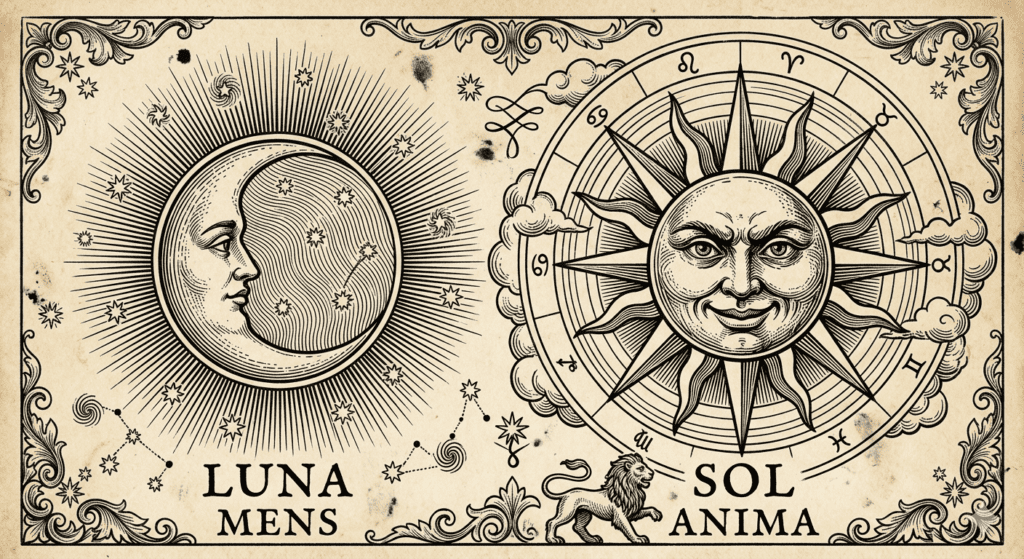
You know your Sun sign. Almost everyone does — it’s the sign people mean when they ask “what’s your sign?” at a party.
But at some point you’ve probably read your Sun sign description and thought: this is only partly me. Or you’ve met someone with your sign who felt nothing like you. Or someone told you about their Moon sign and suddenly something clicked that the Sun sign never quite explained.
That’s not a coincidence. The Sun sign and the Moon sign describe two genuinely different dimensions of who you are — and understanding both of them together gives you a far more accurate picture than either one alone.
See it in your own chart
Calculate your natal chart free — with a real interpretation of your Sun, Moon, and Ascendant. No sign-up.
Calculate My ChartWhat the Sun Sign Actually Describes
The Sun sign is determined by where the Sun was in the zodiac on the day you were born. It changes signs approximately every 30 days, which is why everyone born in roughly the same month shares a Sun sign.
In astrology, the Sun describes your conscious identity — the qualities you’re actively developing, the direction of your personal growth, the way you express yourself when you’re most deliberately and intentionally you. It’s the version of yourself you’re building over a lifetime.
It also describes your creative self-expression, your relationship to vitality and purpose, and the qualities you need to express in order to feel genuinely alive rather than just functional.
The Sun is who you’re becoming. It’s your direction of travel, your conscious self-image, and the energy you put forward most deliberately in the world.
What the Moon Sign Actually Describes
The Moon moves much faster than the Sun — it changes signs every two and a half days, which means the Moon sign is far more individually specific. Two people born in the same month but two weeks apart are likely to have different Moon signs entirely.
The Moon describes your emotional nature — how you feel, what you need to feel safe and nourished, how you instinctively react before the conscious mind has had time to weigh in. It’s the part of you that operates below the surface of the deliberate, purposeful Sun self.
Specifically, the Moon describes:
- Your emotional needs — what you genuinely require to feel secure, cared for, and at home
- Your instinctive reactions — the immediate, unfiltered response before you think about how you want to respond
- Your relationship to comfort and safety — what soothes you, what unsettles you, what you reach for when you’re stressed
- Your inner private self — the you that exists when no one is watching and nothing is being performed
The Moon is who you are when you’re not trying to be anything. It’s the emotional baseline, the instinctive self, the part that was formed earliest and runs deepest.
Why They Feel Different — and Sometimes Contradictory
Here’s where it gets interesting: the Sun and Moon are often in very different signs. And when they are, you genuinely experience both of those sign energies — sometimes in harmony, sometimes in tension.
A Capricorn Sun with a Pisces Moon is consciously ambitious, structured, and professionally driven (Capricorn Sun) — but emotionally sensitive, imaginative, and privately quite soft (Pisces Moon). The outer presentation is disciplined and capable. The inner life is dreamy and emotionally porous. These two dimensions of the same person can feel almost contradictory from the inside.
A Gemini Sun with a Scorpio Moon is intellectually curious, verbally quick, and socially adaptable on the surface (Gemini Sun) — but emotionally intense, psychologically probing, and privately suspicious of surface-level connection (Scorpio Moon). They can talk about everything lightly while privately needing depth.
A Leo Sun with a Virgo Moon wants to express themselves boldly and be seen (Leo Sun) but feels most emotionally comfortable when things are organized, analyzed, and under control (Virgo Moon). The desire for the spotlight coexists with a private inner critic who notices every flaw.
This is why “I’m a Gemini but I’m not particularly social” or “I’m a Scorpio but people think I’m friendly and easy-going” are such common experiences. The Sun sign is real — but so is everything else in the chart.
Which One Feels More Like “You”?
People vary enormously on this. Some people identify strongly with their Sun sign — the conscious qualities feel accurate and central. Others find their Moon sign is more immediately recognizable as “them” — particularly in private, in close relationships, or under stress.
A useful test: think about how you are with people you’re completely comfortable with, with your guard fully down, when nothing is being performed. That’s closer to Moon sign territory. Now think about how you present yourself when you’re deliberately engaged with the world — at work, in new situations, when you’re consciously bringing your best. That’s closer to Sun sign territory.
For many people, the Moon sign feels more instinctively true, while the Sun sign describes qualities they’re actively developing or growing into. This is actually consistent with how the two luminaries work: the Moon describes what’s already deeply formed; the Sun describes what’s being consciously developed. You might feel more naturally like your Moon sign while gradually becoming more like your Sun sign over the course of a lifetime.
The Sun-Moon Combination: Your Emotional and Conscious Self Together
The real richness comes from reading the two together — not as separate descriptions but as two dimensions of one person.
A few combinations to illustrate:
Aries Sun, Cancer Moon — consciously bold, direct, and self-initiating; emotionally sensitive, protective of family and close connections, and privately quite vulnerable. Can charge forward in the world with apparent confidence while privately needing far more reassurance and emotional safety than the Aries Sun would suggest.
Taurus Sun, Aquarius Moon — consciously steady, sensory, and stability-seeking; emotionally detached, independent, and in need of mental freedom. May look like someone who values routine and comfort while privately needing unusual amounts of intellectual and emotional space.
Virgo Sun, Sagittarius Moon — consciously analytical, precise, and service-oriented; emotionally expansive, philosophically curious, and in need of freedom and meaning. The careful Virgo outer self coexists with a restless, big-picture inner life that finds pure practicality emotionally unsatisfying.
Scorpio Sun, Libra Moon — consciously intense, strategic, and psychologically penetrating; emotionally oriented toward harmony, fairness, and relational balance. The powerful, probing Scorpio quality is emotionally moderated by a genuine need for peace and aesthetic comfort.
In each case, neither sign alone tells the full story. Both are genuinely present — operating simultaneously in different registers of the same person.
What About the Rising Sign?
The Rising sign — also called the Ascendant — adds a third layer. It’s determined by the sign rising on the eastern horizon at your exact moment of birth, and it changes every two hours.
If the Sun is who you’re becoming and the Moon is who you are privately, the Rising sign is how you appear to others — the quality of your presence, the first impression you make, the lens through which everything else in your chart is expressed to the world.
Some people are immediately recognizable as their Sun sign. Others are much more recognizable as their Ascendant — particularly to people who don’t know them well. The Ascendant is what people see before they know you; the Moon is what they find when they know you very well; the Sun is the thread that runs through your whole life’s development.
All three together — Sun, Moon, and Rising — give a genuinely multidimensional picture that a single sign description simply cannot provide.
“I Don’t Relate to My Sun Sign” — What’s Usually Going On
This is one of the most common things people say when they first look more carefully at astrology. And it almost always has a clear explanation in the full chart.
The most common reasons:
A very prominent Moon sign. If your Moon is in a sign very different from your Sun, and especially if the Moon is in an angular house (1st, 4th, 7th, or 10th), the Moon’s qualities may be more immediately visible — to you and to others — than the Sun’s.
An Ascendant that dominates first impressions. If your Ascendant is in a sign nothing like your Sun, people who meet you will instinctively describe you in Ascendant terms. “You don’t seem like a Leo at all” often means “your Ascendant is something quieter or more reserved.”
A stellium in another sign. If you have three or more planets in a sign other than your Sun sign, that sign’s energy may simply outweigh the Sun sign in terms of sheer emphasis.
The Sun in a weak house. The house the Sun occupies modifies how prominently its qualities are expressed. A Sun in the 12th house, for example, often produces someone who doesn’t strongly identify with their Sun sign’s more visible, expressive qualities — because the 12th house is private, internalized, and below the surface.
The short answer to “I don’t feel like my sign” is almost always: you’re not just your sign. You never were.
How to Find Your Moon Sign
To find your Moon sign, you need your birth date and ideally your birth time — because the Moon changes signs every two and a half days, and if you were born near a sign change, the time of birth determines which sign you have.
Your complete natal chart — including Sun sign, Moon sign, Rising sign, and all ten planets in their houses — is available for free at astrocore.pro. Enter your birth date, time, and location, and the chart shows you the complete picture rather than just one piece of it.
If you’d like to understand what your specific Sun-Moon combination means for you personally — and how all the pieces of your chart fit together — professional natal chart readings are available at astrocore.pro.
The Short Version
The Sun sign describes who you’re consciously becoming — your direction, your creative expression, your purposeful self.
The Moon sign describes who you already are at the emotional core — your instinctive reactions, your inner needs, your private self.
Neither is more “you” than the other. They’re both you — operating in different registers, describing different dimensions of the same person. And seeing both together, in the context of the full chart, is where astrology stops being general and starts being genuinely personal.
Rowena Winslow is a professional astrologer and the author of the Astrology Made Easy series. Her practice covers natal chart interpretation, Solar Returns, and predictive astrology. astrocore.pro


Leave a Reply