

Every astrologer hears this question eventually, usually from someone whose chart has just shown them something they didn’t want to see. If my chart depends on where I was born — can I move somewhere and get a better one?
It’s a fair question. And the honest answer is more interesting than a simple yes or no. So let me give you the real one, because relocation astrology is one of the most misunderstood corners of this field — oversold by some, dismissed by others, and rarely explained plainly.
What Never Changes
Your natal chart is a photograph of the sky at the moment you were born, taken from the exact place you were born. That moment happened once. It will never happen again, and no plane ticket can revise it.
This means the core of your chart travels with you everywhere:
Your planets stay in their signs. A Capricorn Sun is a Capricorn Sun in Kyiv, in Lisbon, in Buenos Aires. Your Moon keeps its sign, your Venus keeps its sign, all of it.
Your aspects stay exactly as they are. If your Mars squares your Saturn, that square is part of your psychological wiring. It came with you out of the delivery room and it boards every flight you ever take. The friction, the discipline forged from that friction, the temper you’ve learned to manage — none of that is geographical.
Your natal houses remain your natal houses. The chart of your birth is the base document of your life, and every serious astrologer reads it as such, no matter where you live now.
So no — you cannot escape your natal chart by moving. Whoever told you otherwise was selling something.
What Actually Changes
Here is where it gets interesting. While the chart itself is fixed, where its energies play out most loudly is not.
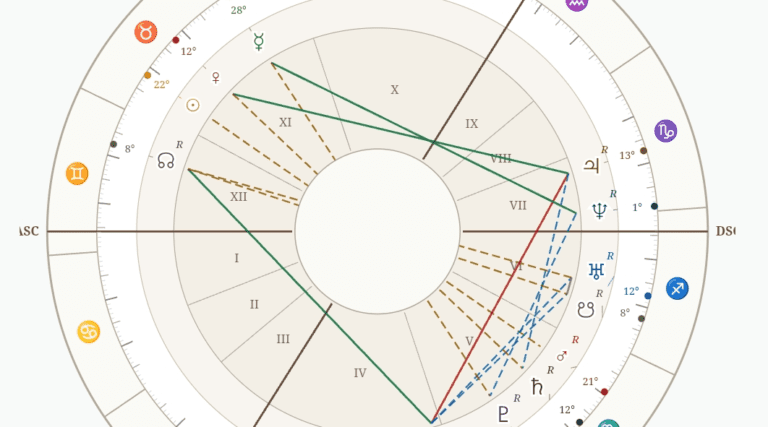
When you move to a new place, astrologers can calculate what’s called a relocated chart: the same birth moment, viewed from your new coordinates. The planets don’t move — but the houses do, because houses are calculated from the horizon, and the horizon depends on where you’re standing on the Earth.
In a relocated chart, the Ascendant, Midheaven, and all twelve house cusps shift. A planet that sat in your 10th house of career at birth might fall into your 9th or 11th house in the new location. A planet that was buried in the quiet 12th house might land directly on the Ascendant — suddenly front and center in how you experience life there.
This is the entire basis of astrocartography, the method developed by Jim Lewis in the 1970s. His observation was simple and, after decades of practice by working astrologers, well supported: people experience the same chart differently in different places. The chart doesn’t change. The emphasis changes.
What This Means in Practice
Say you have a difficult Saturn. At your birthplace, it sits right on your Midheaven — so its weight presses on your career, your reputation, your standing in the world. Every professional step feels like climbing with a loaded backpack.
Move far enough east or west, and in the relocated chart that same Saturn slides off the angle into a quieter house. The Saturn is still yours. The lessons it demands are still yours. But the environment stops amplifying it through your career at full volume. People who make such moves often describe it as the pressure becoming workable instead of crushing.
The reverse is also true — and this is the part people forget. You can move onto a hard line just as easily as off one. Plenty of people have relocated to a dream city and unknowingly parked their Ascendant on Pluto or their Midheaven under a Saturn beam, then spent years wondering why life there felt like a siege.
Two honest caveats before you start packing:
Distance matters. Moving to the next town over changes almost nothing — house cusps shift by a degree or two. Relocation effects become real when you cross significant longitude: a different country, a different continent. A move from Europe to North America rebuilds the house structure of the chart entirely.
The natal chart keeps speaking. Relocation shifts the stage, not the script. A Saturn in the natal 7th house describes something true about how you approach partnership, and that remains true in every city on Earth. What changes is how strongly your surroundings activate it. Think of relocation as turning the volume knob on different rooms of your chart — not as remodeling the house.
How to Calculate Your Relocated Chart — Free
Here is something most people don’t realize: you don’t need special software for this. Any proper natal chart calculator can build a relocated chart, including the free one on this site. The method is the classical one, and it takes two minutes.
Step 1. Take your birth date and time, and convert the time to what the clock showed in your new city at that same moment. This is just a time zone conversion. Example: you were born on 5 March 1990 at 14:00 in London. At that exact moment, clocks in New York showed 09:00 on the same date. (Search “time zone converter” if you don’t want to do the math — and watch the date, because big longitude jumps can roll it forward or back a day.)
Step 2. Enter that converted time into the natal chart calculator — with the new city as the location. In our example: 5 March 1990, 09:00, New York.
Step 3. Read the result. Your planets will be in the same signs and degrees as your natal chart — that’s how you know you did the conversion correctly. But the Ascendant, Midheaven, and house positions will be new. That is your relocated chart for that city.
See it in your own chart
Calculate your natal chart free — with a real interpretation of your Sun, Moon, and Ascendant. No sign-up.
Calculate My ChartRun it for your birthplace first, then for the city you’re curious about, and put the two side by side. Watch where planets change houses, and especially watch the angles: anything that lands within a few degrees of the relocated Ascendant or Midheaven will be a defining theme of your life in that place.
What to Look For When You Compare
A short field guide for reading the comparison:
Planets crossing onto angles. A planet conjunct the relocated Ascendant, Midheaven, Descendant, or IC becomes one of the loudest voices in your life there. Jupiter or Venus on an angle is the classic “lucky city” signature. Saturn or Pluto on an angle is a place that will demand something serious from you — not necessarily bad, but never light.
Planets changing houses. Your natal Sun moving from the 12th to the 1st house means a place where you become far more visible. Mars moving into the 6th points daily life and work toward friction — or toward productive drive, depending on its natal condition.
The new Midheaven ruler. Whichever planet rules the sign on the relocated Midheaven gets a promotion in that city’s version of your career story. Check its natal condition before you celebrate.
The Bottom Line
You cannot outrun your chart. The person who boards the plane is the person who lands. But you can choose the stage on which your chart performs — and for some configurations, that choice makes a genuine, measurable difference in how life feels day to day.
So the question was never really “can I escape my natal chart?” The better question is: which version of my chart’s expression do I want to live in? That one, astrology can actually answer.
If you’re weighing a serious move and want the relocated picture read properly — which placements will quiet down, which will get louder, and what the new angles will ask of you — that’s exactly the kind of question a personal reading is built for. Bring me the cities you’re considering, and we’ll look at what each one would do with the chart you already have.
Rowena Winslow is a professional astrologer and the author of the Astrology Made Easy series. Her practice covers natal chart interpretation, Solar Returns, and predictive astrology. astrocore.pro


Leave a Reply