

There is a difference between being alone and being lonely, and a further difference between circumstantial loneliness and the kind that persists regardless of circumstances. The person who is surrounded by people and still experiences profound isolation. The person who forms connections easily and finds none of them sustaining. The person whose relationships consistently disappoint in the same specific ways, leaving them more alone after the connection ends than before it began.
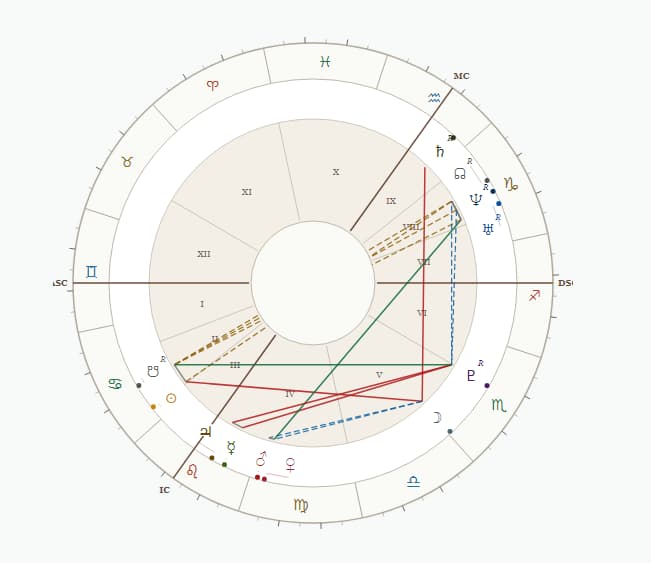
This is the loneliness the chart describes. Not the situation — but the structure.
See it in your own chart
Calculate your natal chart free — with a real interpretation of your Sun, Moon, and Ascendant. No sign-up.
Calculate My ChartThe 11th House: where belonging lives
The 11th House governs friendships, social connections, communities of shared interest, and the experience of belonging to something larger than oneself. A well-configured 11th House — with strong, unafflicted planets, a dignified ruler, and harmonious aspects from Jupiter or Venus — describes a person for whom genuine social connection comes relatively naturally. Friends arrive, stay, and contribute something real.
An afflicted 11th House tells a different story.
The 11th House ruler in the 12th House is one of the clearest isolation indicators in any chart. The house governing friendship is ruled from the house of hidden things, of self-undoing, of what operates beneath conscious awareness. What this produces in practice is the experience of connection that consistently retreats into concealment or disappointment — friendships that fade without clear cause, social connections that appear promising and then dissolve, the persistent sense that genuine belonging is always slightly out of reach.
Malefic planets conjunct the 11th House cusp with hard aspects to other malefic planets describe the specific quality of false friends — people who present as allies and operate as adversaries, whose betrayal shapes the person’s willingness to invest in connection going forward. Saturn here specifically warns of betrayal by those the person trusts most. Neptune here describes the covert enemy who operates under the guise of friendship — the person whose loyalty is a performance concealing something else entirely.
An empty 11th House with an afflicted ruler describes a person for whom the social sphere is simply not active — where the natural flow of connection and belonging is absent, and where what community the person builds requires sustained individual effort rather than arising naturally from who they are and where they are.
Saturn and the structure of emotional distance
Saturn is the primary planet of isolation. Not because it produces indifference — Saturn often produces the opposite, a longing for connection so deep it becomes its own obstacle — but because of what it does to the capacity for genuine contact.
Saturn in the 11th House afflicted describes a person whose friendships are colored by a quality of heaviness and obligation. The strong, unafflicted Saturn in the 11th produces loyal, enduring friendships with older, wiser, more serious people. The afflicted version produces something different: the slow accumulation of disappointments, the difficulty sustaining social connections over time, and the specific pattern of the person who works hard at friendship and finds the return consistently insufficient.
Moon–Saturn in hard aspect is the configuration most directly associated with emotional isolation. The classical text is specific: these aspects predict cold relationships with the opposite sex, with close women, and with the social environment generally. They increase psychological barriers, reduce the energy available for social engagement, and produce the tendency toward solitude and emotional withdrawal that makes genuine connection progressively more difficult to achieve.
The Moon–Saturn person does not withdraw because they prefer isolation. They withdraw because connection has been repeatedly experienced as unsafe or disappointing, and withdrawal is the learned response to that experience. The tragedy is that the withdrawal confirms the belief — each retreat produces the very isolation that the person then experiences as evidence that connection is not available to them.
Saturn on the Ascendant in hard aspect to the Moon is perhaps the loneliness configuration I encounter most consistently in chart work. The person is visibly defended — the Saturnian quality of self-containment and emotional control is evident to everyone they meet. What is not evident is how much warmth exists beneath the defense, and how genuinely painful the distance between that warmth and the person’s actual relational life tends to be.
Venus–Saturn: the loneliness of love
The 11th House governs friendship and community. Venus governs love, warmth, and the quality of all close relationships. When Venus is under significant Saturnian pressure, the loneliness is not social but intimate — the person may have friends, may function socially, and still experience a profound isolation within their closest relationships.
Venus–Saturn in hard aspect produces the specific quality of emotional coldness in love — not because the person is cold, but because the Saturnian structure prevents the warmth from expressing. The person longs for genuine intimacy and cannot access it, or accesses it briefly and finds it withdrawn, or chooses partners who provide the Saturnian quality of distance and withholding because that is what love has come to feel like.
The tradition also identifies in Venus–Saturn the specific pattern of attraction toward partners who are emotionally unavailable — older, colder, more controlled — and the tendency to remain in relationships that provide stability without genuine warmth because genuine warmth, being unfamiliar, does not register as love.
This is the loneliness of being in relationship and still being alone. It is, in my experience, one of the most pervasive and least discussed forms of human isolation.
Uranus: the loneliness of exceptionalism
Uranus in the 11th House produces a different kind of loneliness. The Uranian person in the 11th is not without connection — they may have many acquaintances, many social contexts, and genuine enthusiasm for people. What they lack is the experience of being genuinely understood.
Uranus in the 11th House describes a person who lives by their own rules, who values freedom and independence above all other things in the social sphere, and who demands from friendship an intellectual and spiritual quality that most people cannot provide. The connections that form are real — often deeply real. But they are also unstable, subject to the Uranian quality of sudden change, and perpetually insufficient in the specific way that no single person can be both the freedom Uranus requires and the sustained presence that genuine belonging involves.
This is the loneliness of the genuinely exceptional person — not exceptional in the narcissistic sense, but in the literal sense of someone who falls outside the range of ordinary experience in ways that make ordinary connection structurally limited. The Uranian in the 11th can describe themselves precisely. They simply cannot find many people who can understand the description.
Neptune and the loneliness of the porous self
Neptune’s contribution to loneliness is the least visible and in some ways the most complete. Where Saturn produces the defended self that cannot let connection in, Neptune produces the self that cannot hold its own shape long enough to be genuinely known.
Neptune in the 11th House afflicted describes the experience of false friendship — of connections that appear genuine and turn out to be exploitative, of the specific Neptunian pattern of mistaking someone’s projection for actual contact. The person is seen, but not seen accurately. They are connected to, but the connection is to a fantasy of who they are rather than to who they actually are.
The Neptunian loneliness is the loneliness of invisibility — of being in rooms full of people and having none of them quite see the person who is actually there. This is not shyness. It is a specific quality of the Neptunian presence that makes clear, direct self-presentation difficult and makes the kind of contact that would require it effectively unavailable.
What the structure actually requires
The loneliness configurations described above are not verdicts about a person’s ultimate capacity for connection. They are descriptions of the specific obstacles — the architecture of distance — that this person is working with.
The Moon–Saturn person needs to understand that their withdrawal is a learned response, not an accurate assessment of what is available. The Venus–Saturn person needs to recognize that the familiar quality of emotional coldness is not love — that warmth, when it finally arrives, will feel unfamiliar precisely because it is genuine. The Uranian in the 11th needs to accept that the depth of understanding they require from connection will never be fully met by any single person and can be met partially by many.
The chart does not promise that the loneliness will end. It describes what the loneliness is made of — which is the first step toward being able to work with it rather than simply endure it.
You can calculate your natal chart at AstroCore. If you want to understand what your specific chart shows about your relational patterns — including the configurations that produce isolation — a full natal chart reading addresses this directly.
Rowena Winslow is a professional astrologer and the author of the Astrology Made Easy series. Her practice covers natal chart interpretation, Solar Returns, and predictive astrology. astrocore.pro

Leave a Reply