

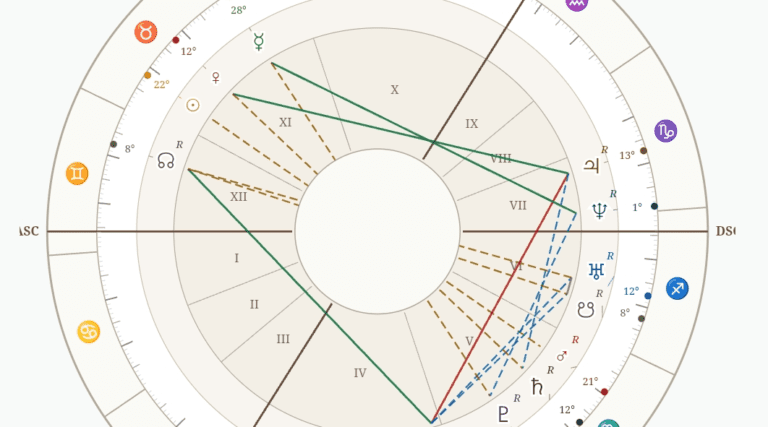
A relocated chart shows how your birth chart works in a different city — same birth moment, same planets, but with the houses and angles recalculated for a new place on the map. It’s the core tool of relocation astrology, and people pay good money for software and reports that produce one.
Here’s what almost nobody tells you: you don’t need any of that. Any honest natal chart calculator can build a relocated chart, including the free one on this site. The method is the classical one astrologers used long before astrocartography software existed, and it takes about two minutes once you’ve done it twice.
This is the full step-by-step. If you want the theory first — what relocation can and can’t change in a chart — read Can You Escape Your Natal Chart by Moving? and come back. This article is purely about the how.
What You Need
Three things, the same three a natal chart needs:
- Your birth date
- Your exact birth time — this matters even more here than in a natal chart, because the entire point of relocation is the houses, and houses are built from the birth time
- The city you want to relocate the chart to
No exact birth time means no reliable relocated chart. The angles move roughly one degree every four minutes, so “sometime in the morning” won’t do. If your time is approximate, treat everything below as approximate too.
The Method in One Sentence
Convert your birth time to what the clock showed in the new city at that same moment, then calculate a chart for that converted time in the new city.
That’s the entire trick. The moment of your birth was a single instant everywhere on Earth — it just had a different clock reading in every time zone. By entering the new city’s clock reading for your birth moment, you force the calculator to build the houses for the new location while keeping the planets exactly where they were.
Now the steps, slowly.
Step 1 — Convert Your Birth Time to the New City’s Clock
Take your birth date and time, and find out what time it was in the target city at that exact moment.
The lazy way (recommended): search “time zone converter with historical dates”, enter your birth date, time, and birthplace, and set the target city. The converter does everything, including the traps below.
The manual way: take the time zone difference between the two cities on your birth date and add or subtract it.
Example 1 — simple. Born 5 March 1990 at 14:00 in London. New York is 5 hours behind London in March. Relocated time: 09:00, 5 March 1990, New York.
Example 2 — the date rolls over. Born 10 June 1985 at 03:00 in Sydney. Los Angeles is 17 hours behind Sydney in June. Relocated time: 10:00 on 9 June 1985, Los Angeles. Yes, the date changes — your birth moment hadn’t reached June 10th yet in California. Big east-west jumps do this constantly, and entering the wrong date is the single most common relocation mistake. Always check the date, not just the hour.
Example 3 — daylight saving. Born 20 July 1992 at 11:30 in Berlin (summer time, UTC+2). New York in July runs daylight time too (UTC−4), so the difference is 6 hours, not the winter 7. Relocated time: 05:30, 20 July 1992, New York. Daylight saving rules differ by country and by decade — this is exactly why the historical time zone converter is the recommended route.
Step 2 — Enter the Converted Time Into the Calculator
Open the natal chart calculator and enter:
- Your real birth date — adjusted only if the conversion rolled it over, as in Example 2
- The converted time from Step 1
- The new city as the place of birth
It will feel wrong to type a city you weren’t born in. That’s the method working as intended.
See it in your own chart
Calculate your natal chart free — with a real interpretation of your Sun, Moon, and Ascendant. No sign-up.
Calculate My ChartStep 3 — Verify You Did It Right
This method has a built-in error check, and you should always use it.
Compare the planet positions in your relocated chart against your natal chart. They must match — same signs, same degrees, down to the decimal. The Sun, the Moon, everything. If even one planet sits at a different degree, your time conversion is off: most likely a daylight saving slip or a missed date rollover. Go back to Step 1.
When the planets match and only the Ascendant, Midheaven, and house cusps differ — you have a correct relocated chart.
Step 4 — Read the Comparison
Put the two charts side by side: natal on the left, relocated on the right. Work through this checklist:
The new Ascendant and its sign. This is how the new place “dresses” you — the register your personality broadcasts on there. A Capricorn rising person relocating onto a Leo Ascendant will be perceived very differently, even though they’re the same person.
Planets on the relocated angles. Anything within roughly 5 degrees of the new Ascendant, Midheaven, Descendant, or IC becomes a headline theme of life in that city. Venus or Jupiter on an angle is the classic favorable signature. Saturn, Mars, or Pluto on an angle marks a demanding place — sometimes formative, never light. This single check carries more weight than everything else on the list.
Planets that changed houses. Trace each planet from its natal house to its relocated house. A Sun moving from the 12th house to the 1st describes a city where you stop being invisible. A Moon moving into the 4th points life toward home, family, and roots. The planet’s nature stays the same — the arena changes.
The Midheaven ruler. Find the sign on the relocated Midheaven and the planet that rules it. That planet’s natal condition — its sign, house, and aspects — tells you what the career story in this city would be built on.
What left the angles. Just as important as what arrived. A harsh planet that was angular at birth and goes cadent in the relocation is a pressure being turned down — often the whole reason a particular city feels lighter.
Common Questions
Does a short move count? No. Moving within the same region shifts cusps by a degree or two — real relocation effects need serious longitude change. Across a continent or an ocean is where charts visibly rebuild.
Can I check several cities? Yes, and you should. Run the conversion for each candidate city and compare them against the natal chart and against each other. This is precisely how astrologers shortlist locations before a deeper astrocartography analysis.
Does the relocated chart replace my natal chart? Never. The natal chart remains the base document — the relocated chart only shows how a place redistributes its emphasis. Read them together or not at all.
What about transits and solar returns after I move? Transits are calculated to your natal positions and don’t care where you live. Solar returns are a different story — most working astrologers calculate them for the place you are at the moment of the return, which makes your location each birthday genuinely matter. That deserves its own article.
When the Calculator Has Done Its Job
The free comparison will show you what changes. What it can’t tell you is how much it matters for your particular chart — whether that Saturn arriving on the Descendant lands on an already-loaded natal theme or a quiet one, and whether the city you’re dreaming about supports the life you’re actually trying to build there.
If you’re choosing between real cities for a real move, that’s a question worth answering properly. A personal relocation reading compares your candidate cities against the full natal picture — bring me two or three, and I’ll tell you what each one would amplify, what it would quiet, and which one your chart would thank you for.
Rowena Winslow is a professional astrologer and the author of the Astrology Made Easy series. Her practice covers natal chart interpretation, Solar Returns, and predictive astrology. astrocore.pro


Leave a Reply