
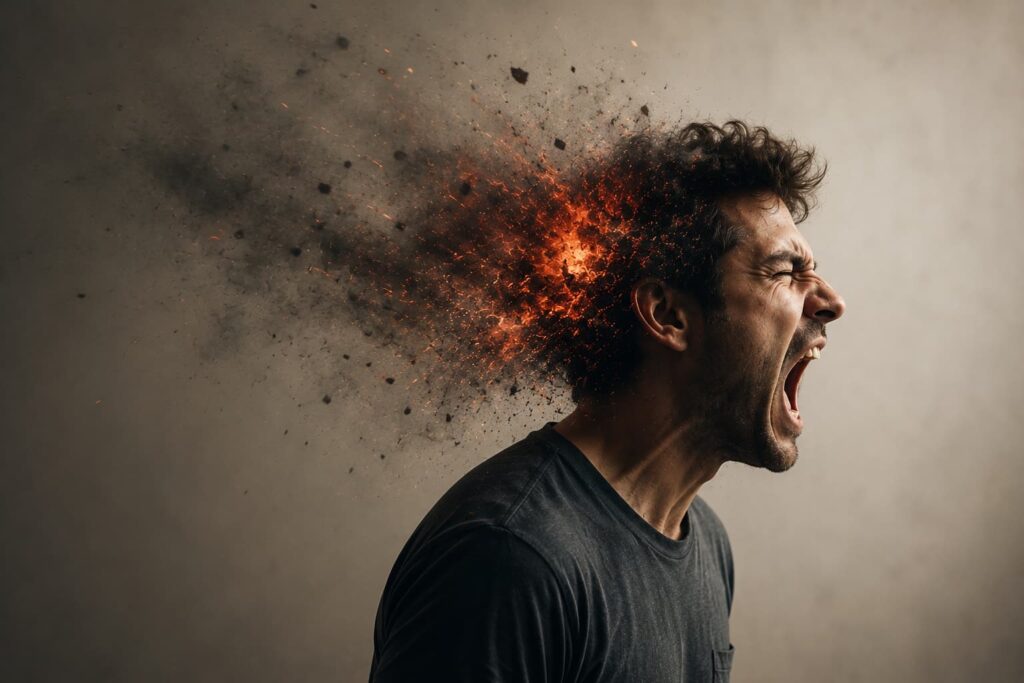
Anger is normal. Every chart carries it. What varies is the threshold — how much pressure is required before the response becomes disproportionate — and the quality of what happens when that threshold is crossed.
Rage is something different from anger. Rage is what happens when anger bypasses the processing stage entirely and goes directly to action. When the person cannot stop it, cannot modulate it, and sometimes cannot even fully remember it afterward. When the explosion leaves damage that the ordinary anger of ordinary people does not produce.
The chart describes this precisely. Who explodes, why, under what conditions, and — critically — what form the explosion takes.
See it in your own chart
Calculate your natal chart free — with a real interpretation of your Sun, Moon, and Ascendant. No sign-up.
Calculate My ChartThe primary aggression indicators
The tradition identifies the primary aggression indicators clearly: Mars, Pluto, and the Sun in the eastern part of the chart and above the horizon. The accentuated signs: Scorpio, Aries, Leo. The accentuated houses: the 8th, 1st, 5th, 10th. The key aspects: Mars–Sun, Mars–Pluto, Sun–Pluto, and the Ascendant in hard aspect to Mars, Pluto, or the Sun.
These are not indicators of aggression in the casual sense of assertiveness or ambition. They are indicators of the specific constitutional orientation toward force — the person for whom the response to obstruction is not patience or strategy but the immediate application of maximum energy.
Mars: the immediate explosion
Mars is the planet of pure, directed aggression — the drive toward action, toward conquest, toward the removal of whatever stands between the person and what they want. When Mars is strong and unafflicted, this produces courage, initiative, and the capacity for decisive action. When Mars is afflicted — under hard aspects from Saturn, Pluto, or Uranus, or in signs that amplify its combative quality — it produces the explosive temperament that the tradition describes with considerable precision.
Mars in Aries — its own sign — produces the most immediate and characteristic Martian explosion. The distinguishing features are unambiguous: impulsiveness, quick-temperedness, rapid irritability and excitability. This Mars does not accumulate pressure over time and then release it. It responds immediately, at full force, to whatever the triggering stimulus is. The reaction arrives before the thought. The regret, sometimes, arrives after.
The specific quality of the Aries Mars explosion: it is hot and fast and then genuinely over. These people do not nurse grievances in the Scorpionic sense. The anger burns at maximum intensity for a short time and then dissipates. The people around them find this unconvincing — the intensity was real — but the person has genuinely moved on.
Sun–Mars in hard aspect produces the most socially consequential rage in the chart. The tradition describes it specifically: due to their unbridledness and unpredictability, people with this configuration cause unrest and excitement in their surrounding world. The spirit of contradiction and confrontation is strongly present; ambition and aggression produce willful conflicts and a pull toward confrontation. Any obstacle or impediment drives these people out of composure, and then they lose self-control and become unmanageable. The consequences of such outbursts can be very grave. The impulsive actions turn boomerang.
This is the rage that ends careers, destroys relationships, and produces legal consequences — not because the person intended these outcomes, but because the Sun–Mars explosion is powerful enough, and public enough, that the fallout exceeds what the ordinary anger response produces.
Mars–Uranus: the unpredictable eruption
Mars–Uranus in hard aspect produces what might be the most dangerous explosive configuration in the chart — not because the anger itself is most intense, but because it is least predictable.
The combination produces willfulness, stubbornness, contrariness, excitability, irritability, impatience, sharpness, coarseness, tactlessness, mercilessness, eccentricity, and various spur-of-the-moment reckless impulses with a tendency toward acts of violence. Self-injury is a specific possibility.
What makes Mars–Uranus explosions particularly damaging is the Uranian quality of suddenness. There is no warning period. The threshold is irregular — the same stimulus that was tolerated yesterday is intolerable today. The person around a Mars–Uranus individual cannot calibrate what will trigger the response. The explosion comes from nowhere, at full force, and leaves the surrounding environment genuinely destabilized.
The fanatic and the rebel emerge from this configuration. The spirit of the revolutionary — the person who will overturn the existing order not because they have a plan for what comes after, but because the existing order has become intolerable and the tolerance for it simply ended.
Mars–Saturn: the accumulated explosion
Where Mars–Uranus produces the sudden eruption, Mars–Saturn in hard aspect produces the opposite: the explosion that has been accumulating for months or years before it finally breaks.
Saturn restricts and delays. When Saturn meets Mars, the natural Martian drive toward immediate action is blocked, suppressed, redirected — and the energy does not disappear. It accumulates behind the Saturnian structure, building pressure that the structure eventually cannot contain.
The tradition is direct: elevated lust for power, aggressiveness, cruelty, mercilessness, and ruthlessness can lead to acts of violence, destruction, or self-destruction. The release, when it comes, has a quality of totality that ordinary anger does not produce — because it is not one day’s anger but months of compressed Martian energy finding its outlet simultaneously.
The specific psychology this produces: the person who appears controlled, restrained, even cold — and who, under sufficient provocation, produces a response so disproportionate to the immediate trigger that the people around them cannot account for it. They are seeing the immediate trigger. The actual accumulated charge is invisible to them.
Moon–Mars: the emotional explosion
Moon–Mars in hard aspect produces a different quality of rage — less strategic than Mars–Saturn, less sudden than Mars–Uranus, but emotionally charged in a way that the other configurations are not.
The Moon governs the emotional life, the instinctive responses, and the baseline sense of safety. Mars in hard aspect to the Moon produces the person whose emotional reactions are rapid, intense, and frequently disproportionate — who does not merely feel frustrated but enraged, not merely disappointed but devastated, not merely inconvenienced but attacked.
The specific quality of Moon–Mars explosions: they are felt as entirely justified by the person having them. The emotional charge is real. The intensity is not performed. But the external trigger and the internal response are not proportionate, because what the person is responding to is not just the immediate situation but the accumulated emotional charge that the Moon carries from a long history of similar moments.
The 1st House and the Ascendant
Rage is not only about which planets are afflicted — it is about where the affliction lands in the chart. Planets in hard aspect to the Ascendant produce their effects in the most immediate, personal, and physically expressed domain.
Mars on the Ascendant in hard aspect to Saturn or Pluto is the configuration that produces the most immediately legible aggressive presence — the person whose physical bearing communicates potential for explosive response before anything has happened to trigger it. Others sense it. They calibrate their behavior around it. The person may not understand why people walk carefully around them.
What the chart shows about managing it
Every configuration described above has a constructive expression. The Mars–Uranus revolutionary can channel the willingness to overturn existing structures into genuine innovation. The Mars–Saturn person’s accumulated force, when it finds legitimate expression in sustained demanding work, produces extraordinary achievement. The Moon–Mars person’s emotional intensity, when it is acknowledged rather than suppressed, can produce genuine passion and real connection.
What the chart shows is the specific quality of the explosive energy — its source, its characteristic form, the conditions that release it. Understanding this is not the same as eliminating the anger. It is the prerequisite for doing something other than simply waiting for the next explosion.
The chart does not make rage inevitable. It shows where the pressure is building and what the pressure is made of — which is, consistently, more useful than discovering both things in the moment of the explosion itself.
See it in your own chart
Calculate your natal chart free — with a real interpretation of your Sun, Moon, and Ascendant. No sign-up.
Calculate My ChartRowena Winslow is a professional astrologer and the author of the Astrology Made Easy series. Her practice covers natal chart interpretation, Solar Returns, and predictive astrology. astrocore.pro

Leave a Reply