

The pattern is specific and recognizable: the person who gets close to something significant — a promotion, a relationship, a creative breakthrough — and then does something that undoes it. Not from stupidity. Not from bad luck. From some mechanism that operates below conscious awareness and that produces, reliably, the same outcome regardless of how intelligently the person approaches the situation.
This is self-sabotage. And the chart shows where it comes from with uncomfortable precision.
See it in your own chart
Calculate your natal chart free — with a real interpretation of your Sun, Moon, and Ascendant. No sign-up.
Calculate My ChartThe 12th House: where self-undoing lives
The 12th House is called, in the classical tradition, the true house of misfortune — but also the house of inner maturity. Its domain includes everything that operates below the threshold of conscious awareness: hidden enemies, secret fears, unconscious patterns, and the specific tendency toward self-undoing that expresses as behavior the person cannot fully account for.
The tradition describes the 12th House’s difficult expressions plainly: anxiety, disappointment, grief, self-abnegation, compulsion, powerlessness. And beneath all of these: the specific mechanism of the person who undermines what they have built, without clearly seeing the mechanism that is doing the undermining.
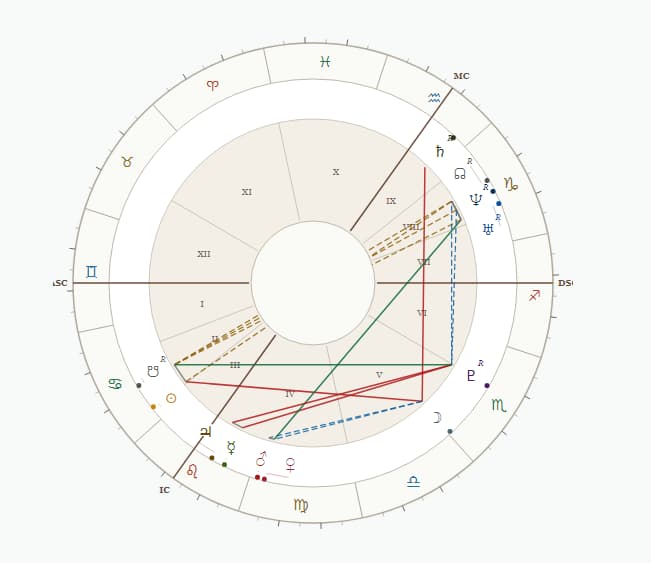
A stellium of malefic planets in the 12th House intensifies everything governed by that house: misfortunes, illnesses, limitations, obstacles, harmful conditions. When the stellium consists of Jupiter, Sun, Saturn, and the Moon simultaneously, the tradition notes something revealing: despite the apparent success these planets could indicate elsewhere, here they describe someone who carries a substantial load below the surface — material that has not been processed, that shapes decisions without the person’s awareness.
A malefic planet in the 12th House forming a square to Venus and Sun and an opposition to the Moon is specifically identified as indicating danger of suicide during a mental episode. This is the most extreme expression of 12th House self-undoing — but the same mechanism that, in extreme circumstances, produces that outcome produces, in ordinary circumstances, the chronic pattern of getting close to what matters and then destroying it.
The 12th House ruler and its chain
The ruler of the 12th House cusp governs the hidden enemies, the enviers, the slanderers and deceivers. The planet governing the next sign of the same elemental triplicity indicates loss of personal freedom and independence. The planet governing the third sign of the same triplicity indicates all manner of misfortune and chronic or incurable illness.
This chain matters for self-sabotage because it shows the mechanism: the 12th House ruler describes the saboteur — which is, almost always, an aspect of the person themselves that has been externalized or is operating below conscious awareness.
When the 12th House ruler falls in the 11th House and is unafflicted, the hidden enemies — including the internal saboteur — can eventually be neutralized and may even become allies. This is the specific indicator of potential for psychological work to actually shift the self-undoing pattern. When the 12th House ruler is severely afflicted and falls in a house associated with crisis (the 8th, the 6th, or the 12th itself), the self-undoing mechanism is more deeply embedded and more resistant to ordinary intervention.
Saturn in the 12th: the invisible restriction
Saturn in the 12th House in negative aspect to the Ascendant ruler, or in configurations involving the rulers of the 4th, 7th, and 12th Houses in hard aspect to each other, describes the specific Saturnian self-sabotage: the self-limiting belief that operates entirely outside conscious awareness.
This is the person who works hard and stops just before the finish line. Who builds something to a certain level and then, inexplicably, begins to undermine it. Who carries the specific Saturnian belief — installed before conscious memory and never subsequently examined — that a certain level of achievement, success, or happiness is not available to them. When they approach that level, the 12th House Saturn activates and begins the work of pulling them back to a more familiar position.
The tradition names the specific fears that 12th House Saturn produces: betrayal, treachery, covert machinations. False accusations. The hidden enemy. What the tradition is describing, at the psychological level, is the internalized critic — the voice that says “who do you think you are?” precisely when success is close enough to be real.
Neptune in the 12th: the self-deception that undoes
Neptune in the 12th House describes a psyche with a chronic leak — a place where the self escapes its own container, where what cannot be consciously held dissolves outward through mechanisms the person cannot see.
The Sun–Neptune negative aspects are described as indicators of unhappy fate. Despite the possibility of professional success, even high positions and genuine fame, these people are tormented throughout life by internal contradictions. They suffer from rapidly changing moods and feelings. Their heightened excitability and excessive sensitivity means they can penetrate the unconscious — but what they find there, the pictures painted by an unhealthy fantasy, they can mistake for reality. They often live inside a world of illusions, frequently creating a wall of mystery and darkness around themselves.
Applied to self-sabotage: Neptune in the 12th, or Sun–Neptune afflicted, produces the person who consistently misreads the situation in a direction that leads to self-undoing. They see threats that are not present. They trust people who are not trustworthy. They pursue paths that seem clearly promising and that turn out to be organized around an illusion rather than a reality. The Neptune mechanism does not feel like self-sabotage from the inside. It feels like genuine perception of genuine reality.
The Moon–Saturn pattern: I do not deserve this
The most pervasive self-sabotage mechanism in the chart — and the least obviously connected to the 12th House — is the Moon–Saturn configuration.
Moon–Saturn in hard aspect produces the soul dissatisfaction, the heightened egoism and self-interest, the elevated psychological barriers, and the reduction of energy in contacts with the surrounding world. These aspects are associated specifically with elevated self-limitation and reduced emotional connection to what is desired.
What this produces in practice: the person who gets close to what they genuinely want and then finds, at the moment of arrival, that they cannot receive it. The relationship that was clearly working and that the person undermined at the point of genuine intimacy. The professional achievement that arrived and that the person managed to turn into a problem. The Moon–Saturn person does not consciously sabotage these outcomes. They are operating from a foundational belief — established in early childhood and never subsequently revised — that what they most deeply want is not actually available to them. When the evidence contradicts this belief by actually delivering the desired outcome, the internal architecture produces the sabotage that restores the familiar condition.
Recognizing the pattern
The chart shows where the self-sabotage mechanism is operating — which planets, which houses, which configurations are generating the pattern. But the person inside the pattern typically cannot see it as a pattern. They experience each instance as a separate situation, separately explained. The relationship that ended was because of the specific partner. The career that stalled was because of the specific workplace. The creative project that collapsed was because of the specific circumstances.
What the chart shows is the common factor in all of these separate situations: the mechanism that was present each time, operating below conscious awareness, producing the same outcome through different circumstances.
Naming the mechanism is not the same as eliminating it. But it is the prerequisite. The question “is this my Moon–Saturn talking, or is this situation actually what it appears to be?” cannot be asked until the Moon–Saturn is visible as a mechanism rather than as an accurate assessment of reality.
The 12th House self-undoing is not a life sentence. It is a structural feature of the chart that, once identified, can be approached consciously rather than simply enacted repeatedly.
See it in your own chart
Calculate your natal chart free — with a real interpretation of your Sun, Moon, and Ascendant. No sign-up.
Calculate My ChartRowena Winslow is a professional astrologer and the author of the Astrology Made Easy series. Her practice covers natal chart interpretation, Solar Returns, and predictive astrology. astrocore.pro


Leave a Reply