
When people ask about astrology compatibility, they often start with sun signs: “Are Scorpio and Aquarius compatible?” or “Do Aries and Libra work?” These questions are real — but they are also incomplete. The answer depends on far more than two sun signs.
One of the most reliable and immediately useful frameworks for understanding compatibility is the elemental analysis — looking at which elements dominate each person’s chart, and how those elements interact. It is not the whole picture, but it is a genuinely illuminating starting point.
Here is how it works.
The Four Elements and What They Mean
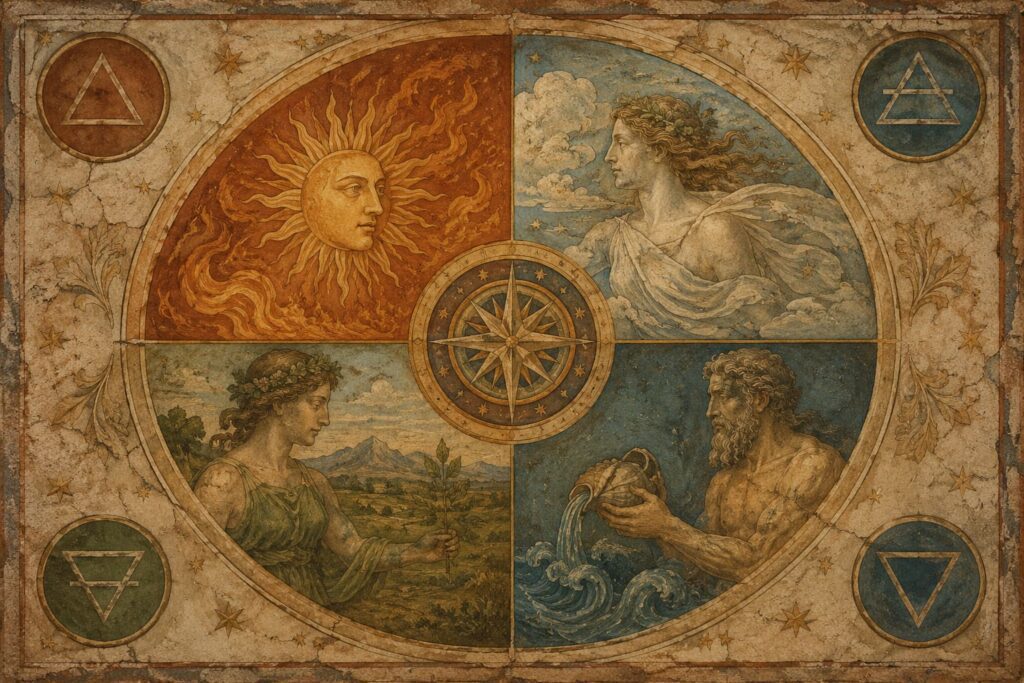
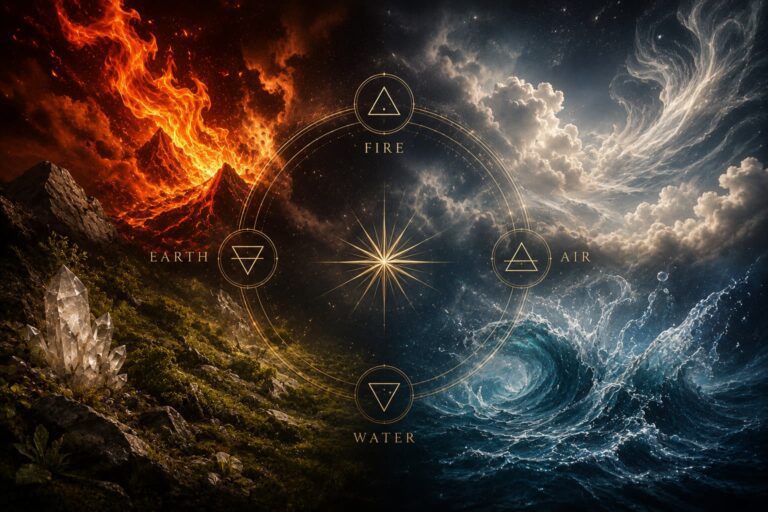
In Western astrology, the twelve zodiac signs are distributed equally across four elements — Fire, Earth, Air, and Water — with three signs belonging to each. The element of a sign describes its fundamental energy type: the quality of its animating force and the mode through which it engages with reality.
Fire Signs: Aries, Leo, Sagittarius
Fire is the element of spirit, will, and inspiration. Fire signs operate from inner certainty — they are oriented toward what could be rather than what is. At their best, they are luminous: generous with their energy, genuinely inspiring, and driven by a sense of purpose that others find infectious. Their shadow is impulsivity and a tendency to exhaust themselves and others with their intensity.
What distinguishes Fire signs is their relationship to meaning. They do not simply want to act — they want to act for something. Purpose is their fuel.
Earth Signs: Taurus, Virgo, Capricorn
Earth is the element of manifestation and endurance. Earth signs are the builders of the zodiac — they understand that ideas only become real through sustained, embodied effort. They are sensory beings: they trust what they can see, touch, measure, and demonstrate. Their relationship to time tends to be long; they think in terms of what lasts.
The genuine strength of Earth is the capacity to complete things. In a world full of grand intentions, that is rarer and more valuable than it sounds.
Air Signs: Gemini, Libra, Aquarius
Air is the element of mind and connection. Air signs live in the space between people and ideas — they are naturally drawn to exchange, synthesis, and the patterns that link apparently separate things. They are the communicators and connectors of the zodiac, genuinely gifted at seeing multiple perspectives simultaneously.
The shadow of Air is detachment — a tendency to intellectualize experience rather than feel it.
Water Signs: Cancer, Scorpio, Pisces
Water is the element of feeling and depth. Water signs experience the world primarily through emotional attunement — they pick up on undercurrents that other elements entirely miss. Their perceptual gift is empathy: a genuine capacity to feel with others, not merely about them.
The vulnerability here is boundary erosion. Water signs absorb the emotional environment around them, which can be an extraordinary asset and a genuine liability.
How the Elements Interact in Compatibility
The traditional elemental compatibility picture is based on which elements naturally support each other and which create friction. But — and this matters — friction is not the same as incompatibility. Some of the most growth-producing relationships involve elemental tension. What matters is whether both people can work with that tension consciously.
Fire and Air: Natural Affinity
Fire and Air feed each other. Air supplies the ideas and the intellectual stimulation that Fire needs to stay inspired; Fire brings the passion and the forward momentum that Air needs to actually move rather than simply think. This combination tends to produce relationships with genuine energy, good communication, and a quality of mutual enthusiasm.
The risk: both elements can lack groundedness. Fire-Air relationships sometimes struggle with practical follow-through, with the unglamorous work that sustains things over time. Neither element is naturally oriented toward consolidation and maintenance.
Earth and Water: Natural Affinity
Earth and Water nourish each other. Water brings the emotional depth, the sensitivity, and the intuitive intelligence that Earth often needs but does not easily access on its own; Earth provides the stability, the structure, and the practical grounding that Water needs to feel genuinely secure. This combination tends to produce relationships with genuine intimacy, practical reliability, and real staying power.
The risk: both elements can be risk-averse and resistant to change. Earth-Water relationships sometimes become too comfortable — maintaining what is familiar even when genuine growth requires genuine disruption.
Fire and Water: Productive Tension
Fire and Water do not naturally understand each other. Fire moves toward action and expansion; Water moves toward depth and emotional processing. Fire experiences Water’s emotional needs as slowing things down; Water experiences Fire’s forward momentum as emotionally dismissive.
But this combination, when both elements are working at their best, produces something neither alone can achieve: emotional depth combined with genuine vitality. The tension between them is real — and if both people are conscious enough to work with it rather than against it, it produces remarkable growth.
Earth and Air: Productive Tension
Earth and Air live in genuinely different realities. Earth trusts what can be demonstrated; Air trusts what can be conceptualized. Earth wants practical results; Air wants intellectual stimulation and variety.
At its worst, this combination produces mutual incomprehension. At its best, it produces a partnership where the grounded practicality of Earth and the intellectual range of Air balance each other in ways that neither could achieve independently.
Fire and Earth: Complementary Friction
Fire initiates; Earth sustains. Fire generates ideas and momentum; Earth builds on what Fire starts and makes it last. These elements need each other in practice — but they often frustrate each other in relationship. Fire finds Earth too slow and too cautious; Earth finds Fire too impulsive and too easily distracted from what has already been built.
Water and Air: Complementary Friction
Water operates through feeling; Air operates through thinking. These are genuinely different modes of processing reality, and they can produce significant misunderstanding. Water may experience Air as cold and emotionally unavailable; Air may experience Water as irrational and too emotionally demanding.
When it works — when both elements develop genuine respect for the other’s mode — this combination produces rare emotional-intellectual integration. But it requires more conscious effort than elementally compatible combinations.
How to Calculate Your Elemental Balance
Here is where most people make the key mistake: they check only their sun sign.
The sun sign is one placement. A complete natal chart contains ten planets, each in a sign, each contributing to the chart’s overall elemental balance. Two people can have the same sun sign but entirely different elemental distributions across their full charts.
To calculate your elemental balance accurately, you need your full natal chart — all ten planets with their signs — and then you count how many planets fall in each element.
For example: Sun in Scorpio (Water), Moon in Taurus (Earth), Mercury in Scorpio (Water), Venus in Libra (Air), Mars in Cancer (Water), Jupiter in Virgo (Earth), Saturn in Capricorn (Earth), Uranus in Sagittarius (Fire), Neptune in Capricorn (Earth), Pluto in Scorpio (Water).
Count: Fire 1, Earth 4, Air 1, Water 4. This is a primarily Earth-Water chart — deeply feeling, practically oriented, with relatively little natural Fire or Air energy.
A person with a primarily Fire-Air chart will experience the world in genuinely different ways and will have genuinely different needs in a relationship. That difference is not an obstacle — it is information.
Where to get your full chart: The free natal chart calculator at AstroCore generates a complete chart with all planetary positions. Once you have it, identify the sign each planet occupies, note its element using the table below, and count.
| Fire | Earth | Air | Water |
| Aries | Taurus | Gemini | Cancer |
| Leo | Virgo | Libra | Scorpio |
| Sagittarius | Capricorn | Aquarius | Pisces |
The Limits of Elemental Analysis
Elemental analysis is a genuinely useful starting point — and it is genuinely incomplete.
Several things it does not account for:
The Ascendant and house emphasis. The rising sign shapes personality and approach to life significantly. Two people with the same planetary elemental balance but different rising signs will express that balance differently and will experience relationships differently.
Aspects between planets. How the planets in a chart relate to each other — whether they support or create tension — modifies the elemental picture substantially. A heavily aspected Mars in a Fire sign operates very differently from an unaspected one.
Synastry — how two charts interact. True compatibility analysis requires looking at how one person’s planets fall in relation to the other person’s chart. A Venus-conjunct-Venus aspect between two charts is a very different quality of connection than a Venus-square-Saturn. The elemental analysis tells you about general tendencies; the synastry tells you about the specific relationship.
The natal chart’s overall story. Relationship patterns — what you attract, what you repeat, where you tend to struggle — are written in the natal chart itself, particularly in Venus, the 7th House and its ruler, and aspects to those points. Two people can be elementally compatible and still find themselves repeating old patterns if those natal indicators are not understood.
This is why elemental analysis is a beginning, not a conclusion.
What a Complete Compatibility Reading Actually Involves
In a professional compatibility reading, I am looking at both natal charts in full — their elemental balances, their relationship indicators, their individual patterns around love and partnership — and then the synastry: how the two charts speak to each other in specific detail.
Where does one person’s Venus fall in the other’s chart? What does the composite chart show about the relationship as its own entity? What do the current transits suggest about the timing and direction of this connection?
That complete picture is what makes a compatibility reading genuinely useful rather than merely entertaining. It is the difference between knowing that Fire and Water have inherent tension, and knowing specifically how that tension is likely to show up in this particular relationship — and what both people can do with that information.
If you want to understand what your natal chart actually shows about your relationship patterns — and how it interacts with a specific person’s chart — natal and synastry readings are available at AstroCore.
Your full natal chart, which is the foundation for everything above, can be generated free at AstroCore.
Rowena Winslow is the author of Astrology Made Easy: A Comprehensive Guide to Zodiac Signs and Horoscope Houses in the Birth Chart and the complete Astrology Made Easy series, available on Amazon and Etsy. Free natal chart and Solar Return calculators are available at AstroCore.

Leave a Reply