

Every year, on or near your birthday, something precise and measurable happens in the sky: the Sun returns to the exact degree, minute, and second it occupied at the moment you were born.
This is not a metaphor or an astrological abstraction. It is an astronomical even— calculable to the minute, repeatable every year, and the foundation of one of the most practically useful tools in predictive astrology.
The chart cast for that exact moment is called your Solar Return. And it describes, with remarkable specificity, the year ahead.
The Natal Chart vs. the Solar Return
Most people who have explored astrology are familiar with the natal chart — the birth chart cast for the moment you entered the world. The natal chart is the foundation. It describes who you are: your psychological architecture, your natural strengths and recurring challenges, the themes that will run through your entire life.
But the natal chart does not tell you what is happening right now. It does not explain why this particular year feels different from the last, or why a pattern that has been quiet for a decade is suddenly active again.
That is the work of predictive astrology. And among the predictive tools available, the Solar Return is one of the most self-contained and immediately useful.
Think of it this way: if the natal chart is the landscape of your life, the Solar Return is the weather forecast for a specific year. Same terrain — different conditions. And knowing the conditions makes an enormous practical difference in how you navigate them.
What the Solar Return Actually Describes
The Solar Return chart covers a twelve-month period — from the moment of this year’s return to the moment of the next one. Within that window, it describes several distinct things.
The year’s dominant theme. The house placement of the Solar Return Sun is the single most important indicator of where life’s primary focus will be concentrated. The Sun in the Solar Return 10th House points to a year in which career, public standing, and professional ambition are central. The Sun in the 4th House suggests a year oriented around home, family, and inner life. The Sun in the 7th House brings significant one-on-one relationships — romantic or professional — to the foreground.
The psychological climate. The Solar Return Ascendant — the degree rising on the eastern horizon at the exact moment of the return — describes the general tone and disposition with which you will approach the year. Unlike your natal Ascendant, which is fixed for life, the Solar Return Ascendant changes every year. A Solar Return Ascendant in Aries produces a year of initiative and forward movement. The same person with a Solar Return Ascendant in Virgo will experience a year of analysis, refinement, and careful attention to detail. These differences are real and noticeable.
Where support and pressure fall. The benefic planets — Jupiter and Venus — in strong Solar Return positions describe where you have natural ease, opportunity, and support during the year. The more demanding planets — Saturn and Mars — in prominent positions describe where friction, discipline, or pressure will require direct engagement. Knowing where both are concentrated is genuinely useful information.
The emotional tone. The Solar Return Moon describes the emotional climate of the year — where your feelings will be most active, what you will be most sensitive to, and where your deepest emotional investment will lie. Because the Moon moves quickly through the zodiac, it occupies a different sign and house in every Solar Return, making it one of the most personally specific indicators in the chart.
What the Solar Return Does Not Do
Understanding the limits of the Solar Return is as important as understanding what it offers.
It does not override the natal chart. The Solar Return activates what is already latent in your natal potential — it does not create conditions from nothing. A natal chart with no significant indicators for marriage will not produce a marriage simply because Venus is on the Solar Return Ascendant. The two charts must always be read together. The Solar Return describes what is being activated; the natal chart shows how that activation will express itself given who you are.
It does not predict events with certainty. The Solar Return describes themes, tendencies, and the psychological climate of the year — not a fixed script of what will happen. The same Solar Return configuration can manifest in different ways depending on the person’s circumstances, choices, and natal chart. A prominent 8th House Solar Return may correlate with a financial inheritance, a major psychological transformation, a partner’s resources coming into focus, or an intense encounter with mortality — or several of these at once. The chart identifies the theme; you navigate the specific expression.
It is one lens, not the whole picture. The Solar Return works best when read alongside current transits and, where applicable, secondary progressions. These three layers — the natal chart, the Solar Return, and ongoing transits — form a complete predictive picture.
The Location Factor — Something Most People Don’t Know
Here is a feature of the Solar Return that surprises people when they first encounter it: the chart is not cast for your place of birth. It is cast for wherever you actually are at the moment the Sun returns.
Because the chart is calculated for your location at the time of the return, the Ascendant and house cusps shift depending on where you are in the world. The planets are where they are regardless of location — but the frame, the house structure, changes with geography.
This creates a real and actionable variable. By being in a different location at the time of your Solar Return, you can shift key planets into more favorable houses— moving a Saturn from the 1st House into the 3rd, for example, or placing Venus directly on the Ascendant. This practice, known as Solar Return relocation, is a legitimate and increasingly studied dimension of Solar Return work.
It does not require exotic travel. Even a few hundred miles can shift the Ascendant into a different sign and meaningfully alter the chart’s emphasis. For those planning significant life decisions in the year ahead, this is worth understanding before the return date arrives.
How the Solar Return Works With Your Natal Chart
The most sophisticated — and most revealing — dimension of Solar Return interpretation is reading the two charts in dialogue with each other.
The technique is called the natal house overlay: identifying which Solar Return house contains the cusp of each natal house. That placement tells you through which area of life your natal themes will express themselves during the year.
If your natal 2nd House cusp falls in the Solar Return 7th House, the themes of the 2nd House — money, resources, material security — will manifest primarily through partnership and one-on-one relationships this year. Income through a business partner, financial matters entangled with a relationship, a significant contract that brings material gain or loss.
If your natal 5th House cusp falls in the Solar Return 10th House, creative projects or children become publicly visible. A creative pursuit gains professional recognition.
This overlay does not replace the standalone reading of the Solar Return chart — it deepens it. It is one of three advanced overlay techniques covered in full in Volume 3 of my Solar Return series, and it consistently produces the most specific and personally precise readings I do.
The Solar Return in Practice
I have been using the Solar Return as a primary predictive tool throughout my practice, and what consistently strikes me is how accurately it captures not just the external events of a year but the psychological climate — the quality of inner experience, the specific nature of the demands, the texture of what the year actually feels like from the inside.
A client once came to me in a year when her Solar Return showed Saturn in the 1st House opposite a cluster of planets in the 7th. She described the year as one in which every significant relationship in her life — personal and professional — was simultaneously under review. Not through drama, but through a relentless quality of honest reckoning with what each relationship actually was and whether it was genuinely worth sustaining. Saturn in the 1st opposite the 7th had named the year before it happened.
Another client had Jupiter in the Solar Return 2nd House trine Venus in the 6th. The year produced an unexpected financial windfall through work she had been doing quietly for years — a royalty payment, then a contract, then a second contract. Jupiter in the 2nd had pointed directly at the area where the year’s good fortune would fall.
The chart does not tell you what will happen. It tells you what the year is about, what territory you will be navigating, and where the landscape is most favorable and most demanding. That information, applied with intelligence and honesty, changes how you approach the year in front of you.
How to Get Your Solar Return Chart
To work with the Solar Return, you need the chart calculated accurately. This requires your birth date, birth time, and birth location — and the location where you will be (or intend to be) at the moment of this year’s return.
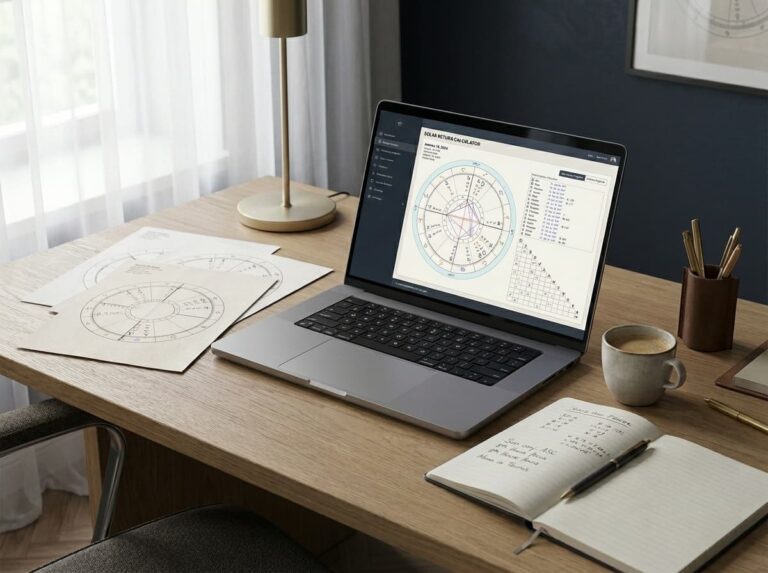
The free Solar Return calculator at AstroCore generates a dual chart that displays your Solar Return and natal chart together on a single wheel — making it immediately visible which Solar Return planets fall in which natal houses and where your natal house cusps land in the Solar Return chart. This dual format is the foundation of the overlay techniques and considerably simplifies the reading process.
Once you have the chart, the interpretation work begins. My three-volume series — Astrology Made Easy: Solar Returns — covers every planet through all twelve Solar Return houses, all three overlay techniques, and a complete step-by-step reading methodology. It is designed to take you from generating the chart to reading it with genuine confidence and depth.
If you want a complete Solar Return reading — with the natal chart integrated, the overlays applied, and the year’s timing mapped — professional readings are available at AstroCore.
The year ahead is already described in the chart. The question is whether you want to see what it says.
Rowena Winslow is the author of Astrology Made Easy: Solar Returns (three volumes) and the Astrology Made Easy natal chart series, available on Amazon and Etsy. Free Solar Return and natal chart calculators are available at AstroCore.


Leave a Reply