
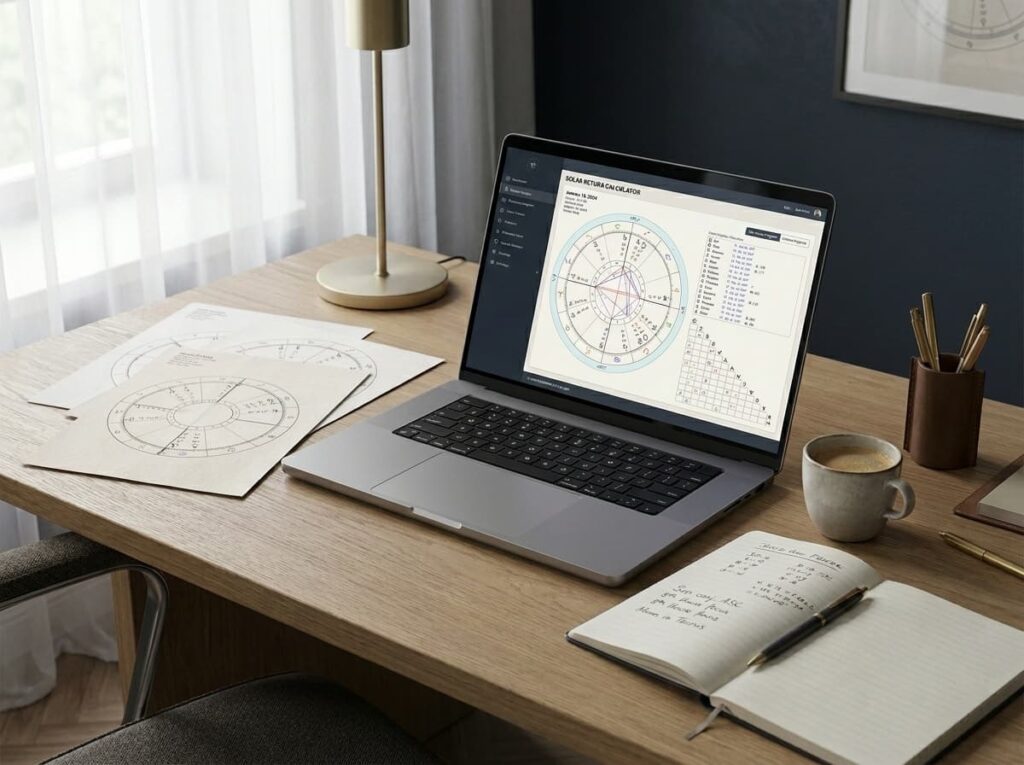
Calculating your Solar Return chart is simpler than most people expect — and considerably more precise than simply casting a chart for your birthday. This article walks you through exactly what you need, where to get it, and one feature of the Solar Return calculation that most people don’t know about: the location factor that makes your birthday trip an astrological decision.
What You Actually Need
To calculate an accurate Solar Return chart, you need three pieces of information.
1. Accurate birth data
Date, time, and place of birth. All three matter, but the birth time is the most critical. The Solar Return is calculated for the precise moment the transiting Sun returns to the exact degree, minute, and second it occupied at your birth. That precise degree comes from your birth time. An inaccurate birth time produces an inaccurate natal Sun position — and therefore an inaccurate Solar Return moment.
Even a difference of a few minutes in birth time can shift the Solar Return Ascendant into a different sign and change the house structure of the entire chart. If you are uncertain about your birth time, check your birth certificate. Many countries record it. If it is genuinely unavailable, the Solar Return can still be calculated and partially read — but the houses will be uncertain, and the Ascendant will not be reliable.
2. The year you want
The Solar Return is typically calculated for the current year — the return that has most recently occurred or is about to occur. But it can be calculated for any year, past or future. Looking back at a previous year’s Solar Return and comparing it to what actually happened is one of the best ways to develop confidence in the technique.
3. Your location at the time of the return
This is where most people are surprised: the Solar Return chart is not calculated for your place of birth. It is calculated for wherever you physically are at the exact moment the Sun returns to its natal degree.
This distinction matters enormously — and it opens up one of the most practically useful dimensions of Solar Return work, which I will cover in detail below.
See it in your own chart
Calculate your Solar Return free and see what your year ahead is built around. No sign-up.
Calculate My Solar ReturnThe Solar Return Is Not Your Birthday Chart
Before going further, one common misconception worth addressing: the Solar Return is not a chart cast for noon on your birthday, or for midnight, or for any fixed time.
The Sun completes one full circuit of the zodiac in approximately 365 days and 6 hours. Because the solar year is not an exact number of days, the Sun does not return to its natal position at the same clock time each year — the return moment shifts, and it may fall slightly before or after the calendar birthday depending on the year.
The Solar Return is calculated for the precise instant the transiting Sun reaches the same zodiacal degree, minute, and second it occupied at birth. This moment — sometimes called the astro-birthday — must be calculated, not assumed. A difference of even a few minutes produces a different chart.
This is why using a proper calculator matters. Estimating or approximating produces an unreliable chart.
How to Calculate It: The Free Calculator at AstroCore
The simplest and most direct way to calculate your Solar Return chart is the free calculator at AstroCore.
What makes the AstroCore calculator different from most online options: it generates a dual chart that displays your Solar Return and natal chart together on a single wheel. This matters because the Solar Return must always be read in dialogue with the natal chart — seeing both simultaneously, rather than switching between two separate charts, is how a working astrologer reads them in practice.
The dual chart format makes immediately visible which Solar Return planets fall in which natal houses, and where your natal house cusps land in the Solar Return chart. This is the foundation of the overlay interpretation techniques that produce the most precise and personally specific Solar Return readings.
To generate your chart: enter your birth date, time, and place, then select the Solar Return year and the location where you will be (or were) at the time of the return. The calculation takes two to three minutes — the dual chart format requires more processing than a standard single chart. The result is worth the wait.
Setting Up the Chart for Interpretation
Once you have the Solar Return chart, work through this sequence before beginning interpretation. This is the order I use in every professional reading.
Step 1: Identify the Solar Return Ascendant and note its sign. This is the year’s primary orientation — the mode you will operate in, the instinctive approach you bring to new situations. Note which sign rises and what that sign’s essential nature implies for the year ahead.
Step 2: Locate the Solar Return Sun and note its house. The house of the Solar Return Sun is the single most important indicator of the year’s dominant focus — the arena of life that will receive the most attention and conscious energy. This is the year’s central theme.
Step 3: Locate the Solar Return Moon and note its sign and house. The Solar Return Moon describes the emotional climate of the year and where feelings will be most active. It also serves as a timing device: advancing approximately one house per month through the year, it marks when each Solar Return theme is most likely to peak.
Step 4: Identify any angular planets. Scan the four angles — Ascendant, IC, Descendant, Midheaven — and note any planets within approximately five degrees. Angular planets carry the most immediate weight in the chart. They represent what cannot be ignored during the year ahead.
Step 5: Note any stelliums. If three or more planets cluster in a single house, mark that house as a zone of concentrated focus. The year’s attention will be drawn there consistently.
Step 6: Assess the hemisphere balance. Are most planets above or below the horizon? East or west? Above the horizon points to a more externally focused year — public, relational, visible. Below the horizon points to a more internally focused year — personal, private, developmental. East-heavy charts favor independent initiative; west-heavy charts favor relational engagement.
Step 7: Examine major aspects. Focus first on aspects involving the Solar Return Sun, Moon, and Ascendant ruler. Then note any particularly tight aspects — within two degrees of orb — between other planets. These describe how the year’s various themes interact and modify each other.
With these seven steps complete, you have a working foundation for interpretation.
The Location Factor: Your Birthday Trip Is an Astrological Decision
Here is the feature of Solar Return calculation that surprises people most: because the chart is cast for wherever you physically are at the moment of the return, traveling to a different location on your birthday changes the chart.
The planets’ positions in the sky remain the same regardless of where you are. What changes is the Ascendant and house cusps — which rotate with geography. Move a few hundred miles east or west, and the Ascendant shifts into a different sign. Move further, and the entire house structure reorganizes. A planet that falls in the Solar Return 12th House at home might fall in the 10th or 11th House in a city a few hours away.
This practice — deliberately choosing where to be at the time of the Solar Return — is called Solar Return relocation. It is not an astrological workaround. It is a direct and legitimate consequence of how the technique works.
When relocation is worth considering:
When a difficult planet falls angular in the home chart — particularly Saturn, Uranus, Neptune, or Pluto conjunct the Ascendant or in the 1st House — relocating to move that planet out of an angular position and into a cadent house (3rd, 6th, 9th, 12th) significantly reduces its most immediate and disruptive influence. The planet’s themes remain present in the year, but they are less insistently foregrounded.
When a beneficial planet is buried in a weak house — Jupiter in the 12th, for instance, is far less visibly productive than Jupiter in the 1st or 10th. Relocation that moves Jupiter into an angular position makes the year’s opportunities more accessible and more tangible.
When a specific area of life needs support — someone prioritizing career might seek a location that places Jupiter or the Solar Return Sun in the 10th House. Someone navigating a significant relationship year might look for a chart with Venus angular or the 7th House ruler well-placed.
How far do you need to travel?
At mid-latitudes (roughly 30°–55° north or south), the Ascendant moves approximately one sign every two hours of clock time — translating to roughly 400–600 miles of east-west travel to shift the Ascendant by one full sign. Smaller distances of 100–200 miles can still produce meaningful changes: shifting angular planets into adjacent houses, or moving the Ascendant degree far enough within its sign to alter which planets are angular.
You do not need to stay at the relocation point for the entire year. Being physically present at the chosen location at the moment of the return is what establishes the relocated chart. Arriving the day before and leaving the day after is practical; even a few hours at the location around the exact return time is technically sufficient.
One important caution: relocation is most genuinely useful when the home chart contains a concentrated or angular difficulty that exceeds what is practically manageable, and when a meaningful improvement is available within a reasonable travel distance. Attempting to relocate every year, or treating the chart as a problem to be engineered around, misses the point. Sometimes the year’s demands are worth engaging with rather than deflecting. A year with Saturn angular may be demanding — and it may produce the most lasting development of any recent year. The chart is a map, not a threat.
Checking Your Work: Common Calculation Errors
A few common mistakes to avoid when calculating the Solar Return:
Using an approximate birth time. If you are working with a rounded birth time — “around 3pm,” “in the evening” — the Solar Return Ascendant will be unreliable. A birth time accurate to within 5–10 minutes is needed for confident house placement.
Using the wrong location. The chart must be calculated for where you are (or will be) at the time of the return — not your birthplace, not your current home if you are traveling. If you will be in a different city during the return window, use that city.
Calculating for the wrong year. The Solar Return runs from return to return, not from January to December. If your birthday falls in August, this year’s Solar Return covers August to August — not January to December.
Assuming the return falls on the birthday. It usually does, but not always. The exact return moment may be a day earlier or later than the calendar birthday. Always use the calculated return time, not the birthday date.
After the Calculation: What Comes Next
Generating the chart is the beginning, not the end. The Solar Return yields genuine insight only when each element is interpreted accurately and in relationship to the natal chart.
The seven-step setup sequence above gives you the foundation. For a complete guide to interpreting every planet through all twelve Solar Return houses — with detailed delineations, aspect descriptions, and practical examples from real consultations — the three-volume Astrology Made Easy: Solar Returns series covers the full system from first principles to advanced overlay techniques.
If you want a fully worked reading — with the Solar Return chart calculated, the natal chart integrated, the overlay applied, and the year’s timing mapped — professional Solar Return readings are available at AstroCore.
Generate your chart at AstroCore and see what the year ahead is already saying.
Rowena Winslow is the author of Astrology Made Easy: Solar Returns (three volumes) and the Astrology Made Easy natal chart series, available on Amazon and Etsy. Free Solar Return and natal chart calculators are available at AstroCore.



Leave a Reply