

People ask me regularly whether they should bother with a professional reading when AI can generate a chart interpretation in thirty seconds for free. It is a fair question. And I want to answer it honestly, because the answer is not simply “yes, hire a human astrologer” — it is more specific than that.
AI chart readings are not bad. They are incomplete in a particular way. And whether that incompleteness matters depends entirely on what you actually need.
A chart is not a list of placements
Here is the core problem. Every AI tool I have seen reads a chart the same way: it identifies your placements — Sun in Scorpio, Moon in Gemini, Saturn in the 7th House — and retrieves the description for each one. Then it presents them sequentially, sometimes with a connecting sentence or two.
This produces output that sounds like astrology. It uses the vocabulary correctly. Some of it will resonate.
But a chart is not a list of placements. It is a system, and its meaning comes from the relationships between the parts — not the parts themselves.
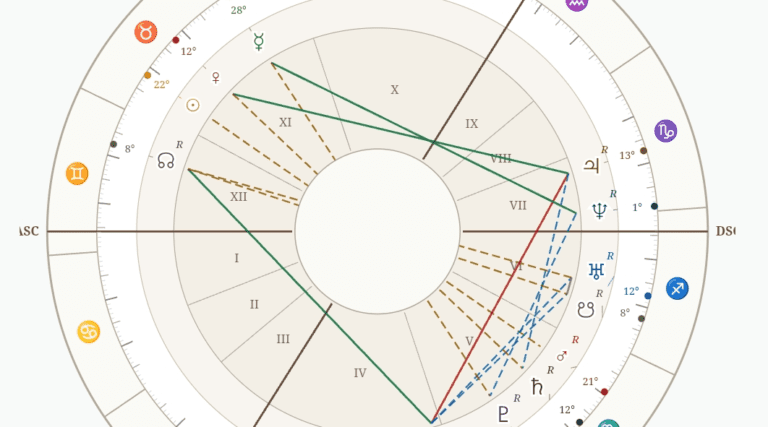
The Saturn in the 7th House of someone whose Saturn also rules their Ascendant, sits in exact conjunction with their Moon, and receives a square from Pluto is a completely different Saturn than the same placement in a chart where Saturn is unaspected and rules nothing of significance. Same house, same planet. Completely different life. AI cannot tell the difference because making that distinction requires holding the entire chart in view simultaneously — not processing elements one at a time.
The things that actually require a human
Knowing what matters. The most important skill in reading a chart is not knowing what placements mean. It is knowing which ones matter most in this particular chart, and why. Some configurations are doing the heavy lifting — defining the life, shaping every major pattern. Others are background detail. AI assigns roughly equal weight to everything it identifies. I immediately know what is loud and what is not. That difference is not a refinement. It is the difference between a reading and a list.
Following the chains. Real chart work moves through planetary rulerships — the connections between houses created by the fact that each house is governed by a specific planet, which is itself sitting somewhere, doing something, aspecting something else. A Capricorn Descendant with Saturn in the 3rd House describes a completely different relationship life than the same Descendant with Saturn in the 9th. AI stops at the Descendant sign. I follow Saturn to wherever it actually lives and read what it is doing there.
Recognizing what repeats. The most reliable signal in any chart is when the same theme appears through multiple independent configurations. A person with Moon–Saturn in hard aspect, Saturn ruling the 4th House, and the 4th House ruler afflicted is not simply someone with “Saturn themes.” They are someone whose relationship to heaviness, limitation, and authority runs as a structural thread through the entire life — not a single note but a chord that plays through everything. Identifying that requires reading the whole chart at once. AI reads the parts.
Knowing what the person came to ask about is not always the right question. People arrive with questions about money, career, relationships. These are reasonable questions. They are often not what the chart is most urgently pointing to. Part of what twenty years of chart work gives you is the ability to recognize when what you are being asked and what the chart is saying are two different things — and the willingness to say so.
What experience actually gives you
I have read thousands of charts. Not as training data — as real people, with lives and outcomes I sometimes heard about later. That accumulation does not give me a larger library of descriptions. It gives me something closer to what a surgeon has after a thousand operations: not just theoretical knowledge of the procedure, but direct knowledge of what it actually looks like in practice — the variations, the surprises, the ways a textbook case differs from a real one.
When something in a chart is loud — when multiple independent indicators are all pointing at the same thing — I recognize that loudness immediately. AI processes everything at the same volume. It has no sense of what is shouting.
That gap cannot be closed by making the AI more sophisticated. It is not a technology problem. It is a problem of what chart reading actually requires: someone who has seen enough real lives to know when the theory matches the reality and when it doesn’t.
Where AI is genuinely useful
If you have never looked at a birth chart before and want a basic orientation — what your main placements are, what the houses mean — AI is a reasonable starting point. It is accessible and patient with beginners.
It is also useful for generating questions. If an AI reading flags your Saturn in the 7th as a theme, that is a reasonable prompt to bring to a human reading: I keep seeing this, what does my chart actually show about it?
What it cannot do is answer that question properly. Because answering it properly means reading the whole chart — not retrieving what Saturn in the 7th means in the abstract, but understanding what this Saturn, in this chart, in this life, is actually doing.
That is what a professional reading is for. If you want to find out what your chart is actually saying, readings are available here. You can calculate your chart first using the free calculator at AstroCore.
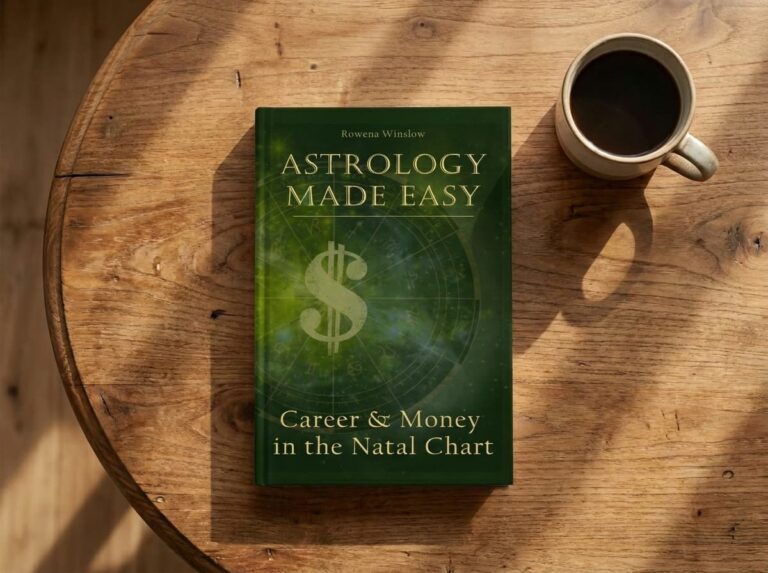
Rowena Winslow is a professional astrologer and the author of the Astrology Made Easy series. Her practice covers natal chart interpretation, Solar Returns, and predictive astrology. astrocore.pro
Leave a Reply