

Most people come to astrology looking for career guidance, relationship insight, or a map of the year ahead. Fewer people come looking for what I consider one of the chart’s most genuinely useful applications: understanding the psychological architecture underneath the surface — why certain emotional patterns keep returning, why particular kinds of suffering feel so deeply personal, and what the chart says about how a specific nervous system is actually built.
This is not comfortable territory. The chart can show a predisposition toward depression. It can show anxiety, compulsive behavior, emotional fragility, or a particular kind of psychological hardness that expresses itself as cruelty toward others or oneself. These are not pleasant things to read in a chart. But they are real, and understanding them is far more useful than pretending they are not there.
What the Chart Describes — and What It Does Not
Before going further, a necessary distinction. The birth chart describes predisposition and pattern. It does not diagnose. It does not predict that a specific person will develop a specific condition. What it shows is the emotional and psychological terrain a person is working with — the areas where the ground is solid, and the areas where it is not.
A chart that shows strong Saturn-Moon contacts does not mean that person will become clinically depressed. It means that person has a relationship with heaviness, with limitation, with the experience of emotional weight, that will be a consistent feature of their inner life. Whether that becomes depression or becomes depth, discipline, and emotional resilience depends on a hundred other factors — including, significantly, what that person does with what they find in themselves.
The chart is a map. Maps do not determine outcomes. They show the landscape.
The Planets Most Connected to Psychological Experience
The Moon: Emotional Foundation
The Moon is the single most important planet for psychological and emotional life. It governs the instinctive emotional responses, the quality of early nurturing and its lasting effects, and the fundamental relationship to security and vulnerability.
A well-placed, harmoniously aspected Moon describes emotional resilience — the capacity to feel, to recover, to establish genuine security. A Moon under significant pressure tells a different story: chronic emotional sensitivity, difficulty with the past, patterns of anxiety or instability that run beneath the surface of even an apparently well-functioning life.
Moon–Saturn contacts in particular are worth examining carefully in any discussion of mental health. This aspect combination consistently appears in charts where depression is a genuine lifelong companion — not necessarily a clinical disorder, but a structural tendency toward heaviness, toward self-restriction, toward the experience of life as fundamentally effortful. The positive expression of this combination is genuine emotional discipline and depth. The shadow expression is the weight becoming the whole story.
Moon–Neptune contacts carry a different quality: a permeability to the emotional environment, difficulty with boundaries, a tendency toward emotional confusion or idealization, and — in the hardest configurations — a susceptibility to the kinds of dissolution that substances temporarily provide. Neptune on the Ascendant in difficult aspect to the Moon is one of the configurations that can indicate a particular vulnerability to addiction or to states that blur the boundary between self and world.
Saturn: Structure, Limitation, and Fear
Saturn is the planet of structure, limitation, and the experience of time. When it operates well, it produces discipline, responsibility, and genuine mastery built through sustained effort. When it is under significant pressure — afflicted, as the classical tradition says — it can describe fear that operates as a permanent background condition, a self-restrictiveness that reads from the inside as caution but from the outside can look like joylessness.
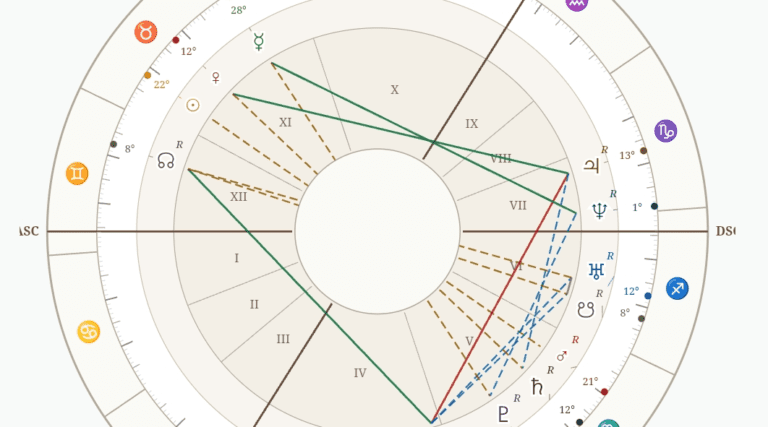
Saturn on the Ascendant in hard aspect to the Moon is one of the clearest configurations for a persistent depressive tendency. The person is not dramatically ill, necessarily. They are simply heavy. The world costs them more effort than it costs others. Pleasure is accessible but requires more effort to reach. The emotional default is toward seriousness, toward duty, toward the expectation that things will be difficult.
What I consistently see in these charts, when the person has done real work on themselves, is that this very heaviness becomes a kind of gift: the capacity for genuine depth, for staying with difficulty when others flee, for building things that last precisely because they were never built lightly.
Neptune: Dissolution and Permeability
Neptune governs the dissolution of boundaries — the capacity for transcendence, for mystical experience, for deep empathy and creative imagination. It also governs the places where the self can become lost: in substances, in fantasy, in relationships where the person’s own needs become invisible.
A strongly afflicted Neptune, particularly in the 12th House or in hard aspect to the personal planets, can describe a psyche that struggles to maintain clear definition — a person who absorbs the emotional states of the surrounding environment without adequate filtration. This is not weakness, exactly. It is a particular kind of permeability that, without conscious management, produces emotional exhaustion, confusion about what belongs to the self and what belongs to others, and a chronic longing for the kind of obliteration that alcohol, certain medications, or dissociation temporarily provide.
Alcoholism and addiction indicators in the chart tend to involve Neptune prominently — Neptune afflicted in the 12th House, Neptune in hard aspect to the Moon or Ascendant, or Neptune in strong aspect to Venus and Mars in water signs. These are not verdicts. They are signals that the person in question has a particular relationship to dissolution and needs to be unusually intentional about how they manage it.
Mars and Pluto: Aggression, Control, and Its Distortions
Mars governs drive, desire, and aggression. Pluto governs power, transformation, and the forces that operate beneath conscious control. Together, in challenging configurations, they describe the part of human psychology that most people find hardest to acknowledge in themselves: the capacity for cruelty, for the use of power against others, for the expression of pain as dominance.
Afflicted Saturn–Mars–Pluto configurations are the classical indicators for what might be called controlling or domineering behavior — what older texts describe plainly as sadistic tendencies. This does not mean everyone with a difficult Saturn-Mars-Pluto configuration becomes cruel. It means they are carrying something that, without consciousness, can express itself as the desire to exert control over others, to impose their own suffering outward rather than working with it internally.
In my experience, these charts very often belong to people who were themselves controlled or harmed — whose cruelty, when it appears, is the direct expression of something that was done to them. The chart does not excuse the behavior. It does explain the terrain.
Sun in hard aspect to the Moon can describe a fundamental internal conflict — the conscious will and the emotional instincts pulling in opposite directions — that expresses outwardly as volatility, as difficulty maintaining consistent relationships, or as a chronic sense of being fundamentally divided against oneself.
The Houses Most Connected to Psychological Life
The 12th House is the house most directly connected to the psychological interior — to what is hidden, to what has been repressed, to the place where the unprocessed material of a life accumulates. Planets here operate in a way that is less visible to the conscious self than planets elsewhere in the chart. A stellium in the 12th House consistently describes someone carrying a significant load beneath the surface — material that has not been worked through, that does not show up cleanly in the personality, but that influences the life from underground.
A particular 12th House signature to watch for: Saturn in the 12th, especially in hard aspect to the Moon, describes fears that operate entirely outside conscious awareness. The person may not be able to name what they are afraid of. They only know that something beneath the surface prevents them from fully engaging with life.
The 8th House governs psychological transformation — the capacity to go into the depths and come back changed. Under difficult configurations, it can also describe a relationship to darkness, to crisis, to loss, that the person has not yet integrated.
The 4th House describes the psychological foundation — the quality of early life and its lasting effects on the interior life. Planets here under significant pressure tell the story of what was not adequately provided in the earliest years: the insecurity that became chronic anxiety, the emotional absence that became depression, the chaos that became hypervigilance.
The Chart Is Not a Verdict
I want to be direct about something that matters. The configurations described in this article are patterns, not destinies. I have sat with charts that carry significant psychological weight — heavy Saturn, afflicted Moon, Neptune in the 12th, the full set — and the person in question was living with remarkable depth, creativity, and genuine wellbeing. Not because the pattern was not there. But because they had done the work of understanding it.
The chart does not determine whether you will suffer. It describes the particular texture of the suffering you are most vulnerable to, and therefore what you most need to understand. A person who knows they are working with Moon–Saturn heaviness can stop interpreting that heaviness as evidence that life is fundamentally joyless, and start recognizing it as a pattern with its own internal logic — one that responds to specific kinds of attention.
Astrology is most useful here not as a diagnostic tool but as a map of where to look. What in the chart is under the most pressure? What has not been integrated? What is the person’s relationship to the planets that most directly govern their psychological life?
Those are the questions a thorough natal chart reading addresses. If you would like to explore what your own chart shows about your psychological makeup and emotional patterns, you can calculate your chart at AstroCore and order a natal chart reading that works through this material in depth.
Rowena Winslow is a professional astrologer and the author of the Astrology Made Easy series. Her practice covers natal chart interpretation, Solar Returns, and predictive astrology. astrocore.pro

Leave a Reply