
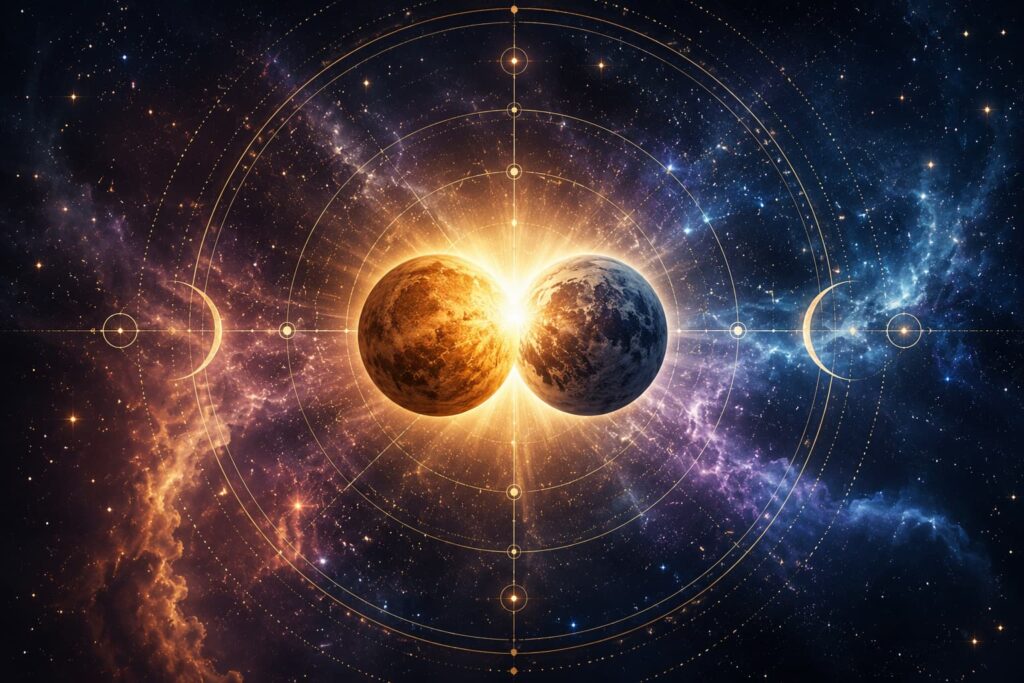
If you have ever looked at a birth chart and noticed two planets sitting very close together — nearly on top of each other — you were looking at a conjunction. It is one of the most powerful and immediately recognizable aspects in astrology, and understanding what it means is one of the most useful steps you can take toward reading any chart more accurately.
What Is an Aspect?
Before getting to the conjunction specifically, it helps to understand what aspects are in the first place.
Aspects are the angles between planets in a birth chart. They describe how different planetary energies interact with each other — whether they support each other, challenge each other, or create productive friction that pushes development.
In astrology, planets are not isolated forces. Each one represents a specific psychological function: action and drive (Mars), emotional life and instinct (Moon), communication and intellect (Mercury), love and attraction (Venus), structure and discipline (Saturn), and so on. Aspects reveal how these functions work together in a specific person’s chart.
A harmonious aspect between two planets suggests those functions operate with natural ease and mutual reinforcement. A tense aspect suggests friction, inner conflict, and the kind of pressure that, when worked with consciously, tends to produce genuine growth.
There are five major aspects in natal astrology: the conjunction (0°), the sextile (60°), the trine (120°), the square (90°), and the opposition (180°). Each describes a fundamentally different quality of relationship between the two planets involved.
The Conjunction: When Two Planets Become One
A conjunction occurs when two planets occupy the same degree — or very close to the same degree — of the zodiac. Typically, a conjunction is considered active when two planets are within approximately eight to ten degrees of each other, with the strongest influence felt when they are within two or three degrees.
The essential quality of a conjunction is fusion. The two planets’ energies combine and act as a single force. They are no longer two separate functions operating independently — they are intertwined, each coloring and amplifying the other.
This creates an intense focus. Whatever the two planets represent, they cannot be separated in this person’s experience. They arise together, express together, and are experienced as a unified quality of character or recurring life theme.
The Conjunction Is Not Automatically Positive or Difficult
This is the most important thing to understand about conjunctions: the meaning depends entirely on which planets are involved.
Some conjunctions are among the most harmonious and productive configurations in astrology. Others describe significant inner tension or recurring life challenges. The conjunction itself simply means fusion — what that fusion produces depends on the natures of the planets being combined.
Sun conjunct Venus, for instance, brings charm, warmth, and a natural ease of personal expression. The ego and the capacity for love and beauty are fused — the person tends to radiate genuine warmth and to attract others through natural grace. This is a conjunction that most people experience as a gift.
Mars conjunct Saturn describes a very different quality. Mars represents drive, action, and the desire to move forward; Saturn represents structure, limitation, and the need to slow down and assess. Fused together, these energies create inner tension between the impulse to act and the instinct to hold back. This conjunction requires considerable conscious work — but when integrated honestly, it can produce extraordinary discipline and sustained, focused achievement.
Sun conjunct Neptune fuses identity with Neptune’s qualities of idealism, spiritual sensitivity, and dissolution of boundaries. The result can be a person of genuine spiritual depth and creative inspiration — and someone who must work carefully to maintain clarity about who they are and what is real.
The same principle applies to every conjunction in the chart. The quality of the fusion is determined by what is being fused.
Tight Conjunctions vs. Wide Conjunctions
The closeness of a conjunction — its orb — affects how strongly and how consciously it is felt.
A conjunction within one or two degrees is very tight. The two planets are nearly inseparable in their influence. The fusion is intense, immediate, and usually highly noticeable in the person’s character and life experience. People with tight conjunctions often describe those planetary qualities as fundamental to who they are — not a separate aspect of their personality but a core feature of it.
A conjunction within five to eight degrees is still active but operates with less intensity. The planets are still meaningfully connected, but there is slightly more room between their expressions. The fusion is present without being quite so total.
The general principle: the tighter the orb, the stronger the influence.
Conjunctions to the Angles
Some of the most significant conjunctions in any chart involve not planets alone but the chart’s four major angles: the Ascendant (the degree rising on the eastern horizon at birth), the Descendant (directly opposite), the Midheaven (the highest point of the chart), and the IC (directly opposite the Midheaven).
A planet conjunct the Ascendant colors the entire personality and physical presentation — it is one of the first things others notice about the person and one of the most persistently felt influences in the life. A planet conjunct the Midheaven shapes the career, public standing, and the way the person is seen in the world. These angular conjunctions often describe what is most immediately and consistently visible in a person’s life.
The Conjunction in Context: Reading the Whole Chart
No conjunction operates in isolation. To understand what a specific conjunction means in a specific chart, it must always be read in the context of the whole picture.
Several factors modify how a conjunction expresses itself:
The signs involved. A conjunction between two planets in compatible signs tends to express more smoothly than the same conjunction in signs that create additional tension. Mars conjunct Saturn in Capricorn — a sign where Saturn is in its home and Mars is exalted — operates very differently from Mars conjunct Saturn in Cancer, where both planets are in difficult positions.
The house the conjunction occupies. The house tells you where in life the conjunction is most active. The same Sun-Venus conjunction in the 1st House (personal identity and appearance) produces a different quality of expression than in the 7th House (significant partnerships) or the 10th House (career and public life).
Aspects from other planets. If a third planet aspects the conjunction — particularly if it makes a square or opposition to one or both planets — that aspect modifies the conjunction’s expression significantly. A Jupiter trine to a Mars-Saturn conjunction, for instance, adds perspective and expansive support to an otherwise tense configuration.
The overall condition of the planets involved. Whether each planet is in a sign of dignity or difficulty, whether it is angular or cadent, whether it is otherwise well-supported or isolated — all of these factors affect how the conjunction ultimately operates.
This is why reading a chart requires the whole picture, not just the identification of individual aspects.
The Five Major Aspects at a Glance
To place the conjunction in context with the other major aspects:
The sextile (60°) is a gentle, cooperative connection — an opportunity for the two planets to develop each other’s qualities, requiring some conscious effort to actualize.
The trine (120°) is the most naturally flowing aspect — an easy, supportive connection that tends to operate with little friction. Trines describe natural talents and areas of genuine ease, though they can lead to passivity if taken for granted.
The square (90°) creates friction and inner tension — a motivating pressure that requires active engagement. Squares describe where growth is needed most, and they consistently produce the kind of challenge that, when worked through honestly, produces genuine strength.
The opposition (180°) creates polarity — two planets pulling in opposite directions, often projected outward onto other people or situations. Oppositions ask for balance and the recognition of both poles rather than the suppression of one in favor of the other.
And the conjunction (0°) fuses the two energies into a single force — the most intense form of planetary interaction, and the one that most directly shapes the core character of the person who carries it.
Finding the Conjunctions in Your Chart
Every birth chart contains conjunctions — some charts have several, some have only one or two, some have none involving the personal planets. The specific conjunctions present in your chart describe some of the most fundamental and persistent qualities of your character and life experience.
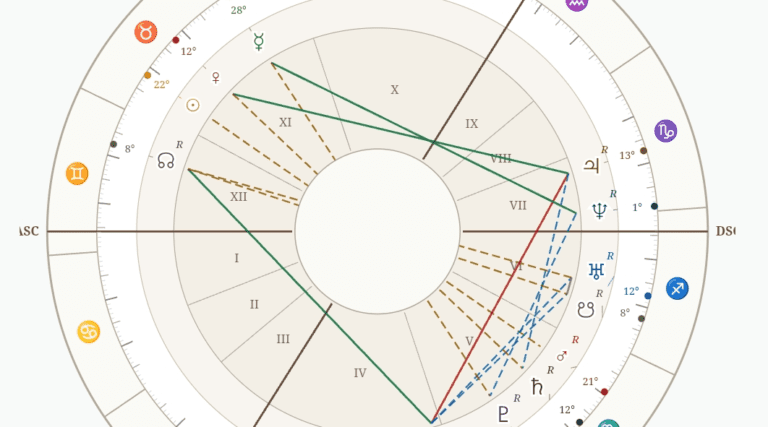
To find yours, you need your full natal chart with all planetary positions and aspects listed. The free natal chart calculator at AstroCore generates a complete chart with a full aspect table — including aspects to house cusps, which most standard calculators omit.
For a complete guide to understanding aspects in the natal chart — every major aspect between every planet combination, with detailed interpretations and practical examples — Astrology Made Easy: A Comprehensive Guide to Planets and Aspects in the Birth Chart covers the full aspect system in depth.
For a professional natal chart reading that integrates your conjunctions and all other major aspects into a coherent picture of your chart and your life — readings are available at AstroCore.
Rowena Winslow is the author of the Astrology Made Easy series, available on Amazon and Etsy. Free natal chart and Solar Return calculators are available at AstroCore.

Leave a Reply