
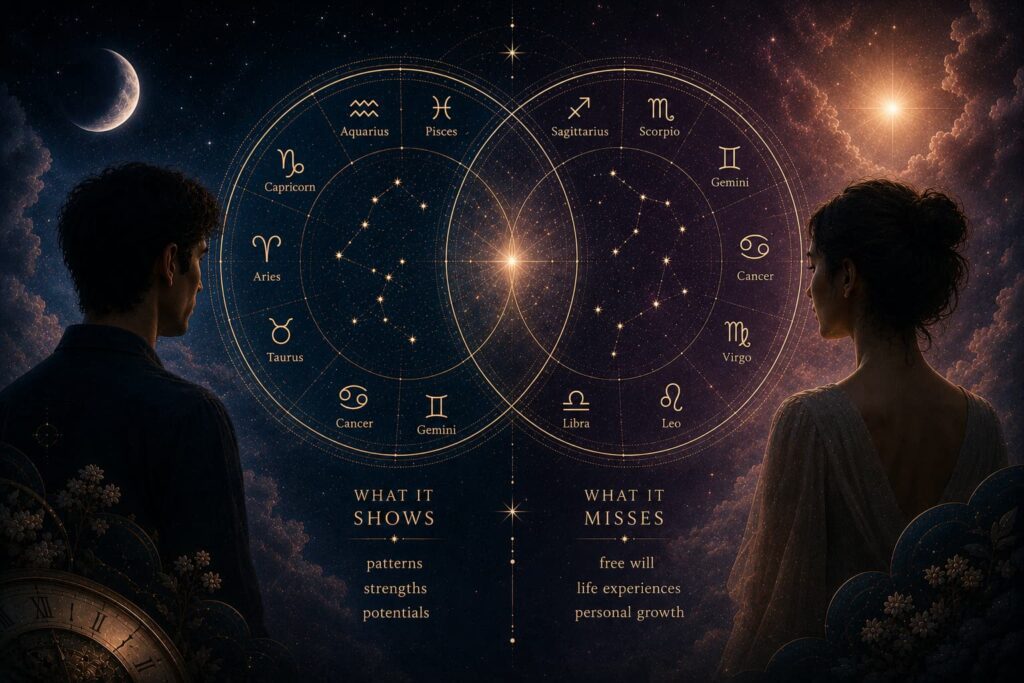
Can you determine romantic compatibility from a date of birth alone? The honest answer is: partially — and understanding both what date-of-birth compatibility shows and what it misses is more useful than a simple yes or no.
What a Date of Birth Tells You
Your date of birth establishes several important astrological factors:
Your Sun sign — the zodiac sign the Sun occupied on your birthday. The Sun changes signs approximately every 30 days, so your birth date determines your Sun sign precisely (with the caveat that people born near a sign change — called a cusp — may need to check their exact Sun degree to confirm which sign applies).
The approximate positions of the outer planets — Jupiter, Saturn, Uranus, Neptune, and Pluto move slowly enough that birth date alone establishes their signs with reasonable accuracy. Someone born in 1995 has Saturn in Pisces or Aries regardless of their exact birth time.
A general picture of Mercury and Venus — these planets move more quickly, but their sign positions can usually be narrowed down significantly from birth date alone, with some ambiguity for people born near a sign change.
What a date of birth does not tell you:
The Moon sign, the Ascendant (Rising sign), and the house positions of all planets — these require birth time and birth location. Because the Moon moves through a full sign approximately every 2.5 days, even the Moon sign is uncertain without a birth time. The Ascendant changes sign every two hours and cannot be determined from date alone.
See it in your own charts
Compare two birth charts free — every aspect between your planets and your partner’s, in seconds. No sign-up.
Compare Two ChartsSun Sign Compatibility by Date of Birth
The most widely used form of date-of-birth compatibility is Sun sign compatibility — comparing the zodiac signs of two people based on their birth dates and assessing the elemental and modal relationship between them.
This gives you a broad picture of how two fundamental energies relate:
Fire and Air (Aries, Leo, Sagittarius with Gemini, Libra, Aquarius) tend to reinforce each other — Fire’s passion and vision is energized by Air’s ideas and communication; Air’s intellectualism is ignited by Fire’s forward momentum.
Earth and Water (Taurus, Virgo, Capricorn with Cancer, Scorpio, Pisces) tend to nourish each other — Earth’s practicality and stability grounds Water’s emotional depth; Water’s feeling and intuition enriches Earth’s sometimes rigid focus on the material.
Same element pairings — Fire with Fire, Earth with Earth, Air with Air, Water with Water — share natural understanding and common orientation, though they can also amplify the shadow qualities of the shared element.
Cross-element pairings — Fire with Earth, Fire with Water, Air with Water, Air with Earth — produce genuine friction alongside genuine complementarity, requiring more conscious effort to work with than elementally harmonious combinations.
This elemental picture is real and useful. It describes the broad quality of how two people’s fundamental orientations relate — the general territory of the dynamic.
What it does not describe is the specific quality of the connection between two actual people.
Why Date of Birth Alone Is Not Enough
Two people can share the same Sun sign pairing — Aries and Taurus, for example — and have entirely different relationship dynamics depending on what the rest of their charts contain.
The Moon sign matters enormously for emotional compatibility. The Moon describes how each person processes feeling, what they need to feel secure, and how they instinctively respond under stress. Two people can have compatible Sun signs and Moon signs that process emotion in genuinely incompatible modes — producing a relationship that works well on the surface but creates persistent emotional friction underneath.
Because the Moon requires birth time to determine accurately, date-of-birth compatibility misses this dimension entirely.
Venus placement describes how each person actually loves. Venus governs love, attraction, what you need from a partner, and the relational style you naturally bring. An Aries with Venus in Pisces loves very differently from an Aries with Venus in Aries — more gently, more empathically, with considerably more willingness to yield. Date-of-birth compatibility, focused on the Sun sign, misses these Venus differences entirely unless Venus happens to be in a different sign than the Sun.
The Ascendant shapes first impressions and personal chemistry. The rising sign — which changes every two hours and requires birth time to calculate — describes how each person presents themselves at first encounter and how they approach new situations. Two people can have compatible Sun signs and very different rising signs, producing a different quality of initial chemistry than the Sun comparison would suggest.
The house positions show where in life the connection operates. Where each person’s planets fall in the other’s chart — the synastry house positions — describes in which domains of life the connection is most activated. This requires full birth charts with accurate times and locations to determine.
What You Can Determine From Date of Birth Alone
Despite these limitations, date-of-birth compatibility is not meaningless. Here is what you can reliably assess:
The elemental dynamic — whether the two Sun signs are in compatible, complementary, or friction-producing elemental relationship. This describes the broad quality of how two fundamental orientations meet.
The modal relationship — whether the signs are both Cardinal (initiative-oriented), both Fixed (persistence-oriented), both Mutable (adaptability-oriented), or in cross-modal relationship. Two Fixed signs together produce strong mutual determination and potential stubbornness. Two Cardinal signs produce initiative and potential competition for leadership. Two Mutable signs produce flexibility and potential lack of direction.
Saturn’s generational position — important in longer-term relationship assessment. Two people with Saturn in the same sign share generational challenges and orientations. Two people with Saturn in incompatible signs may have fundamental differences in their relationship to structure and commitment.
The approximate Venus relationship — if Venus can be determined from the birth date, its elemental relationship to the other person’s Venus gives a general picture of relational style compatibility.
The Most Accurate Compatibility Reading
To move from date-of-birth generalities to genuinely specific compatibility analysis, you need both people’s complete natal charts — birth date, birth time, and birth location for each person.
With complete charts, the analysis expands considerably:
The full synastry — how each person’s planets fall in relation to the other’s chart — describes the specific quality of the connection in detail: which contacts produce natural ease, which create productive friction, which describe the relationship’s central dynamic.
The composite chart — calculated from the midpoints of both charts — describes the relationship itself as its own entity: what it is fundamentally about, what it nourishes in both people, and where it demands sustained work.
And the individual natal charts — read for the relational patterns each person brings — show what each person tends to attract and repeatedly encounter in significant partnerships, independent of the specific pairing.
Generating Your Compatibility Charts
To move beyond date-of-birth compatibility into a complete astrological compatibility analysis, start by generating both natal charts with accurate birth data.
The free natal chart calculator at AstroCore generates a complete chart for any birth date, time, and location — instantly. With both charts generated, you can begin to examine the synastry between them.
For a professionally worked compatibility reading — examining both natal charts individually, the full synastry, and the composite chart — readings are available at AstroCore.
Rowena Winslow is the author of the Astrology Made Easy series, available on Amazon and Etsy. Free natal chart and Solar Return calculators are available at AstroCore.


Leave a Reply