
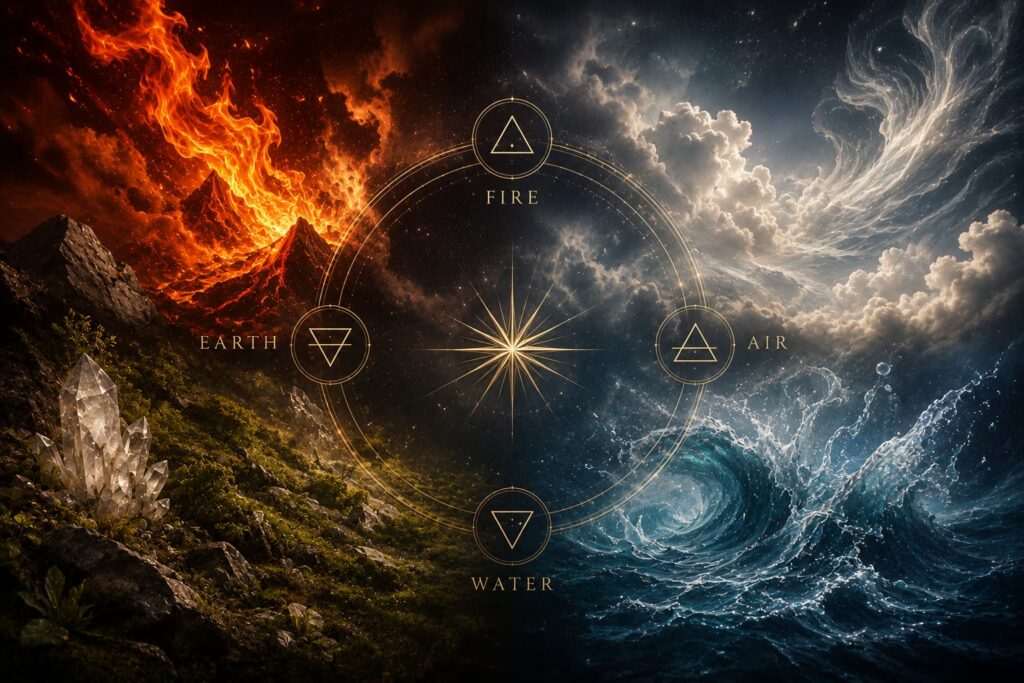
The four elements — Fire, Earth, Air, and Water — are one of the oldest and most reliable frameworks in astrology. They predate modern psychology, modern personality theory, and most contemporary self-development tools by thousands of years. And they remain genuinely useful precisely because they describe something real about how human beings are fundamentally different from each other.
Understanding the elements is one of the most efficient ways to understand any birth chart — and any person.
What the Elements Describe
In astrology, the twelve zodiac signs are distributed equally across four elements, with three signs belonging to each. The element of a sign describes its fundamental energy type — the quality of its animating force and the mode through which it engages with reality.
The elements are not personality labels. They are not a simplified version of astrology for people who do not want to go deeper. They are a foundational layer of the interpretive system — one that experienced astrologers return to constantly because it cuts through complexity and identifies the essential character of any placement quickly and accurately.
Every planet in your birth chart occupies a sign, and that sign belongs to an element. The distribution of your planets across the four elements describes the elemental balance — or imbalance — of your chart. That distribution is one of the first things I look at in any natal chart reading.
The Four Elements
Fire: Aries, Leo, Sagittarius
Fire is the element of spirit, will, and inspiration. Fire signs operate from a place of inner certainty — they are oriented toward what could be rather than what is. At their best, they are luminous: generous with their energy, capable of genuine inspiration, driven by a vision that others find infectious.
The animating force of Fire is meaning and purpose. Fire signs do not simply want to act — they want to act for something. When a Fire sign loses connection to a sense of purpose, their vitality dims quickly. Restore the sense of meaning, and it reignites.
The shadow of Fire is impulsivity, restlessness, and a tendency to exhaust both themselves and others with their intensity. Fire burns brightly — and can burn through things.
Earth: Taurus, Virgo, Capricorn
Earth is the element of manifestation, endurance, and practical intelligence. Earth signs are the builders of the zodiac — they understand that ideas only become real through sustained, embodied effort. They are sensory beings: they trust what they can see, touch, measure, and demonstrate. Their relationship to time tends to be long; they think in terms of what lasts.
The animating force of Earth is substance and completion. Earth signs finish what they start. In a world full of grand intentions, that is rarer and more valuable than it sounds.
The shadow of Earth is rigidity — a resistance to change that can calcify into stubbornness or over-attachment to security. But the genuine strength is the capacity to create lasting things where others produce only ideas.
Air: Gemini, Libra, Aquarius
Air is the element of mind, connection, and the exchange of ideas. Air signs live in the space between people and concepts — they are naturally drawn to synthesis, communication, and the patterns that link apparently separate things. They are the communicators and connectors of the zodiac, genuinely gifted at seeing multiple perspectives simultaneously.
The animating force of Air is understanding and exchange. Air signs need intellectual stimulation and genuine communication the way other elements need emotional warmth or practical grounding. Without it, they become scattered and restless.
The shadow of Air is detachment — a tendency to intellectualize experience rather than feel it, and to drift toward abstraction when embodied engagement would serve better.
Water: Cancer, Scorpio, Pisces
Water is the element of feeling, depth, and emotional intelligence. Water signs experience the world primarily through emotional attunement — they pick up on undercurrents that other elements entirely miss. Their perceptual gift is empathy: a genuine capacity to feel with others, not merely about them.
The animating force of Water is connection and meaning through feeling. Water signs process experience emotionally and often intuitively, accessing dimensions of a situation that purely rational or practical approaches cannot reach.
The shadow of Water is boundary erosion — a tendency to absorb the emotional environment, which can be an extraordinary asset and a genuine liability. Learning to distinguish between their own feelings and those they have absorbed from others is often one of the central developmental tasks for Water-heavy charts.
How to Find Your Elemental Balance
Most people know their Sun sign’s element — if you are a Sagittarius, your Sun is in Fire. But the Sun is one placement in a chart that contains ten planets.
Your elemental balance is determined by counting how many of your ten natal planets fall in each element. A chart with six planets in Water signs has a very different quality than a chart with six planets in Fire — even if both have a Fire Sun.
To calculate yours: generate your full natal chart at AstroCore, note the sign each planet occupies, and count the elements.
Fire: Aries, Leo, Sagittarius
Earth: Taurus, Virgo, Capricorn
Air: Gemini, Libra, Aquarius
Water: Cancer, Scorpio, Pisces
What the balance reveals:
A chart heavily concentrated in one element tends to express that element’s qualities prominently — and to struggle with the qualities of the missing or underrepresented elements.
A person with most planets in Fire and very little Earth may be genuinely inspiring and visionary — and may consistently struggle with follow-through, practical grounding, and the sustained daily effort that turns inspiration into lasting results.
A person with most planets in Water and very little Air may have extraordinary emotional intelligence and intuitive depth — and may find it difficult to communicate their inner experience clearly, or to maintain the kind of analytical distance that some situations require.
A person with most planets in Earth and very little Fire may be extraordinarily capable and practically reliable — and may find it difficult to connect with genuine enthusiasm, to take risks, or to access the kind of inspired vision that motivates others.
This is not determinism — it is information. Understanding your elemental balance describes the natural strengths of your chart and the areas where conscious development is most needed.
The Elements and Compatibility
The elements also provide one of the most reliable initial frameworks for understanding how two people relate to each other — what flows naturally between them and where friction is likely to arise.
The traditional elemental affinities: Fire and Air tend to reinforce each other — Fire’s passion and vision is fed by Air’s ideas and communication, while Air’s tendency toward abstraction is energized by Fire’s forward momentum. Earth and Water tend to nourish each other — Water’s emotional depth is grounded by Earth’s practicality, while Earth’s sometimes rigid focus on the material is enriched by Water’s emotional and intuitive intelligence.
The cross-element combinations — Fire with Earth, Fire with Water, Air with Earth, Air with Water — tend to produce genuine tension alongside genuine complementarity. These pairings often generate the kind of productive friction that pushes both people to develop capacities they would not develop as naturally on their own. But they require more conscious effort than elementally compatible combinations.
This is why elemental analysis is a useful starting point for compatibility — and why it is not the whole picture. Two people whose charts are elementally similar may still face significant relational challenges depending on how their specific planetary placements interact. Two people whose elements create friction may build something extraordinary precisely because their differences are genuinely productive.
The elements describe the territory. The full synastry — how two charts interact in specific detail — describes the specific quality of the relationship.
The Elements in the Houses
The elements do not only describe the signs — they also describe the houses. Each house has a natural elemental correspondence that reflects its domain.
The Fire houses (1st, 5th, 9th) are associated with identity, self-expression, creative output, and the search for meaning.
The Earth houses (2nd, 6th, 10th) govern material resources, daily work and health, and career and public standing.
The Air houses (3rd, 7th, 11th) govern communication and local environment, significant partnerships, and community and goals.
The Water houses (4th, 8th, 12th) govern home and roots, transformation and shared resources, and the unconscious and hidden life.
A planet in a Fire house operates differently than the same planet in a Water house — even if the planet’s sign element is the same. The house element adds another layer of context to the interpretation.
Going Deeper
The elements are the foundation — and astrology builds considerably on that foundation. Once you understand the elemental basis of the signs and houses, the next layer is the modalities (Cardinal, Fixed, and Mutable), which describe how each element moves. Then the planets, which describe what functions are operating within each sign and house. Then the aspects, which describe how those functions interact.
Each layer adds precision. The elements are where the framework begins — and where, in complex chart work, the most experienced astrologers consistently return.
For a complete guide to the elements, modalities, signs, and houses — and how to read all of them as an integrated system — Astrology Made Easy: A Comprehensive Guide to Zodiac Signs and Horoscope Houses in the Birth Chart covers the full foundation in depth.
Generate your natal chart free at AstroCore and discover your elemental balance.
Rowena Winslow is the author of the Astrology Made Easy series, available on Amazon and Etsy. Free natal chart and Solar Return calculators are available at AstroCore.
Leave a Reply