Most people who dismiss astrology have never actually studied it. They’ve encountered the watered-down version — the twelve-sign column in a lifestyle magazine, the algorithm that reduces a human life to a single solar placement and calls it insight. That version deserves the skepticism it receives.
What they haven’t encountered is a real chart reading.
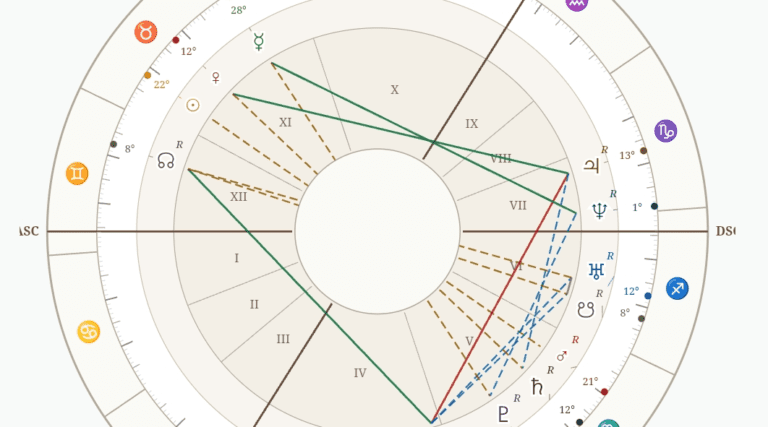
One that begins with the exact configuration of the sky at the moment of birth — not a generalized archetype, but a specific, unrepeatable map. That identifies the sign on each of the twelve house cusps and asks what it means for that particular domain of life. That examines where each planet falls, how strong or compromised it is in that position, and what it reveals about the psychological function it represents. That traces the aspects — the precise angular relationships between planets — and reads in them the inner dynamics that generate a person’s recurring patterns, their tensions, their areas of natural fluency.
That is a different discipline entirely. And the difference is not subtle.
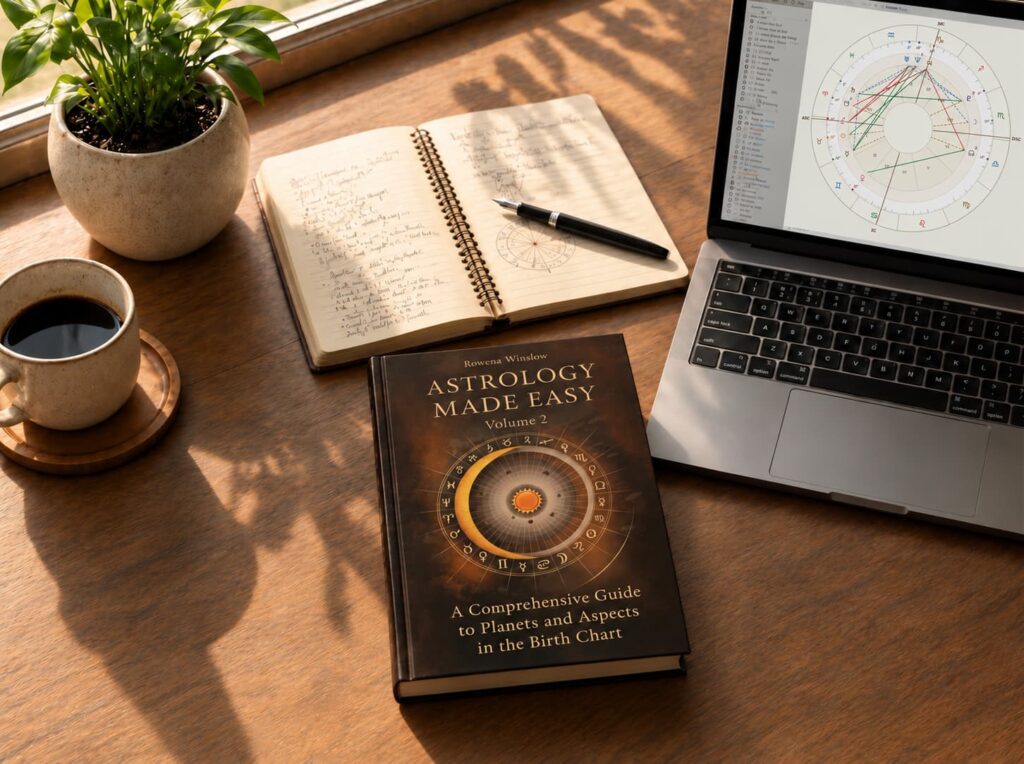
My own practice has been built around a single conviction: that astrology is too precise and too useful to be left in the hands of oversimplification. There is a version of this subject — widely available, enthusiastically marketed — that offers the vocabulary without the grammar. Signs without houses. Planets without dignity. Aspects reduced to “challenging” or “harmonious” without any examination of what is actually in tension and why. That version produces readers who can identify a Scorpio stellium but cannot tell you what it means when its ruling planet is in fall in the 12th House.
I wanted something more rigorous. So I wrote it.
The Astrology Made Easy series now spans four volumes, each designed to function as a serious working reference rather than an introductory overview.
Volume 1 — Zodiac Signs and Horoscope Houses in the Birth Chart lays the structural foundation. The signs are not personality types — they are archetypal fields of energy that color every planet and house cusp they touch. The houses are not abstract categories — they are the twelve domains of lived experience, each with a distinct thematic architecture and a ruling planet that functions as its secondary significator. Understanding how sign, house, and ruler operate as a three-layer interpretive unit is the skill that separates fluent chart reading from symbol-matching.
Volume 2 — Planets and Aspects in the Birth Chart turns to the actors on that stage. Each planet represents a distinct psychological function — the Sun as core identity and purpose, the Moon as emotional instinct and need, Mars as drive and desire, Saturn as structure, discipline, and the places where growth requires friction. Volume 2 examines each planet in depth: its symbolism, its expression across all twelve houses, its sign placements, and its aspects to other planets. The aspect work here is particularly detailed, because it is in the aspects — the conjunctions, squares, oppositions, trines — that the inner life of the chart reveals itself most clearly.
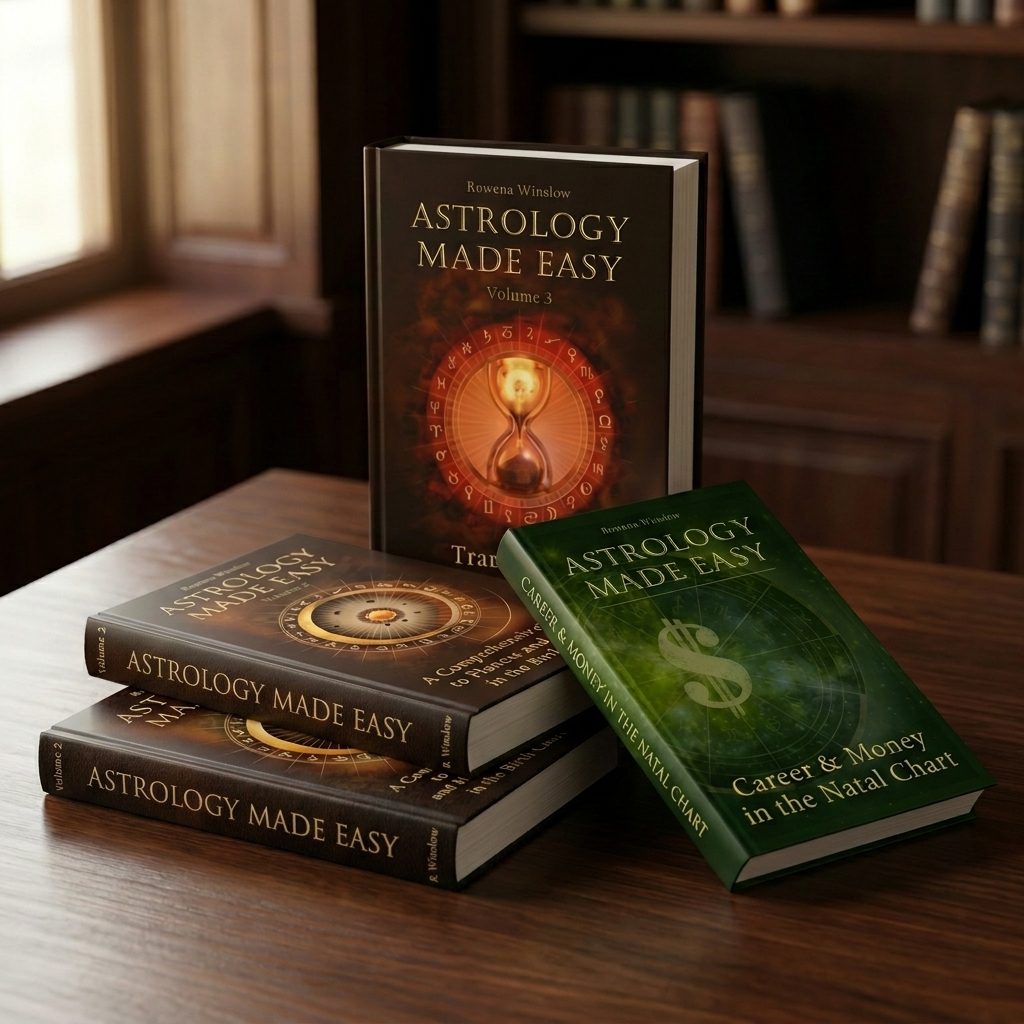
Volume 3 — Transits and Planetary Cycles in Predictive Astrology moves into time. The natal chart describes who you are. Transits describe the dialogue between the sky’s current positions and that natal blueprint — and through that dialogue, the timing of development, challenge, and change. Volume 3 gives you a systematic framework for reading that dialogue: how to identify significant transit periods, how to layer multiple transits into a coherent picture, and how to work with the major planetary cycles — Saturn returns, Uranus oppositions, Pluto transits — that mark the structural turning points of a life.
Volume 4 — Career and Money in the Natal Chart applies the full interpretive framework to one of the areas where people most need genuine clarity. This is not a list of “best careers for your Sun sign.” It is a detailed examination of the vocational indicators in the natal chart: the 10th House and its ruler, the 2nd and 8th Houses as the architecture of resources and transformation, the placement of Saturn as the planet of professional structure, and the aspects that describe both natural aptitude and the specific kinds of work through which a person will find lasting meaning and material stability.
The four volumes together form a complete curriculum. Beginners will find a rigorous path in. Experienced practitioners will find a framework precise enough to work from at the chart table.
This site exists as the practical extension of that work. You can calculate your natal chart here, examine your current transits, and explore your solar return for the year ahead. If you want interpretation that goes beyond symbol lists into actual meaning — that is available too.
The chart has always been yours. The question is how deeply you’re willing to read it.
Rowena Winslow is a practicing astrologer and the author of the four-volume Astrology Made Easy series, available on Amazon.