

There is a difference between reading a Solar Return chart and interpreting one.
Reading is identifying what is there: the Ascendant sign, the Sun’s house, the angular planets, the Moon’s position. These are the building blocks — and knowing them is genuinely useful. If you have worked through the previous articles in this series, you already have a solid foundation.
Interpretation is understanding what it means for this specific person, in this specific life, in this specific year. That deeper layer is where the Solar Return becomes genuinely precise — where it stops describing what any person with Saturn in the 10th might experience and starts describing what you, with your particular natal chart, your particular history, and your particular circumstances, are actually facing.
This article is about how to reach that layer.
See it in your own chart
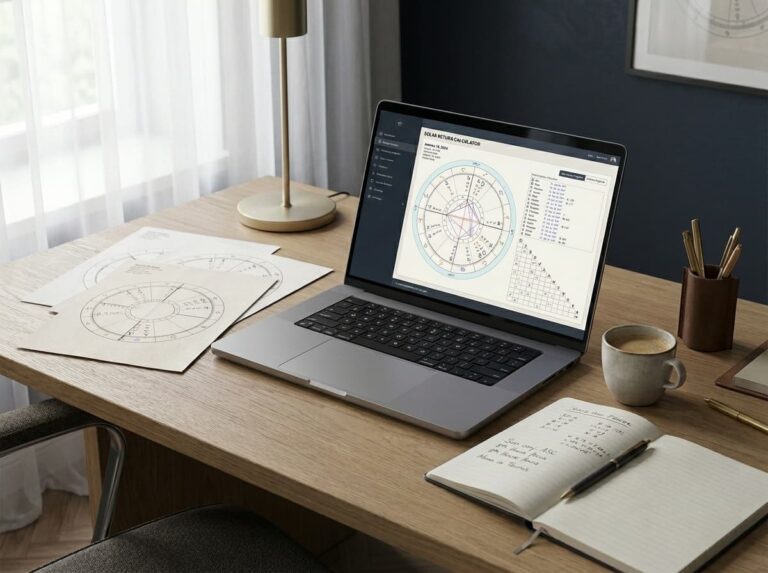
Calculate your Solar Return free and see what your year ahead is built around. No sign-up.
Calculate My Solar ReturnWhy Two Charts Are Always Better Than One
Every Solar Return reading that stops at the Solar Return chart alone is an incomplete reading.
The Solar Return chart describes the year’s themes and conditions. The natal chart describes who is navigating them. These are two genuinely different pieces of information, and both are necessary for an accurate picture.
Here is a simple illustration. Two people have the same Solar Return Sun in the 7th House — partnership is the year’s central theme for both. But one person’s natal chart shows Venus in the 7th, well-aspected, with Jupiter trine the 7th House ruler: the natal potential for significant partnership is strong, and the Solar Return is activating fertile ground. The other person’s natal chart shows a heavily afflicted Venus, Saturn squaring the 7th House ruler, and a history of recurring relational difficulty: the same Solar Return placement is activating territory that requires very different preparation.
Same Solar Return. Entirely different year.
This is why the Solar Return must always be read in dialogue with the natal chart. The Solar Return describes what is being activated. The natal chart shows what that activation is working with.
The Three Layers of a Complete Solar Return Reading
A fully worked Solar Return interpretation has three distinct layers, each adding precision to what the previous layer established.
Layer 1: The Solar Return chart read on its own terms.
This is what most Solar Return articles cover — and what the previous article in this series walked through in detail. Ascendant sign, Solar Return Sun house, Moon position, angular planets, stelliums, aspects. This layer identifies the year’s primary themes, its psychological climate, and where support and pressure are concentrated.
It is a genuinely useful starting point. It is not the complete picture.
Layer 2: The Solar Return planets read against the natal chart.
Each Solar Return planet is checked against the natal chart to understand how the year’s conditions interact with what is already present in the natal potential.
Where does the Solar Return Saturn fall in relation to the natal chart? If Solar Return Saturn is transiting a sensitive natal point — conjuncting the natal Sun, squaring the natal Ascendant — the year’s Saturnian demands are amplified and directly personal. If Solar Return Saturn is making no significant natal contact, its influence is more background than foreground.
The same principle applies to every Solar Return planet. The year’s Jupiter placement is encouraging — but is Jupiter in a position to deliver, given the natal chart’s own Jupiter condition and what aspects the Solar Return Jupiter is making to natal points?
This layer adds specificity. The Solar Return tells you where the year’s pressure falls; the natal contact tells you how personally and directly that pressure is felt.
Layer 3: The natal house overlay.
This is the most sophisticated layer — and the one that consistently produces the most precise readings in professional practice.
The principle: identify which Solar Return house each natal house cusp falls in. That placement tells you through which area of life each natal theme will express itself during the year.
A single example: if your natal 5th House cusp falls in the Solar Return 10th House, your 5th House themes — creative work, romantic life, children — will express themselves primarily through the 10th House domain this year: career, public standing, professional recognition. In practice, this often describes a year in which creative work becomes professionally visible, a creative project gains public recognition, or a child’s development intersects with the parent’s professional life in significant ways.
Every natal house cusp can be read this way. The complete overlay produces a map of how every major life theme is being routed this year — which domains are connected, which are dormant, and which are carrying unusual weight.
This technique, along with two others of equal analytical power, is covered in full in Volume 3 of my Solar Return series. Together they form the most personally precise layer of Solar Return interpretation available.
The Outer Planets: When the Year Goes Deeper
Most Solar Return years are shaped primarily by the personal and social planets — Sun, Moon, Mercury, Venus, Mars, Jupiter, Saturn. These move quickly enough to occupy meaningfully different houses each year and to describe the year’s individual character with genuine specificity.
But when Uranus, Neptune, or Pluto occupy prominent Solar Return positions — particularly angular houses — the year takes on a different quality entirely.
Uranus angular describes a year of genuine disruption and genuine liberation. What has been maintained through habit, social pressure, or fear of change rather than through genuine current alignment tends to become unsustainable. The disruption Uranus produces is rarely comfortable — and it tends to dismantle exactly what most needed dismantling, which is only visible in retrospect.
Uranus in the Solar Return 7th House doesn’t threaten solid partnerships. It makes it impossible to sustain partnerships that have been held together primarily by inertia rather than genuine ongoing choice. One client described such a year as the most exhausting of her relational life — until the relationship ended, by mutual recognition, in month seven. She said the most surprising thing about it was how undramatic the ending was once both parties stopped pretending not to know what they knew.
Neptune prominent describes a year in which clarity requires deliberate effort and idealization is an active risk. The domain Neptune occupies in the Solar Return tends to be experienced through a layer of soft focus — things are felt more than seen, impressions are richer than facts, and decisions made in Neptune’s atmosphere often require revision when the fog lifts.
Neptune in the Solar Return 7th House: significant relationships are perceived partly through projection rather than accurate seeing. The person is not necessarily being deceived. They are, for the year, systematically unable to see the other clearly — and the most important practical guidance is to delay significant irreversible commitments until the picture sharpens.
Pluto prominent describes a year of genuine transformation — the kind that is not chosen and not comfortable, but that tends to produce the years remembered longest. Pluto in the Solar Return 8th, for instance, excavates the foundations of existing structures — financial, relational, psychological — to find out what is genuinely there. The process is slow, often adversarial, and tends to reward thoroughness and punish avoidance.
What makes the outer planet years most accurately readable is, again, the natal chart. Uranus in the Solar Return 1st House means something different for someone whose natal chart already carries strong Uranian themes than for someone for whom Uranian disruption is unfamiliar territory.
Timing Within the Year
One of the most practically useful dimensions of Solar Return interpretation — and one that most introductory treatments skip entirely — is timing: identifying when within the twelve-month period specific Solar Return themes are most likely to be active.
The primary timing tool is the Progressed Solar Return Moon: the Solar Return Moon advanced at approximately one house per month through the year. As it moves through each Solar Return house in sequence, it activates that house’s themes — bringing them into sharper focus during the weeks it occupies that position.
A Solar Return Moon in the 2nd House at the return moment suggests financial themes are most active in the year’s first month. When the progressed Moon reaches the 5th House around month three or four, creative and romantic themes come into focus. When it reaches the 8th House around month six, the year’s deeper psychological and financial territory becomes most active.
This technique does not predict events. It identifies windows — the periods when specific themes are most likely to crystallize into concrete experience. Used alongside the Solar Return’s primary planet-by-house picture, it adds a timing dimension that makes the reading considerably more practically useful.
The Step-by-Step Reading Algorithm
A fully worked Solar Return interpretation follows a specific sequence that ensures nothing significant is missed and that the layers are integrated rather than read separately.
The complete algorithm — integrating the Solar Return chart, the natal contacts, the three overlay techniques, and the timing tools — is laid out step by step in Volume 3 of my Solar Return series. It is designed to be used at the chart table, returned to with each new chart until the sequence becomes second nature.
What I can offer here is the essential principle: read the layers in order, from the most general to the most specific. Start with the Solar Return chart on its own terms. Add the natal contacts. Apply the overlay. Check the timing. Only when all layers have been read can the picture be synthesized into a coherent, prioritized, and practically useful reading.
Each layer narrows the picture. The Solar Return alone might describe “a year of significant partnership themes.” The natal contacts specify “and your natal Venus-Saturn tension means those themes will require real work rather than easy development.” The overlay adds “and that relational work will express itself primarily through professional contexts this year.” The timing notes “with the most active period likely falling in months four through six.”
That is the difference between reading and interpreting.
When to Read Your Own Chart vs. Seek a Professional Reading
Reading your own Solar Return chart is genuinely valuable — and the previous articles in this series give you the tools to do it meaningfully.
There are situations where a professional reading adds something self-study cannot fully replicate: when the year ahead carries genuinely high stakes, when multiple difficult configurations overlap in ways that require experienced pattern recognition to assess accurately, or when the natal-Solar Return interaction produces a picture complex enough that objective eyes are more reliable than one’s own.
In professional readings, what I am doing in the final analysis is not simply identifying what is present. I am assessing the year’s overall weight and direction — which themes are primary, which are secondary, which apparent difficulties are genuinely serious and which are transient — and translating that assessment into practical guidance for the specific person and the specific year.
That integration requires everything: the complete Solar Return chart, the natal chart in full, the overlay techniques, the timing tools, and the years of pattern recognition that come from reading thousands of charts across the full range of human experience.
Where to Go From Here
If you want to develop the ability to interpret Solar Returns at this level yourself, the complete system is laid out across the three-volume Astrology Made Easy: Solar Returns series — every planet, every house, all three overlay techniques, the timing methodology, and the complete reading algorithm. Available on Amazon and Etsy.
If you want a complete professional Solar Return interpretation — with all layers integrated and the year’s specific picture clearly mapped — readings are available at AstroCore.
Generate your chart free at AstroCore and see what this year is already telling you.
Rowena Winslow is the author of Astrology Made Easy: Solar Returns (three volumes) and the Astrology Made Easy natal chart series, available on Amazon and Etsy. Free Solar Return and natal chart calculators are available at AstroCore.
Leave a Reply