
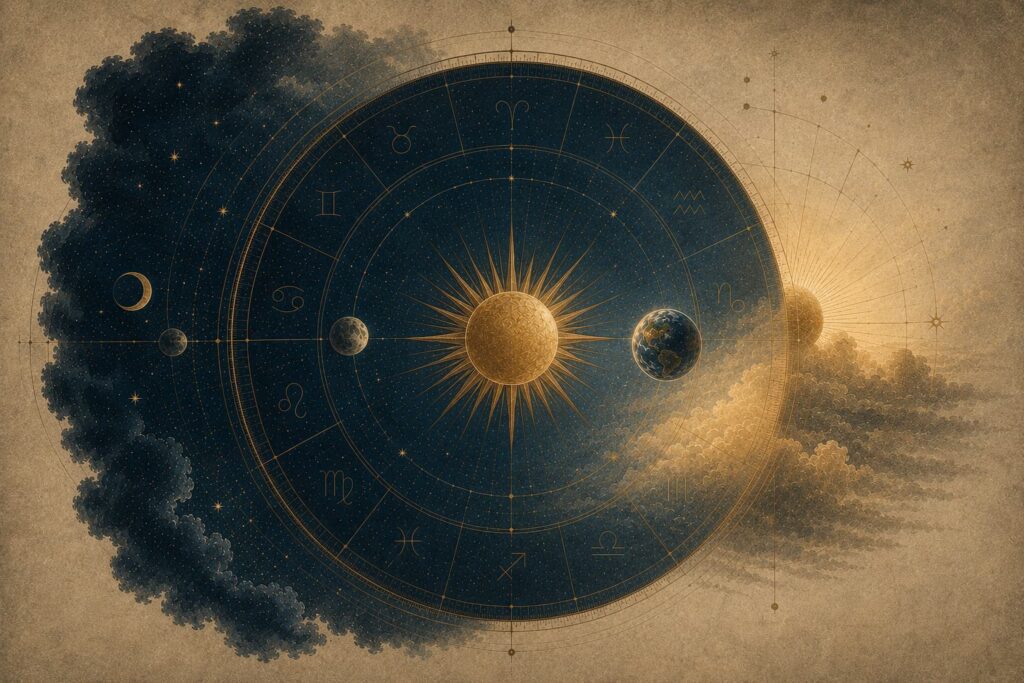
You’ve heard that a Solar Return chart can describe the year ahead. But when you look at one for the first time, it looks like any other astrological chart — a circle divided into twelve sections, symbols scattered across it, lines connecting them. What exactly are you looking at? And where do you start?
This article walks through every element of the Solar Return chart: what it is, what each component describes, and how the pieces work together to produce a complete picture of the year ahead. By the end, you will know exactly what you are looking at and why each element matters.
The Solar Return Chart Is an Annual Chart
First, the foundation: the Solar Return chart is cast for the exact moment the Sun returns to the degree, minute, and second it occupied at your birth. This happens once a year, on or near your birthday, and the chart cast for that moment covers the twelve months that follow.
It looks like a natal chart because it uses the same structure — twelve houses, ten planets, the signs of the zodiac, aspects between planets. But the interpretive frame is different. Where the natal chart describes who you are across a lifetime, the Solar Return chart describes a single year: its themes, its psychological climate, its areas of opportunity and demand.
The two charts must always be read together. The Solar Return activates what is already present in the natal chart — it does not create conditions from nothing. Understanding what the Solar Return chart contains is the first step to reading it accurately.
The Six Elements of the Solar Return Chart
1. The Solar Return Ascendant
The Ascendant — the degree rising on the eastern horizon at the exact moment of the return — is the first and most structurally important point in the chart. It sets the house cusps, determines which planets fall in which houses, and describes the general orientation of the year.
Unlike your natal Ascendant, which is fixed for life, the Solar Return Ascendant changes every year. The sign it falls in describes the mode you will operate in during the year — the instinctive approach you bring to new situations, the quality of how you show up in the world.
A Solar Return Ascendant in Aries describes a year of initiative, directness, and forward movement — a year in which you are inclined to act first and assess later. The same person with a Solar Return Ascendant in Virgo will experience a very different year: one of analysis, refinement, careful attention to detail, and a focus on getting things right rather than getting things done quickly. A Solar Return Ascendant in Libra orients the year around relationships, deliberation, and the management of competing interests.
These differences are real and noticeable. The Solar Return Ascendant sets the tone before you even look at the planets.
Because the Ascendant depends on both the exact time of the return and the location where you are at that moment, it is one of the chart’s most sensitive points — and one of the most actionable. By choosing to be in a different location at the time of your Solar Return, you can shift the Ascendant into a different sign and meaningfully change the year’s orientation. This is the basis of Solar Return relocation.
2. The Solar Return Sun
The Sun is always present in the Solar Return chart, and its house position is the single most important indicator of the year’s dominant focus. Because the Sun returns to its natal degree each year, its sign never changes in the Solar Return — it is always the same sign as in your natal chart. What changes, as the Ascendant shifts from year to year, is the house it occupies.
The house of the Solar Return Sun describes the arena of life that will receive the most attention, energy, and conscious investment over the twelve months ahead. It is the year’s central theme.
Sun in the Solar Return 1st House: a year of focused self-development, personal identity, and the way you present yourself to the world. Sun in the 4th House: a year centered on home, family, roots, and inner life. Sun in the 7th House: a year in which significant one-on-one relationships — romantic or professional — are at the center. Sun in the 10th House: career, public standing, and professional ambition dominate.
The aspects the Solar Return Sun makes to other planets in the chart add nuance to this central theme. A Solar Return Sun in sextile to Jupiter suggests the year’s focus comes with expansion and relative ease. A Solar Return Sun in square to Saturn suggests the same focus will involve considerable effort, discipline, or limitation that must be worked through.
3. The Solar Return Moon
The Solar Return Moon — the position of the Moon at the exact moment of the return — describes the emotional climate of the year: where your feelings will be most active, what you will be most sensitive to, and where your deepest emotional investment will lie.
Because the Moon moves quickly through the zodiac, it occupies a different sign and house in every Solar Return. This makes it one of the most personally specific and variable indicators in the chart — and one of the most revealing.
The sign of the Solar Return Moon describes how you process and express emotion during the year. Moon in Capricorn: emotions are managed with control and directed toward achievement. Moon in Cancer: emotional life is rich, sensitive, and oriented around home and family. Moon in Gemini: emotional needs are met through communication, variety, and intellectual engagement.
The house of the Solar Return Moon describes where those emotions are concentrated. Moon in the 7th House: emotional investment centers on a significant partnership. Moon in the 2nd House: emotional security is tied to material stability and financial conditions. Moon in the 12th House: emotional life is rich but largely private, processed inwardly rather than expressed outwardly.
The Solar Return Moon also serves as a timing tool. As the Moon progresses through the Solar Return chart over the course of the year — advancing approximately one house per month — it activates each area of the chart in sequence. This technique, the Progressed Solar Return Moon, is one of the most reliable methods for identifying when specific Solar Return themes are likely to be most active. If your Solar Return Moon is in the 3rd House, communications, writing, and local environment themes are likely to peak in the early months. When the progressed Moon reaches the 7th House around month four or five, relational themes come into sharper focus.
4. Angular Planets
Planets in the four angular houses of the Solar Return — the 1st, 4th, 7th, and 10th — are in positions of maximum prominence. They represent forces that will be visibly and consistently active throughout the year, demanding direct engagement rather than passive reception.
The closer a planet is to an angle — the Ascendant, IC, Descendant, or Midheaven — the more powerfully it colors the entire year. A planet within five degrees of the Ascendant, for example, will affect how you approach virtually everything during the year. A planet sitting in the middle of the 3rd House will influence communications and local travel, but its reach is considerably narrower.
When reading a Solar Return chart, identify the angular planets first. They tell you what cannot be ignored during the year ahead.
Saturn angular — particularly conjunct the Ascendant or in the 1st House — describes a year of sustained personal effort, discipline, and genuine reckoning with what is and is not working in your life. It is not an easy placement, but it is a productive one for those willing to work with rather than against its demands.
Jupiter angular — conjunct the Ascendant or Midheaven — describes a year in which opportunity, expansion, and genuine good fortune are actively present in how you approach the world. The expansion Jupiter promises requires engagement to actualize, but the support is genuinely there.
Mars angular in the 1st or 10th carries the year’s energy toward initiative, action, and at times conflict. Venus angular in the 7th or 1st brings warmth, relational ease, and aesthetic pleasure to the foreground of the year.
5. Stelliums and Hemispheric Emphasis
When three or more planets cluster in a single house, they form a stellium — a concentrated focus of energy in that house’s area of life. A Solar Return stellium in the 2nd House suggests that finances, material resources, and questions of value will dominate the year comprehensively. A stellium in the 5th House brings creative work, romance, and children to the center of the year’s experience with unusual intensity.
The sheer weight of planets in one house draws life’s attention there — sometimes productively, sometimes at the cost of adequate engagement with other areas. A person with a 7th House stellium may find the year’s entire orientation organized around a significant relationship, with other areas of life receiving less attention than they might otherwise deserve.
Beyond individual house concentrations, the overall distribution of planets between the chart’s hemispheres provides useful background context.
When most planets fall above the horizon — in houses 7 through 12 — the year is primarily outwardly oriented: external achievement, public visibility, and measurable results in the world take precedence over internal processes.
When most planets fall below the horizon — in houses 1 through 6 — the year is primarily inwardly oriented: internal integration, personal development, and the cultivation of inner resources matter more than external recognition.
An eastern hemisphere emphasis — most planets in houses 10 through 3 — describes a year of independent initiative and self-directed action. A western emphasis — most planets in houses 4 through 9 — describes a year in which significant goals are accomplished through others and relational engagement.
These are broad indicators rather than primary interpretive points, but they are useful for setting the general direction before examining the planetary placements in detail.
6. Aspects in the Solar Return Chart
Aspects between planets in the Solar Return chart connect the themes of the houses those planets occupy. A planet in an aspect relationship does not operate in isolation — it carries the influence of its aspecting planet into its own house’s domain, and vice versa.
Conjunctions are the most powerful aspect in the Solar Return. Two planets in conjunction describe themes and house domains that are fused and inseparable for the year. A Moon-Venus conjunction in the 5th House describes romantic and creative life that is both emotionally nourishing and genuinely pleasurable — the emotional and relational dimensions of the year reinforce each other. A Moon-Saturn conjunction in the same position describes creative and romantic life that is tested, restricted, or carried with emotional weight — a very different quality of 5th House experience.
Trines and sextiles describe connections between planetary themes that are supportive and mutually reinforcing — areas of the chart that cooperate naturally, where movement between the two domains flows with relative ease.
Squares describe connections that produce through friction rather than through ease. The two planets’ themes compete or create tension that requires deliberate integration. Squares are not negative aspects — they are demanding ones. The development they produce tends to be more lasting precisely because it required genuine effort.
Oppositions create tension between two areas of life that pull in genuinely competing directions. The characteristic experience of a Solar Return opposition is the sense of being pulled simultaneously toward two different demands — the resolution tends to come through genuine acknowledgment of both rather than the sacrifice of one for the other.
Orbs in the Solar Return are generally kept tighter than in natal work — within five degrees for major aspects, with the most significant influence felt within two degrees of exact.
How the Elements Work Together
The Solar Return chart is read as a whole, not as a collection of separate pieces. The Ascendant sets the year’s orientation. The Sun identifies the central theme. The Moon describes the emotional climate and provides timing. Angular planets identify what cannot be ignored. Stelliums and hemispheric emphasis provide background context. Aspects show how the year’s various themes interact and modify each other.
A practical reading order: start with the Ascendant sign to establish the year’s general orientation. Move to the Solar Return Sun’s house for the central theme. Note any angular planets — they are the year’s most insistent voices. Then examine the Solar Return Moon for emotional tone and timing. Finally, read the aspects to understand how the year’s themes connect and interact.
This sequence is the one I use in professional readings, and it is the methodology developed fully across the three volumes of my Solar Return series.
Getting Your Solar Return Chart
To work with the Solar Return chart, you need it calculated accurately — for the precise moment of the Sun’s return and the location where you will be at that moment.
The free Solar Return calculator at AstroCore generates a dual chart that overlays your Solar Return and natal chart on a single wheel, making it immediately visible which Solar Return planets fall in which natal houses. This dual format is the foundation of the overlay interpretation techniques and considerably simplifies the reading process.
For a complete walkthrough of every planet through all twelve Solar Return houses — with detailed delineations, aspect descriptions, and In Practice examples from real consultations — the three-volume Astrology Made Easy: Solar Returns series covers the full system from first principles to advanced overlay techniques.
Professional Solar Return readings — with the natal chart integrated and the year’s timing mapped — are available at AstroCore.
Rowena Winslow is the author of Astrology Made Easy: Solar Returns (three volumes) and the Astrology Made Easy natal chart series, available on Amazon and Etsy. Free Solar Return and natal chart calculators are available at AstroCore.


Leave a Reply