
Most people approach their Solar Return chart the wrong way. They open it up, see ten planets scattered across twelve houses, and try to read everything at once. Within minutes they have a contradictory, overwhelming mess: Jupiter says this is a great year for love, Saturn says slow down, Mars is somewhere stressful, and the whole thing is useless.
The problem isn’t the chart. It’s the order.
Solar Return chart interpretation is not about reading everything — it’s about reading the right things first. Here’s how to actually do it.
Before You Read a Single Planet: Look for Concentration
The first thing you do when you open a Solar Return chart is not look at the Sun. It’s not look at the Ascendant. It’s scan the whole chart and ask one question:
Is anything piled up?
If you have four or more planets in one house — that’s a stellium, and it’s the loudest thing in the chart by a wide margin. Whatever house that stellium occupies, that area of life is going to dominate the year. Not “be important.” Dominate.
A stellium in the 7th house means this is a relationships year, full stop. Career themes, creative themes, health themes — they might show up, but they’ll feel secondary. The 7th house is where everything is pointing.
Next, check the angular houses: the 1st, 4th, 7th, and 10th. Any planets sitting in these houses carry enormous weight. Angular planets are inescapable — they show up without being invited and tend to produce the year’s most memorable events.
Three or more planets in the 10th house? This is a career year whether you planned for it or not. Saturn sitting in the 1st? You’ll feel that every single day — it’s not subtle.
Once you’ve spotted the stelliums and the angular planets, you have the year’s loudest themes. Everything else is context.
The Year’s Tone: The Solar Return Ascendant
The Ascendant sign sets the overall atmosphere for the year — not specific events, but the quality of how the year feels and how you’ll approach it.
A few examples to give you a sense of what this means:
Aries Ascendant — the year has an initiating, driven energy. You’re more decisive than usual. Things tend to move fast.
Scorpio Ascendant — the year has depth and intensity. Surface-level engagement with things feels inadequate. You want to know what’s really going on.
Libra Ascendant — the year is relational and diplomatic. Partnerships matter. Aesthetics matter. Direct confrontation feels uncomfortable.
Capricorn Ascendant — serious, ambitious, accountable. What gets built this year tends to last.
Think of it as the background music of the year. It doesn’t tell you what happens — it tells you how it feels to live through it.
The Central Question: Where Is the Sun?
The Solar Return Sun is the most important planet in the chart. Its house position tells you where the year’s primary energy is going — where your attention will be concentrated and where the most deliberate choices happen.
- Sun in the 1st house — the self is the main project. Personal development, identity, how you’re seen and how you see yourself.
- Sun in the 4th house — home, family, inner life. The private world is where the real work happens this year.
- Sun in the 7th house — relationships are front and center. A significant person is central to the year’s story.
- Sun in the 10th house — career and professional ambition. This is a public year.
One thing that surprises people: the Sun’s sign matters less than you’d expect, because the Solar Return Sun is always near your natal Sun sign. The house is where the individual variation lives. That’s what changes year to year.
The Emotional Layer: The Solar Return Moon
If the Sun tells you what you’re consciously working on, the Moon tells you what you’re feeling most deeply.
And unlike the Sun, the Moon’s sign genuinely varies — it moves through all twelve signs in a month, so wherever it lands in your Solar Return is individually meaningful.
Moon in Scorpio in the 3rd house describes a year of emotionally intense communication — conversations that go somewhere real, writing that carries genuine psychological weight, a sibling relationship that gets complicated.
Moon in Gemini in the 9th house describes a year where the emotional search for meaning is intellectually active — studying, traveling, questioning what you believe — but the feelings are processed through words and ideas rather than silence.
When the SR Sun and SR Moon land in the same house, that house’s themes are doubly dominant. Both the conscious direction and the emotional life are pointing the same way. When they’re in different houses, you have two distinct focal points: where you’re building something and where you’re feeling something.
What Modifies the Picture: Aspects and Retrogrades
Once you have the primary picture — stelliums, angular planets, Ascendant, Sun, Moon — you add the conditions.
Aspects to the Sun and Moon tell you how the year’s themes play out. The house tells you where; the aspects tell you under what conditions.
- Jupiter conjunct the SR Sun: the year’s primary theme comes with genuine confidence and real opportunity. Things open up.
- Saturn conjunct the SR Sun: the same territory is demanding and slow. Results come, but they’re earned.
- Mars conjunct the SR Sun: direct initiative, possible conflict, high personal energy. The year asks you to act, not wait.
For retrogrades, the ones that actually matter in a Solar Return are Mercury, Venus, and Mars retrograde. Outer planet retrogrades are too common to be individually meaningful. But when one of the inner three is retrograde:
- Mercury retrograde: a year of independent thinking and inward intellectual processing. More internal dialogue, possibly more careful external communication.
- Venus retrograde: reassessing what you value in relationships and materially. Not the year to make big financial commitments on impulse.
- Mars retrograde: self-directed motivation. Direct confrontation tends not to work well. The drive is real, but it runs better as inner initiative than outward push.
The Part Most Astrologers Skip: Reading the Chart Against Your Natal
Here’s where Solar Return interpretation gets genuinely interesting — and where most online horoscopes don’t even go.
The Solar Return chart doesn’t exist in a vacuum. It’s always in dialogue with your natal chart. And when you put the two together, you get a layer of interpretation that’s genuinely personal rather than generically applicable to anyone with that planetary arrangement.
There are three ways to do this. Let me walk you through the most powerful ones.
Technique 1: Where Do Solar Return Planets Fall in Your Natal Houses?
For each planet in your Solar Return chart, find which house it occupies in your natal chart. This tells you where the year’s planetary energy lands in your personal life — in the domains that have always been yours specifically.
Here’s why this matters with a concrete example:
Suppose your SR Sun is in the SR 10th house. Career is the year’s primary focus — that’s the Solar Return house telling you where the year’s main energy goes.
Now you look at where that SR Sun falls in your natal chart, and it’s in your natal 7th house.
What this adds: the career development this year happens through partnerships and significant professional relationships. The path to professional achievement runs through other people — collaboration, not solo work. The Solar Return house says career; the natal house says the route is relational.
Or: your SR Jupiter — the planet of expansion and opportunity — is in the SR 5th house. Great. Creative life and romance are expanding this year. But when you check the natal chart, SR Jupiter falls in your natal 2nd house. The expansion in creative or romantic life also carries a significant financial dimension. There’s money in this, or this is where material improvement comes from.
The combination of these two perspectives — where the year’s energy goes in the Solar Return, and where that lands personally in the natal — gives you a precision that neither chart alone provides.
Technique 2: Where Do Your Natal House Cusps Fall in the Solar Return?
This one reads the relationship from the other direction. Instead of asking where the SR planets land natally, you ask: which of your permanent life territories is being developed through which Solar Return context this year?
Imagine your natal chart as a map of your permanent life. Your 2nd house is your financial territory. Your 10th house is your career territory. These don’t change.
Now ask: where does the cusp of your natal 2nd house fall in this year’s Solar Return chart?
If it falls in the SR 5th house, your financial territory this year is being developed through creative and romantic themes. The money story this year is a creative money story — income from creative work, a creative business with financial stakes, a speculative investment, spending on genuine pleasure.
If it falls in the SR 10th house, your financial territory is being developed through career achievement. The fastest route to financial improvement this year is professional advancement.
Same natal 2nd house. Completely different year depending on where its cusp lands in the Solar Return.
The most important natal cusps to check are:
- Your natal Ascendant (1st house cusp) — where is your personal identity developing this year?
- Your natal Midheaven (10th house cusp) — through which context is your career developing?
- The natal house containing the SR Sun — which permanent life territory is being spotlit this year?
You don’t need to run all twelve. Focus on the ones that matter most given what the year already looks like from the primary chart.
Putting It Together
After all of this, the task is synthesis — not cataloguing every placement, but finding the coherent story.
Think of it in three layers:
Layer 1 — The core story: What is this year fundamentally about? Stelliums, angular planets, Ascendant, SR Sun, SR Moon. If someone asked you to describe this year in two sentences, this is the answer.
Layer 2 — The conditions: How does the core story play out? Aspects and retrogrades tell you whether the year’s main themes develop with ease or friction, clarity or complication.
Layer 3 — The personal specificity: Where in your particular life does this play out? The natal overlay makes a reading that could apply to anyone with that planetary arrangement into something specifically, recognizably yours.
The Most Common Mistake
Treating every placement as equally important. It isn’t. Some things shout, some things whisper.
A stellium overrides almost everything else in its house. The SR Sun always matters most among the planets. Angular planets always outweigh cadent ones. A tight conjunction to the Sun matters more than a wide trine between two outer planets.
Read in order of importance. Stop when the picture is clear. The year’s story is almost always visible in the first five things you look at — everything after that adds texture, not a different story.
Calculate Your Chart
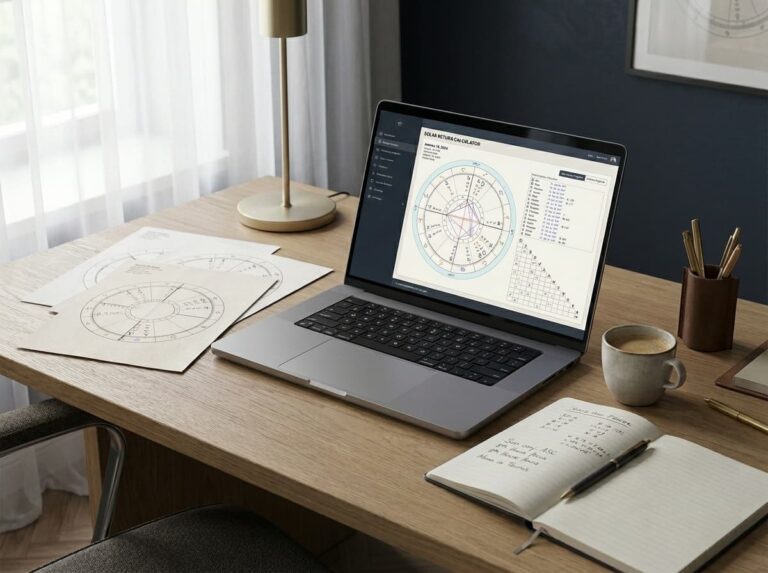
To work with any of this, you need your Solar Return chart displayed alongside your natal chart. A free calculator is available at astrocore.pro — it generates a dual chart showing both the Solar Return and the natal chart on one wheel, which is exactly the format you need to apply the overlay techniques. It also calculates the Solar Return for any location, so you can test relocation options directly.
For a full interpretation with all three overlay techniques applied to your specific chart, professional Solar Return readings are available at astrocore.pro.
Go Deeper
The overlay techniques covered here — Technique 1 (SR planets in natal houses) and Technique 3 (natal house cusps in SR houses) — are detailed in full in Astrology Made Easy: Solar Returns, Volume 3, with complete delineations for every combination. It’s designed as a working reference for both students and practicing astrologers.
Rowena Winslow is a professional astrologer and the author of the Astrology Made Easy series. Her practice covers natal charts, Solar Returns, transits, and predictive astrology. astrocore.pro

Leave a Reply