

Author: Rowena Winslow
Series: Astrology Made Easy | 343 pages
Available on: Payhip | Amazon | Etsy
Most people sense that something in their relationship with work or money isn’t quite right. Income feels unpredictable. Career direction feels unclear. The same patterns keep repeating regardless of how hard they try. Career & Money in the Natal Chart is built around a straightforward premise: those patterns are not accidental. They are written into the natal chart — and once you can read them, everything shifts.
This is a standalone volume in the Astrology Made Easy series, which means it can be read without prior knowledge of the other books. But for readers who have worked through Volumes 1, 2, or 3, it applies that framework directly to two of the most practically urgent questions people bring to astrology: why does my financial life look the way it does, and what does my chart say about professional direction?
What Makes This Book Different
Most career astrology books treat vocation as a single question — “what sign is your Midheaven?” — and offer a list of suggested professions. This book takes an entirely different approach. It treats career and money as an integrated system of chart factors that interact with each other, and it teaches you to read that system rather than look up individual placements.
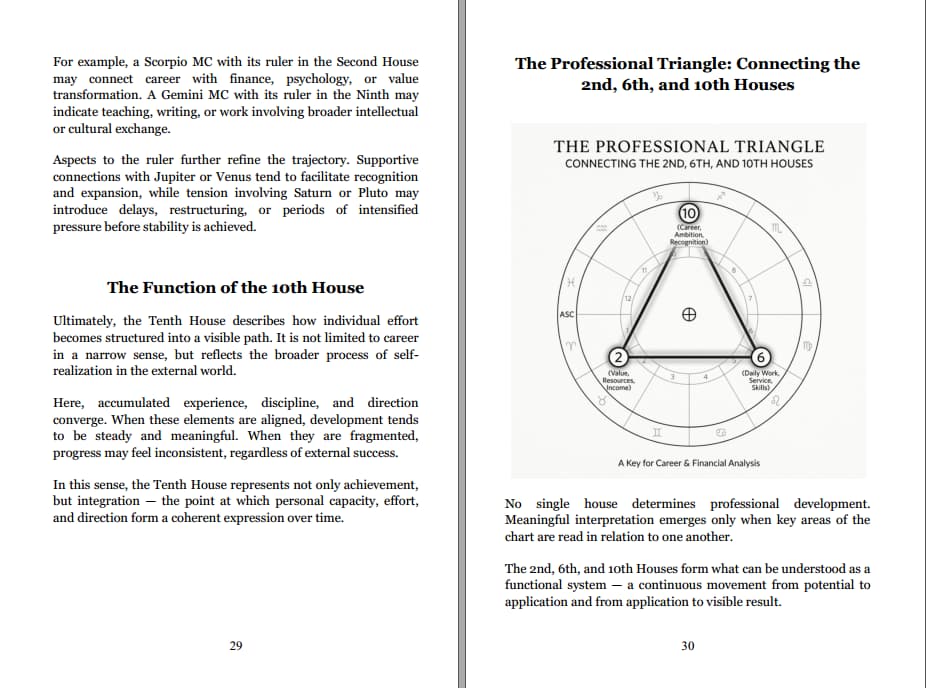
The central organizing concept is the Professional Triangle: the 2nd, 6th, and 10th houses working together as a single process. The 2nd House shows what you have — your earning capacity and your relationship with your own value. The 6th shows how you use it — your daily work habits, skills, and the conditions in which you operate effectively. The 10th shows where it leads — your vocation, public direction, and the kind of achievement you are oriented toward. Understanding how these three interact is what the book is actually about.
What’s Inside
Part I — Foundations of Vocation and Wealth
The book opens with a thorough conceptual foundation before any individual placement is covered.
Chapter 1 introduces the Professional Triangle in depth — not just what each house means in isolation, but how they function as stages of one continuous development. A strong 10th House with an undermined 2nd, for example, produces ambition without stability. A well-functioning 6th House without direction from the 10th produces reliable effort that doesn’t know where it’s going. The chapter shows why all three need to be read together.
Chapter 2 covers the key planets in career and money matters: the Sun (purpose, identity, and confidence in professional direction), Saturn (structure, delayed reward, and professional maturity earned through discipline), Jupiter (expansion, opportunity, and the timing of growth cycles), Mars (initiative, drive, and competitive energy), and Venus and Pluto together (value, attraction, and the kind of transformational power that reshapes financial and professional life at depth). Each planet is covered not just symbolically but practically — how its placement and condition in the chart shapes the specific way career and money themes play out.
Part II — The Houses of Work, Career, and Income
This is the reference heart of the book. Each of the three vocational houses is covered in full depth across four layers of interpretation:
1. Symbolism of the house in career and financial themes — what it governs and how it functions within the professional system
2. Planets in the house — how each planet placed in the 2nd, 6th, or 10th modifies the themes of that house, with detailed interpretations for Sun, Moon, Mercury, Venus, Mars, Jupiter, Saturn, Uranus, Neptune, and Pluto
3. Cusp sign through the zodiac — how the tone and style of the house changes depending on which sign sits on its cusp, covering all twelve signs with practical summaries
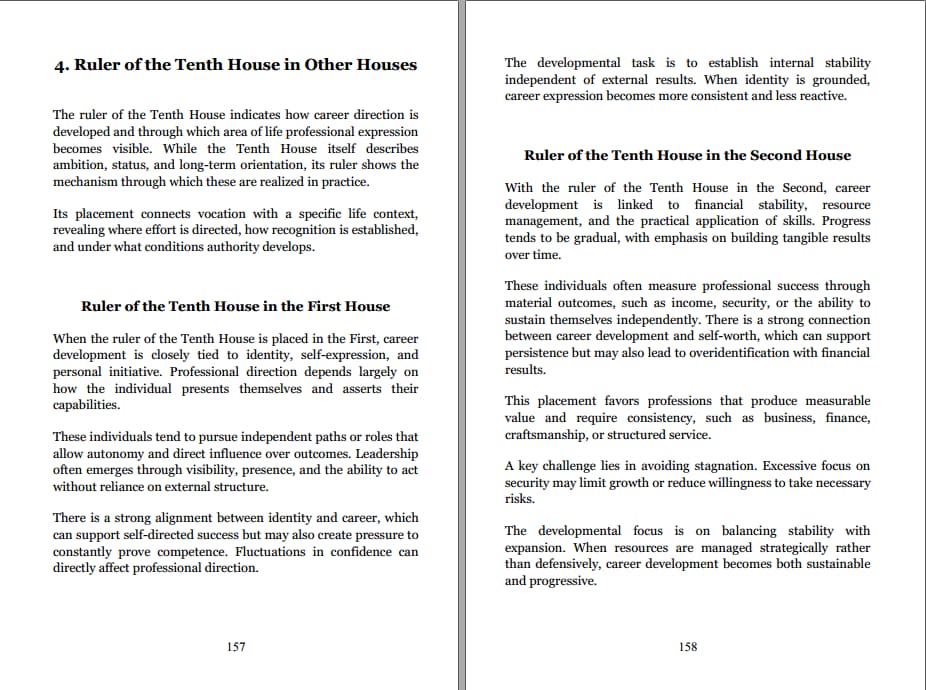
4. House ruler through other houses — where the energy of the house finds its primary expression depending on where the ruling planet falls in the chart; this layer is often where the most specific and biographically accurate interpretations emerge
Each of the three main house chapters closes with a practical worksheet — a structured set of questions that helps you apply the material directly to your own chart. This is the kind of feature that makes the book usable rather than just readable.
Chapter 4 covers the supporting houses — the 8th (shared resources, inheritance, investment, and financial power through partnership), the 11th (income from career activity, community networks, and the social infrastructure that supports professional goals), and the 5th (creativity, entrepreneurship, risk, and the kind of self-expression that generates income through original work). These chapters are shorter than the three main vocational houses but detailed enough to be genuinely useful in chart reading.
Part III — Integrating the Career Story
This section is where the book moves from reference material to synthesis — teaching you to read all the factors together rather than individually.
Chapter 1 — Aspects and Patterns of Success covers how planetary aspects shape professional and financial development. The chapter is organized thematically: Solar aspects (will, confidence, and professional identity), Saturnian aspects (discipline, endurance, and the reality tests that determine long-term achievement), and a combined section on Jupiter, Venus, and Pluto as the dynamics of prosperity. There is also a section on Mars, Uranus, and Neptune as the unconventional paths — placements that don’t follow the standard career trajectory but often produce unusual and original professional lives. Each section closes with a synthesis summary, making it easier to identify dominant patterns across multiple aspects.
Chapter 2 — Psychological and Practical Insights is one of the most distinctive sections in the book, covering four areas that most career astrology books ignore entirely:
- Money mindset in the natal chart — the psychological relationship with money that underlies financial behavior, including why people with strong earning potential sometimes consistently undercharge, underperform, or self-sabotage financially
- Work patterns and self-sabotage — the chart signatures associated with overwork, avoidance, perfectionism, creative blocks, and the specific ways different placements tend to undermine professional development from the inside
- Purpose, calling, and fulfillment — the distinction between a job, a career, and a vocation, and how to read the chart for signs of genuine alignment between who you are and what you do
- Practical integration: using your chart wisely — concrete guidance on how to apply the material to real decisions rather than treating the chart as a static description
Chapter 3 — Predictive Indicators of Career Growth covers timing — when career and financial development is most likely to accelerate, stall, or restructure. This chapter covers planetary transits to key career points (including Saturn and Jupiter transits to the 10th House cusp and Midheaven ruler, and Pluto transits to the 2nd House), progressions and inner maturation cycles, the specific planetary combinations that tend to trigger career change, and practical guidance on how to work with current cycles rather than against them.
Part IV — Case Studies in Career and Financial Astrology
Six detailed case studies show how the framework applies in practice, each following the same structure: natal foundations, development through time, psychological dynamics, and outcome with lesson.
The six cases cover very different professional profiles — a builder of stable long-term wealth, a creative entrepreneur, a healer working through service, a Phoenix-type whose career involved total transformation and rebuilding, an innovator whose path ran outside conventional structures, and a late bloomer whose chart showed strong potential that took time to fully activate. Reading these cases side by side is one of the most effective ways to see how the same framework produces very different readings depending on the specific combination of chart factors.
Appendix
The book closes with a substantial quick-reference appendix: planetary symbols and their career and money interpretations, zodiac signs through the lens of career expression, a full glossary of astrological terms as they apply to vocational work, practical notes on working with transits and progressions, and a reference table of planetary rulerships and chains of dispositors. For anyone using the book as a working reference, this section is consistently useful.
Who This Book Is For
Anyone frustrated with recurring financial or career patterns that don’t seem to respond to effort or intention. The psychological sections of this book address those patterns directly — not as character flaws but as chart signatures that, once understood, can be worked with consciously.
People at a career crossroads — whether that’s a first career, a transition, or a question about whether current work is actually aligned with who they are. The book gives a framework for answering that question specifically rather than generically.
Students of astrology who want to apply natal chart interpretation to practical life questions. The house-planet-ruler-aspect structure is the same one used in the main series, and this book shows exactly how it applies in one specific domain.
Practicing astrologers who want a structured reference for vocational work with clients. The worksheets, summaries, and case studies are organized for professional use.
Also by Rowena Winslow
You can continue your study of astrology with the following volumes:
Natal Astrology
- Vol. 1 — Zodiac Signs and Horoscope Houses in the Birth Chart
- Vol. 2 — Planets & Aspects in the Birth Chart
Predictive Astrology
- Transits & Planetary Cycles, Part 1 — Sun, Moon, Mercury, Venus, Mars
- Transits & Planetary Cycles, Part 2 — Jupiter, Saturn, Uranus, Neptune, Pluto
Synastry
Solar Return Astrology
- Part 1 — Sun, Moon, Mercury
- Part 2 — Venus, Mars, Jupiter, Saturn
- Part 3 — Chart Overlays & Interpretation
Other Specialized Topics
Generate your free natal chart at AstroCore.pro before you begin — you’ll need it open throughout every chapter.




Leave a Reply