
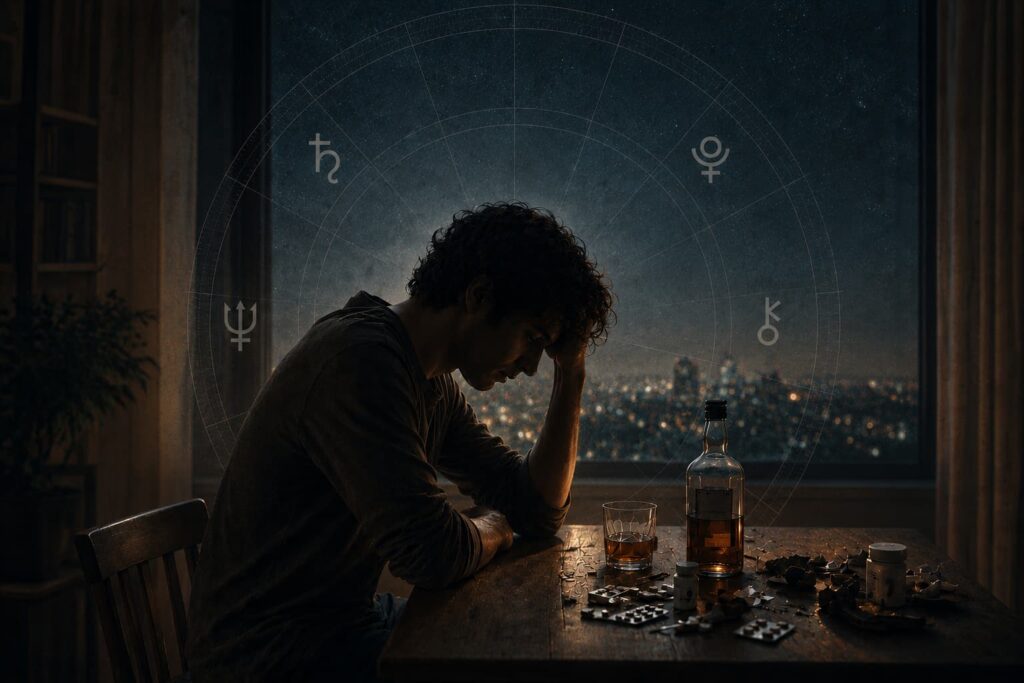
Some charts are built for dissolution. Not metaphorically — literally. There are specific planetary configurations that describe a psyche structurally oriented toward escape, toward the blurring of boundaries, toward substances that temporarily make the unbearable bearable. Those charts belong to real people. And those people, almost universally, have no idea that what they are fighting is written into the blueprint they were born with.
This article is not about judgment. It is about what the chart actually shows — plainly, directly, without softening.
Neptune: The Planet That Wants to Disappear
Neptune is the primary addiction significator in astrology. Understanding why requires understanding what Neptune actually governs.
Neptune is the planet of dissolution — the erasure of boundaries between self and other, between the individual and the formless. At its highest expression, this produces mystical experience, creative transcendence, and the capacity for genuine compassion. At its lowest, it produces the same dissolution through a different mechanism: substances that temporarily erase the self, the pain, the unbearable clarity of being a specific person in a specific life.
The person with a strongly afflicted Neptune is not looking for pleasure. They are looking for relief. The experience they are chasing with alcohol or drugs is precisely the Neptunian experience of dissolution — the sense that the edges of the self have softened, that the world is temporarily bearable, that whatever is inside them has been quieted.
The tragedy is that Neptune, pursued through substances, destroys the very sensitivity that made it valuable in the first place.
The Specific Configurations
Neptune–Moon
This is the combination I see most consistently in charts where addiction becomes a serious life theme. The Moon governs emotional experience, the body’s felt sense of safety, and the baseline relationship to vulnerability. Neptune in hard aspect to the Moon describes an emotional permeability that most people cannot imagine — a sensitivity so acute that ordinary life registers as genuinely overwhelming.
The person with Moon–Neptune in difficult aspect absorbs the emotional states of everyone around them. They feel too much, too constantly, with no adequate filter. Alcohol, at least initially, provides exactly what this configuration craves: a dimming of the signal. A temporary reduction in the relentless emotional noise.
Moon–Neptune in hard aspect, particularly with Neptune in the 12th House or in water signs, is the single most consistent addiction indicator in a chart.
Neptune–Mars
Where Moon–Neptune describes the person who drinks or uses to feel less, Mars–Neptune describes the person who uses to feel more — or more accurately, to feel something coherent at all. Mars is will, drive, and directed energy. Neptune in hard aspect to Mars dissolves that direction. The result is a person who feels chronically directionless, who has difficulty converting desire into action, who experiences their own will as something that dissipates before it can land.
Stimulants are the natural addiction risk here — anything that temporarily creates the sense of directed energy and decisive action that Mars–Neptune denies in its natural state.
Neptune–Mars–Sun configurations are particularly potent. When all three are involved, the person’s core identity, drive, and sense of self are all subject to Neptunian dissolution. This is the configuration most associated with a chronic inability to build a stable life — not from lack of intelligence or talent, but from the structural inability to sustain direction.
Neptune–Sun
The Sun is the core identity — the essential self. Neptune in hard aspect to the Sun describes a person who has difficulty knowing who they are. Not in an existential, philosophical sense — in a daily, practical sense. The identity is permeable. Other people’s needs, projections, and desires flood in easily. The person bends, accommodates, loses themselves.
Substances offer a temporary solution to this problem. Under the influence, the question of identity becomes temporarily irrelevant. The dissolved self is no longer required to hold its shape.
Afflicted Sun in men is specifically noted as a primary addiction indicator. The connection between a man’s relationship to his father, his core identity, and his vulnerability to dissolution runs through this aspect.
The 12th House
The 12th House is the house of what is hidden, what is repressed, and what operates beneath conscious awareness. It is also the house of confinement — hospitals, prisons, rehabilitation centers. A stellium in the 12th House is one of the clearest addiction signatures in the chart. The person is carrying a significant load of unprocessed material that is not accessible to conscious examination, and that material will seek an outlet.
Neptune as the natural ruler of the 12th House intensifies this picture. Neptune afflicted in the 12th, or ruling the 12th and under hard aspect, describes a psyche with a chronic leak — a place where the self escapes its own container, where what cannot be consciously held dissolves outward, often through the mechanism of substances.
The 12th House also governs self-undoing. Addiction, structurally, is self-undoing. There is something in the 12th House that is not being faced, and substances are the way the chart attempts to avoid facing it.
The Signs Most at Risk
Pisces placements — particularly Pisces Moon, Pisces Ascendant, or a heavily tenanted Pisces — carry the Neptune signature by nature. Pisces is the sign of dissolution. The porous boundary between self and world that characterizes this placement is, in its healthy expression, the source of extraordinary empathy and creative imagination. In its unhealthy expression, it is the place where the self disappears into whatever is available.
Cancer placements under Neptune affliction produce a specific pattern: emotional eating, alcohol used as emotional regulation, the use of any substance that creates the sense of warmth, safety, and nurturing that the Cancer archetype craves. The addiction is not recreational. It is the substitute for something that was not adequately provided.
Scorpio under Neptune affliction produces a different quality: the use of substances to access altered states, to push past ordinary experience, to go as far down as possible. The Scorpionic temperament is drawn to intensity and extremity. What Saturn–Moon describes as heaviness, Scorpio–Neptune describes as a drive toward complete obliteration.
What the Chart Does Not Show
The configurations described above do not predict addiction. They describe vulnerability. The difference matters enormously.
A chart with Moon–Neptune in the 12th House belongs to artists, mystics, healers, and therapists as often as it belongs to addicts. The same permeability that creates the addiction risk also creates the capacity for genuine empathy, for creative transcendence, for the kind of art that comes from living closer to the nerve than most people can tolerate.
What determines which direction the Neptune energy flows is largely a question of what other resources the chart provides, what the early life environment looked like, and what conscious choices the person makes about how to work with their particular sensitivity.
The chart does not doom anyone. But it does describe the terrain. And a person who knows their Neptune is under significant pressure — who knows that their psyche is structurally oriented toward dissolution — can make different choices than someone who believes their addiction is simply a moral failure or a lack of willpower.
It is not willpower. It is Neptune. And Neptune responds to very different things than willpower.
The Chart as a Tool for Understanding
In twenty years of chart work, I have read charts for people in recovery, for people in the middle of active addiction, and for people who have lost family members to it. The chart is never a surprise to them. When I describe what the configuration shows — the permeability, the emotional overwhelm, the structural tendency toward escape — the response is almost always recognition. That is exactly what it feels like.
That recognition is worth something. Not because knowing the astrology fixes anything. But because understanding the architecture of one’s own vulnerability is different from experiencing it as a personal moral failure. The chart provides context. Context does not excuse. But it does explain — and explanation, in my experience, is often the first step toward something more useful than shame.
If you want to see what your own chart shows about emotional vulnerability and psychological patterns, you can calculate your natal chart at AstroCore. A full natal chart reading covers this material in depth.
Rowena Winslow is a professional astrologer and the author of the Astrology Made Easy series. Her practice covers natal chart interpretation, Solar Returns, and predictive astrology. astrocore.pro


Leave a Reply