
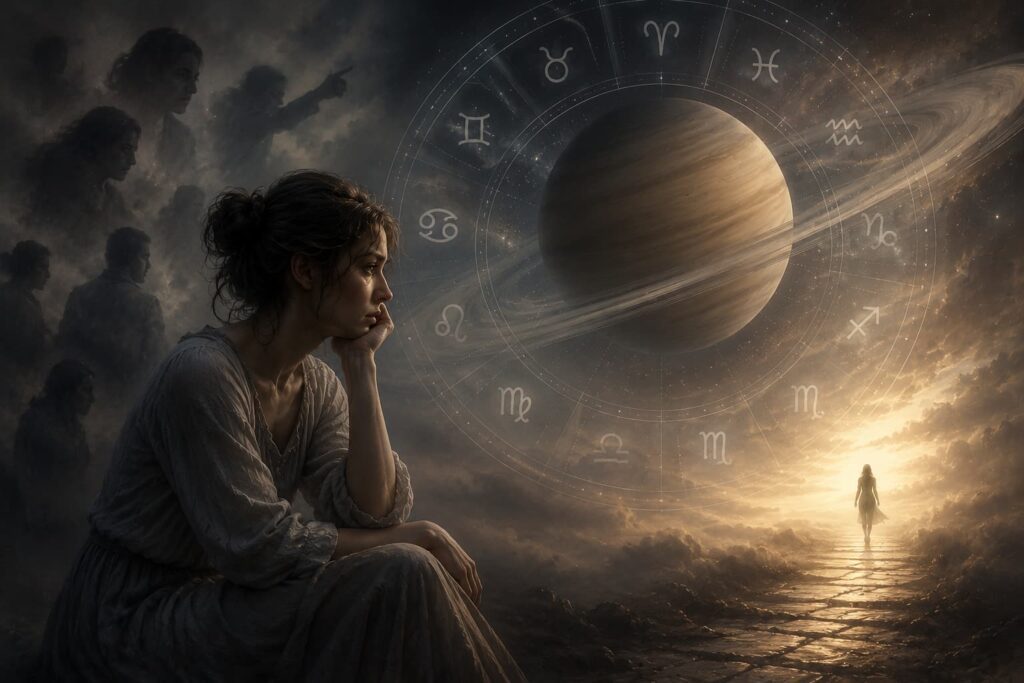
There is a pattern that every experienced astrologer recognizes. The person who has been abused in every significant relationship. The one who attracts cruelty the way others attract ordinary life. The one whose suffering is not random bad luck but something structural — a consistent quality of their experience that seems to have been present from the beginning.
People do not like to talk about this pattern because it sounds like blame. It is not. The chart does not assign guilt. It describes architecture. And the architecture some people are born with makes them structurally more available to harm than others — not because they are weak, but because of specific planetary configurations that were in place before any conscious choice was made.
Understanding these configurations is not an exercise in fatalism. It is the beginning of being able to work with what is actually there.
The 12th House: the house of trials
The 12th House is the astrological house most directly associated with victimhood, suffering, and the experience of powerlessness. The tradition names its core principle plainly: испытание судьбой — trial by fate. Its domain includes hidden enemies, persecution, confinement, involuntary loss of freedom, and the specific quality of suffering that comes not from external events but from the inside — from the weight of what is being carried beneath conscious awareness.
The 12th House describes what the classical tradition calls the “true house of misfortune” — but also, with a precision that is easy to miss, the “house of inner maturity.” The suffering of the 12th House is not purposeless. It is the specific pressure that, when consciously worked with, produces a depth that no other configuration generates.
A stellium in the 12th House — three or more planets — describes someone for whom this house is the central arena of the life. Not in the peripheral sense of occasional difficulty, but in the structural sense of someone whose deepest experiences — suffering, isolation, confinement, service, and the encounter with what others avoid — define the biography. The planets involved describe the specific quality of that experience.
When the 12th House ruler is afflicted by malefic planets, or when malefic planets occupy the 12th in hard aspect to each other and to the Ascendant ruler, the picture intensifies: hidden enemies whose opposition operates invisibly; persecution and humiliation that the person cannot easily identify or name because it operates beneath the surface; and a chronic vulnerability to forces that act on the person without their awareness.
Neptune: the erased self
Neptune governs dissolution — the erosion of the boundary between self and world. In its positive expression, this produces empathy, creative sensitivity, and spiritual openness. In its difficult expression, it produces a person who has no clear sense of where they end and others begin — and who is therefore available to absorption, exploitation, and harm in ways that more boundaried people are not.
The Neptune–Moon in hard aspect describes an emotional permeability that most people cannot imagine. This person absorbs the emotional states of everyone in the room. They cannot reliably distinguish their own feelings from feelings they have taken on from others. They feel the suffering of those around them as if it were their own — and they often respond by trying to fix it, by making themselves smaller, by removing themselves as a source of friction.
This configuration produces extraordinary compassion. It also produces extraordinary availability to manipulation by people who recognize, consciously or not, that this person’s sense of self is not defended.
Neptune afflicted on the Ascendant — particularly in hard aspect to the Moon, Saturn, or Mars — describes a person whose self-presentation is itself porous. They are not clearly visible as a separate entity with separate needs. They flow into the shape of whatever the situation or relationship requires. This is useful in many contexts. In an abusive context, it means there is no hard self to resist against.
Saturn–Moon: the wound that says this is normal
Saturn in hard aspect to the Moon does not produce weakness. It produces a specific internal template formed before conscious memory: the experience of love as conditional, of warmth as earned rather than given, of emotional pain as the expected cost of relationship.
The person with Moon–Saturn afflictions in the natal chart was shaped, typically in the earliest years, by an environment where coldness, control, or emotional deprivation were experienced as the baseline condition of care. This produces adults who do not consciously choose suffering — but who are structurally prepared to tolerate it, because suffering in relationship matches the internal model of what love costs.
The classical indicators for the complex of inferiority — Moon–Saturn, Sun–Moon–Saturn, Saturn–Pluto–Moon, Neptune–Moon–Saturn — describe someone whose self-worth is structurally low in ways that predate and survive any external evidence to the contrary. They achieve, and do not believe the achievement. They are loved, and cannot receive it. They are treated well, and experience it as temporary. The template that says I am not enough was formed before the person had any capacity to question it.
This is the specific architecture that makes people remain in harmful relationships. Not stupidity, not weakness, not choice — but a deeply installed belief that the harm is what they deserve, or that this is simply what relationships are.
The South Node: what was carried in
The Lunar Nodes describe the karmic axis of the chart — the direction the soul is moving toward (North Node) and what it is carrying from the past (South Node). For people with strong victimhood patterns, the South Node and its house placement often describe a past-life or early-life orientation toward service, sacrifice, and self-erasure that has not yet been interrupted.
South Node in the 12th House describes someone who has lived in confinement, self-abnegation, or sacrifice in a previous incarnation — who arrived in this life already oriented toward the interior, already accustomed to suffering as a mode of experience, already equipped with the capacity for self-sacrifice that the 12th House demands. The karma this brings is not punishment. It is the specific pattern that needs to be actively worked against: the habitual retreat, the automatic abnegation, the willingness to dissolve into whatever the surrounding situation requires.
South Node in the 6th House — North Node in the 12th describes someone who was completely consumed by work and service in the past life — who sacrificed themselves to function and productivity. This life brings an opposite demand: toward inner development, solitude, and the spiritual depth that suffering, consciously worked with, can produce. Many people with this nodal axis find that illness, disability, or enforced restriction becomes the vehicle for the most important development of their life.
The difference between pattern and destiny
None of this means that victimhood is the fixed destination of people who carry these configurations.
What the chart describes is the specific psychological architecture — the internal template — that makes a person more available to harm than they would otherwise be. The 12th House stellium does not require a life of persecution. The Neptune–Moon person does not have to spend their life absorbing other people’s suffering. The Moon–Saturn person does not have to remain in relationships that reproduce the coldness of the early home.
What changes the pattern is not willpower and not positive thinking. It is the specific kind of awareness that allows the person to see the template — to recognize, in real time, the moment when the pattern is activating, when the old response is operating below conscious thought.
The chart shows where the template is. A good natal chart reading names it directly: this is the configuration, this is what it tends to produce, this is where it came from, and this is what working consciously with it actually requires.
That is not blame. It is the most useful information the chart can offer.
You can calculate your natal chart at AstroCore. If you want to understand the specific configurations in your chart and what they are producing in your life, a full natal chart reading addresses this directly.
Rowena Winslow is a professional astrologer and the author of the Astrology Made Easy series. Her practice covers natal chart interpretation, Solar Returns, and predictive astrology. astrocore.pro



Leave a Reply